
Catalogue Search | MBRL


Are you sure you want to remove the book from the shelf?

{{itemTitle}}
2,601
result(s) for
"Czech Literature"
Sort by:

Shakespeare in transition : political appropriations in the post-communist Czech Republic
\"This book investigates the political dimensions of Czech Shakespeare appropriation and production in the wake of the fall of communism, uncovering an anxious struggle between dimensions of Czech nationhood that comes to a head in a competition for a 'true' Shakespeare, and addressing key issues such as gender, globalization and national culture\"-- Provided by publisher.
BOOK

Writing Underground
In this collection of writings produced between 2000 and 2018, the pioneering literary historian of the Czech underground, Martin Machovec, examines the multifarious nature of the underground phenomenon. After devoting considerable attention to the circle surrounding the band The Plastic People of the Universe and their manager, the poet Ivan M. Jirous, Machovec turns outward to examine the broader concept of the underground, comparing the Czech incarnation not only with the movements of its Central and Eastern European neighbors, but also with those in the world at large. In one essay, he reflects on the so-called Půlnoc Editions, which published illegal texts in the darkest days of the late forties and early fifties. In other essays, Machovec examines the relationship between illegal texts published at home (samizdat) and those smuggled out to be published abroad (tamizdat), as well as the range of literature that can be classified as samizdat, drawing attention to movements frequently overlooked by literary critics. In his final, previously unpublished essay, Machovec examines Jirous’s “Report on the Third Czech Musical Revival\" not as a merely historical document, but as literature itself.
eBook


Anne’s Bohemia
Considers the development of Czech literature and society from the election of Count John of Luxembourg as king of Bohemia in 1310 to the year 1420, when the papacy declared a Catholic crusade against the Hussite reformers. This period is of particular relevance to the study of medieval England because of the marriage of Richard II to Anne of Bohemia, the figure around whom this book is focused.
eBook

Ekokritika a fáze uvědomění v české literatuře
Ecocriticism represents a trend of thought that has been gaining ground in the Czech academic milieu, and thinking about it raises a number of questions at the moment: whether there are any local analogues of ecocriticism, whether it makes sense to transfer the theory to the local context, and what the impact of such transfer could be. The main part of the article is devoted to the different phases of ecological consciousness in Czech literature and illustrates three of them with examples: the Romantic (Mácha, Erben, Furch), the early 20th century (Deml, Neumann) and the 1980s (Páral, Juliš). The conclusion of the article focuses on the question of the awareness of the state in these different phases and its inevitable incompleteness.
Journal Article

Bohumil Hrabal. a Full-Length Portrait
Described by Parul Sehgal in the New York Times Book Review as \"one of the great prose stylists of the twentieth century; the scourge of state censors; the gregarious bar hound and lover of gossip, beer, cats, and women (in roughly that order),\" Bohumil Hrabal is one of the most important, most translated, and most idiosyncratic Czech authors. In Bohumil Hrabal: A Full-Length Portrait, Jirí Pelán makes the case that this praise is far too narrow. A respected scholar of French and Italian literature, Pelán approaches Hrabal as a comparatist, expertly situating him within the context of European and world literature as he explores the entirety of Hrabal's oeuvre and its development over sixty years. Concise, clear, and as compulsively readable as the works of Hrabal himself, Bohumil Hrabal was universally praised by critics in its original Czech edition as one of best works of Hrabal criticism. Here it is beautifully rendered into English for the first time by David Short, a celebrated translator of Hrabal's works. Also featuring a fascinating selection of black-and-white images from Hrabal's life, Bohumil Hrabal is essential reading for anyone interested in this crucial Czech author.
eBook
Milada Součková v labyrintu paměti
This article focuses on ‘Josefína Rykrová’s Autobiography’ (‘Vlastní životopis Josefíny Rykrové’) by Milada Součková, dealing in particular with issues related to the motif of memory in the form of labyrinthine prose. The collection of texts that is the subject of this analysis presents a retrospective narration based on the memories of Josefína Rykrová (although it makes multiple references to the biography of Milada Součková). Of particular importance is the fact that, at various times in the text, the subject position is split, suggesting a certain play with identities. Having created the figure of Josefína Rykrová, the author points to the splitting and loss of the self in the memories of others, which in turn become part of one’s own memory. Josefína, the titular heroine and the author of the memoirs, gets to know herself not only through her mother’s stories, but also through photographs. In this case, she draws from descriptions written on the back of the photos as an additional source of information. Součková shapes her text on the basis of an architectural metaphor of memory: the labyrinth. Moving towards the centre of this labyrinth is a complex process of remembering and erasing the traces of the past. The reconstruction of memories is aimed at reaching the first memory which remains entirely untainted. In this labyrinth, it is impossible to find the truth about oneself, yet the multiplicity of voices and images causes the subject to lose any certainty about this ‘self ’. Any certainty regarding the ontological status of the narrator is thus also lost by the reader. The labyrinth of the text, even though it uncovers the reality of intimate memories, never creates any intimate space for the subject, because it is interrupted by other voices — quotes, interjections, comments. Going through the labyrinth of memory is a symbolic attempt to confront one’s own identity and determine who one is.
Journal Article
Kamenná promluva: Vnitřní pragmatika Vévody Arnošta
The Old Czech chivalric epic Vévoda Arnošt (Duke Ernst), dated usually to the late 14th century, belongs to a broader German tradition of narratives about Ernst, the Duke of Bavaria, and it follows his conflict with the emperor and the subsequent wanderings of his retinue in search of Jerusalem. The Czech version closely follows the Middle High German Herzog Ernst D. This study examines the effects of human speech that are enacted in the narrative, particularly focusing on the scene of the protagonist’s shipwreck on the Magnetic Mountain. The analysis shows that the stone which traps the hero not only hinders his journey but also serves as a catalyst for confession, verbalized repentance, and prayer, i.e. for valid speech acts that ultimately lead to a happy resolution of the story
Journal Article
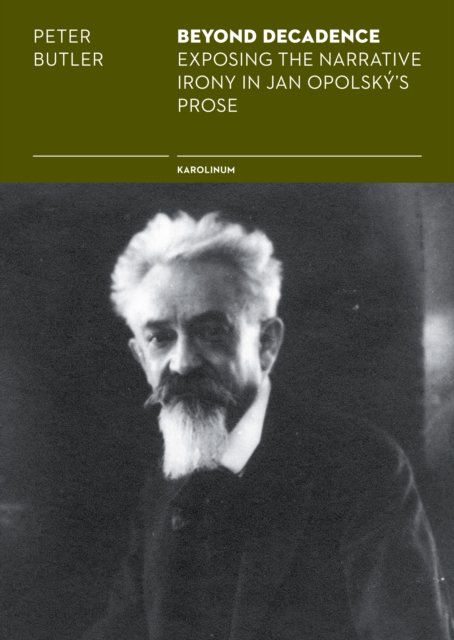
Beyond Decadence
Jan Opolsky has long been considered to be little more than an epigon of the Czech Decadence. By detailed analysis of his prose, this book aims to show that Opolsky is a master of sustained narrative irony and an accomplished writer in his own right. Introduction brings an overview of Czech Decadent/Symbolist literature and art in an European perspective. The first monograph evaluates archival sources, private correspondence with other literary figures and includes classified bibliography of Opolsky.
eBook