
Catalogue Search | MBRL


Are you sure you want to remove the book from the shelf?

{{itemTitle}}
289,700
result(s) for
"DATA COMMUNICATION"
Sort by:


Pragmatics of Computer-Mediated Communication
The present handbook provides an overview of the pragmatics of language and language use mediated by digital technologies. Computer-mediated communication (CMC) is defined to include text-based interactive communication via the Internet, websites and other multimodal formats, and mobile communication. In addition to 'core' pragmatic and discourse-pragmatic phenomena the chapters cover pragmatically-focused research on types of CMC and pragmatic approaches to characteristic CMC phenomena.
eBook

Observing writing : insights from keystroke logging and handwriting
\"Observing Writing: Insights from Keystroke Logging and Handwriting is a timely volume appearing twelve years after the Studies in Writing volume Computer Keystroke Logging and Writing (Sullivan & Lindgren, 2006). The 2006 volume provided the reader with a fundamental account of keystroke logging, a methodology in which a piece of software records every keystroke, cursor and mouse movement a writer undertakes during a writing session. This new volume highlights current theoretical and applied research questions in keystroke logging and handwriting research that observes writing. In this volume, contributors from a range of disciplines, including linguistics, psychology, neuroscience, modern languages, and education, present their research that considers the cognitive and socio-cultural complexities of writing texts in academic and professional settings\"-- Provided by publisher.
Book

An adaptive anti-jamming system in HyperLedger-based wireless sensor networks
Using new methodologies such as Blockchain in data communications in wireless sensor networks (WSN) has emerged owing to the proliferation of collaborative technologies. However, the WSN is still vulnerable to denial of service cyber attacks, in which jamming attack becomes prevalent in blocking data communications in WSN. The jamming attack launches malicious sensor nodes to block legitimate data communications by intentional interference. This can in turn cause monitoring disruptions, data loss and other safety-critical issues. In order to address the malicious attacks, this paper proposes an adaptive anti-jamming solution based on Hyperledger Fabric-based Blockchain, named as ABAS, to ensure the reliability and adaptivity of data communication in case of jamming attacks. In order to validate the ABAS solution, we applied the algorithm in healthcare WSN and showed that ABAS has significantly reduce the jamming coverage and energy consumption while maintaining high computational performance.
Journal Article

Computer-mediated briefing for architects
\"This book overviews the possibilities and limitations offered by various types of computer programs, such as database management systems, diagramming software, CAD, and BIM, offering a practical approach in the accommodation of these programs and as an essential reference for architectural educators, students, and practitioners\"-- Provided by publisher.
Book

Factors influencing research data communication on Zika virus: a grounded theory
Purpose
The purpose of this paper is to propose a theoretical model to illustrate factors influencing research data communication on diseases caused by the Zika virus.
Design/methodology/approach
The grounded theory methodology was adopted. For data collection, interviews were conducted with 13 Brazilian researchers involved with the Zika virus theme. Data analysis was performed using the open, axial and selective coding processes, according to the principles of the grounded theory.
Findings
Based on data collection and analysis, seven theoretical categories representing intervening factors in Zika virus research data communication were identified. The emerging theory showed the centrality of researchers’ expectations for acknowledgment and reward, influenced by the aspects of research funding and academic culture. Three factors involved in the macro processes of research data communication: data use, data production and data sharing. In the use and production processes, factors related to collaboration figured most strongly. In the production and sharing processes, the factors regarding data processing and the use of research data repositories were more pronounced. Finally, data sharing, and the possibility of reusing data are directly affected by the social context of Zika virus disease as an emerging disease.
Originality/value
The study presents a theory developed systematically to explain the phenomenon of communication of research data on Zika virus. The theory presents a set of intervening factors of the process of communication of research data and discusses the factors in light of the fundamentals of information science.
Journal Article


A Reliable Transmission on Cluster Based Wireless Ad Hoc Network with Adaptive Negotiations Using Vector Assisted Energy Efficient Dynamic Opportunistic Routing Mechanism
Reliable data transmission within wireless AdHoc networks is a formidable challenge, owing to the distinct attributes of mobile data communication. Existing routing protocols struggle to accommodate the dynamic nature of data traffic, leading to energy losses and substantial propagation delays. In response to these challenges, we introduce a novel Vector Assisted Energy Efficient Dynamic Opportunistic Routing model, implemented through an Adaptive negotiation-based cluster routing protocol. The approach involves strategically partitioning the network into clusters, each facilitated by an optimal cluster head. These clusters optimize data transmission and network longevity by gathering mobile nodes through negotiations. Our model leverages a reactive opportunistic routing protocol and organizes packet forwarding into vectors. Through extensive simulations using NS2, we evaluate the proposed scheme against conventional routing protocols. Key metrics, including Throughput, Packet delivery ratio, Average end-to-end delay, Network lifetime, and packet drop, demonstrate the efficacy of our model. Notably, our approach outperforms conventional methods, particularly in energy savings during data collection and transmission within high-traffic contexts. And our study contributes a novel solution to the challenges of wireless AdHoc networks. The Vector Assisted Energy Efficient Dynamic Opportunistic Routing model showcases superior reliability, efficiency, and network longevity. This work not only advances data communication in such networks but also provides a template for future research in enhancing wireless communication systems.
Journal Article
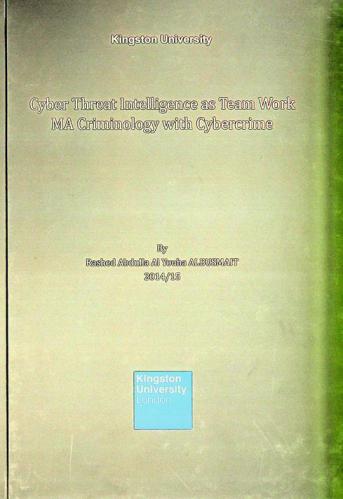
Cyber threat intelligence as team work : how to do team-work activities contribute to the success of cyber-crime initiatives, what are the central principles of' effective team-working', and how necessary are physically integrated teams in a time of inter-agency, online collaborative working ?
Criminology with cybercrime.
Book

Secure data communication in WSN using Prairie Indica optimization
PurposeSecurity is the major issue that motivates multiple scholars to discover security solutions apart from the advantages of wireless sensor networks (WSN) such as strong compatibility, flexible communication and low cost. However, there exist a few challenges, such as the complexity of choosing the expected cluster, communication overhead, routing selection and the energy level that affects the entire communication. The ultimate aim of the research is to secure data communication in WSN using prairie indica optimization.Design/methodology/approachInitially, the network simulator sets up clusters of sensor nodes. The simulator then selects the Cluster Head and optimizes routing using an advanced Prairie Indica Optimization algorithm to find the most efficient communication paths. Sensor nodes collect data, which is securely transmitted to the base station. By applying prairie indica optimization to WSNs, optimize key aspects of data communication, including secure routing and encryption, to protect sensitive information from potential threats.FindingsThe Prairie Indica Optimization, as proposed, achieves impressive results for networks comprising 50 nodes, with delay, energy and throughput values of 77.39 ms, 21.68 J and 22.59 bps. In the case of 100-node networks, the achieved values are 80.95 ms, 27.74 J and 22.03 bps, significantly surpassing the performance of current techniques. These outcomes underscore the substantial improvements brought about by the Prairie Indica Optimization in enhancing WSN data communication.Originality/valueIn this research, the Prairie Indica Optimization is designed to enhance the security of data communication within WSN.
Journal Article