
Catalogue Search | MBRL


Are you sure you want to remove the book from the shelf?

{{itemTitle}}
1,543
result(s) for
"DAVID CHANDLER"
Sort by:

Is resilience a unique extension rather than a rejection of neoliberalism? A critical reading of David Chandler’s writings on resilience
Purpose
This paper aims to engage with the concept of resilience as theorized by David Chandler in his book Resilience: The Governance of Complexity by drawing from the theory of governmentality presented by Michel Foucault and Jonathan Joseph.
Design/methodology/approach
Evolving from classical liberalism to neoliberalism and from natural sciences to social sciences, the term “resilience” raises many questions about its sustainability in terms of its meaning and complexity. While most scholars tend to underscore the significance and practicality of the term, a few scholars argue that it is a failed dogma with neoliberal characteristics. As this is a theory-based study, its methodology involves close readings of academic texts produced mainly by David Chandler, Michel Foucault and Jonathan Joseph.
Findings
The central argument in this paper is though Chandler convincingly explains the paradigm shift of the term resilience from classical to neoliberal, his theorizing lacks the understanding that the type of power and governmentality involved in individual freedom, autonomy and complexity are actually parts of the neoliberal state. Hence, the buzzword resilience today is actually an extension of the same neoliberal thought.
Originality/value
First, the author attempts to critically engage with the term resilience from a sociological point of view using purposively selected academic literature. Second, the paper attempts to bring Chandler’s conceptualization on resilience into the disaster context and evaluates its practicality within the tenets of neoliberalism by drawing on Joseph’s and Foucault’s theorizations.
Journal Article

Red service-intellectual: Phouk Chhay, Maoist China, and the Cultural Revolution in Cambodia, 1964–67
This article examines the phenomenon of Cambodian intellectual curiosity about China through the social experiences of Phouk Chhay, a prominent leftist activist-critic and Pol Pot's one-time secretary. Amid Phnom Penh's urban radical culture, Phouk transformed from rural student to Communist guerrilla. He associated with Communists, formed pro-China student associations, and through his networks, went on trips that left lasting impressions. This study draws from issues of the Cambodian-Chinese newspaper Mianhua ribao (Sino-Khmer Daily) and several forced confessions to tell a story of becoming that examines community and network in charting the course of ‘China-curiosity’ as intertwined with Phouk's life trajectory.
Journal Article

Facing the Khmer Rouge
As a child growing up in Cambodia, Ronnie Yimsut played among the ruins of the Angkor Wat temples, surrounded by a close-knit community. As the Khmer Rouge gained power and began its genocidal reign of terror, his life became a nightmare. In this stunning memoir, Yimsut describes how, in the wake of death and destruction, he decides to live.
Escaping the turmoil of Cambodia, he makes a perilous journey through the jungle into Thailand, only to be sent to a notorious Thai prison. Fortunately, he is able to reach a refugee camp and ultimately migrate to the United States, where he attended the University of Oregon and became an influential leader in the community of Cambodian immigrants.Facing the Khmer Rougeshows Ronnie Yimsut's personal quest to rehabilitate himself, make a new life in America, and then return to Cambodia to help rebuild the land of his birth.
eBook
Start-up offers rootkit protection, partitions virtual machines
The software is analogous to a virtual-machine hypervisor in that it is not an operating system but an abstraction layer that sits between the hardware and the operating systems running on the hardware. The difference, the company says, is that Integrity provides a buffer layer that protects the operating systems on top of it from malware that may have infected the basic hardware below. This would guard against so-called Blue Pills, malicious software that controls a hypervisor. The Blue Pill also simulates the underlying hardware so the hypervisor is unaware of the Blue Pill; it thinks it is running on the hardware. Integrity also securely partitions the virtual environments running on top of it from each other. Integrity partitions are called padded cells; they can be configured to allow communication with certain cells but not with others. In virtual-machine parlance, this is like building in virtual firewalls that insulate one virtual machine from others in accordance with a corporate rule set.
Trade Publication Article

Busy as a ... ; 1.8 million bees ignite start of apple crop
(1) T&G Staff/RICK CINCLAIR (2) T&G Staff/JIM COLLINS (3) DAVID NILES; (1) A bee, carrying pollen from blossom to blossom, hovers near an apple tree in Meadowbrook Orchards in Sterling. (2) Seventy- two colonies of bees were recently delivered to Meadowbrook Orchards in Sterling. The bees will pollinate the nearly 8,000 apple trees on the 90-acre orchard. (3) Berris \"Coco\" Lawrence of Jamaica, who has worked at Meadowbrook Orchards in Sterling for 14 years, prunes an apple tree. (MAP) Mass Macs // Massachusetts produces more than 42 million pounds of apples annually (CHART) Buds to bushels
Newspaper Article
World awaits harvest ; The cycle is complete
PHOTOS; (1) [David Chandler Sr.], right, and his son, [David Chandler Jr.], walk through Meadowbrook Orchards after a successful apple- growing season. (2) David Chandler Sr. inspects some new fruit buds on one of the trees in Meadowbrook Orchards. (3) David Chandler Jr., who oversees the retail operations at Meadowbrook Orchards in Sterling, had orders to cook more than 900 pies for Thanksgiving.
Newspaper Article

Quantity surveyors dig much deeper
David Chandler's piece, \"How to fix out-of-control building costs\" (AFR, February 4 ) contains an unfounded and damning attack on the construction professions, including, but not limited to, the quantity...
Newspaper Article
GANNETT ADVISORY UPDATE FOR FRIDAY, JAN. 4, 2013
A blink could mean life sentence for slaying suspect. CINCINNATI -- As David Chandler was dying from gunshots wounds, he \"told\" Cincinnati police who shot him. Chandler, 35, didn't speak or write out his killer's name.
Newspaper Article
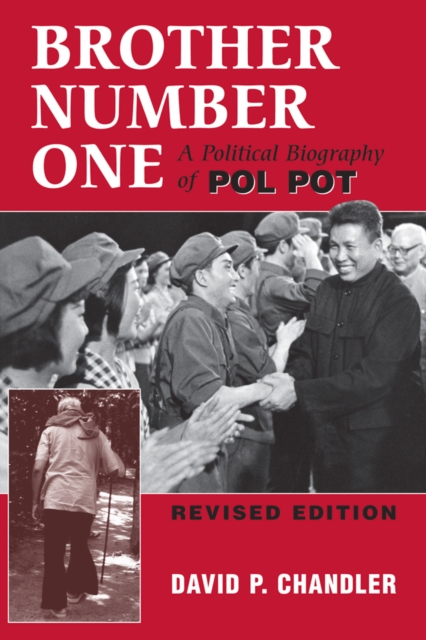
Brother Number One : a political biography of Pol Pot
In the tragic recent history of Cambodia—a past scarred by a long occupation by Vietnamese forces and by the preceding three-year reign of terror by the brutal Khmer Rouge—no figure looms larger or more ominously than that of Pol Pot. As secretary of the Central Committee of the Communist Party of Kampuchea (CPK) since 1962 and as prime minister of Democratic Kampuchea (DK), he has been widely blamed for trying to destroy Cambodian society. By implementing policies whose effects were genocidal, he oversaw the deaths of more than one million of his nation’s people.The political career of Saloth Sar, better known by his nom de guerre Pol Pot, forms a critical but largely inaccessible portion of twentieth-century Cambodian history. What we know about his life is sketchy: a comfortable childhood, three years of study in France, and a short career as a schoolteacher preceded several years—spent mostly in hiding—as a guerrilla and the commander of the victorious army in Cambodia’s civil war. His career reached a climax when he and his associates, coming to power, attempted to transform their country along lines more radical than any attempted by a modern regime. Driven into hiding in 1979 by invading Vietnamese forces, Pol Pot maintained his leadership of a Khmer Rouge guerrilla army in exile, remaining a power and a threat.In this political biography, David P. Chandler throws light on the shadowy figure of Pol Pot. Basing his study on interviews and on a wide range of sources in English, Cambodian, and French, the author illuminates the ideas and behavior of this enigmatic man and his entourage against the background of post–World War II events, providing a key to understanding this horrific, pivotal period of Cambodian history. In this revised edition, Chandler provides new information on the state of Cambodia and the Khmer Rouge following the death of Pol Pot in 1997.
eBook
Out of the Past: Bolita hits Bay and Gulf counties
\"Bolita\" is a word missing from most people's vocabulary. But during the 1950s, this word appeared in newspaper headlines off and on for several years, with some spelling the activity as \"bolita\" and others \"bolito.\" This word was another name for the numbers racket and a form of gambling that involved a large number of people in Bay and Gulf counties. Bolita or the \"numbers racket\" thrived during this period. No one knows when this type of gambling was introduced into this country. Casper Holstein immigrated into Harlem in the late 1800s from the West Indies. Holstein worked as a bellhop for Wall Street brokerage firms. After hearing stock market talk for years, he came up with his own form of the numbers' system. He worked at it, and the \"numbers racket\" proved profitable for him. He became a millionaire. Bolita from Cuba According to the newspaper, the winning number usually was determined by taking the last two or three digits published on daily U.S. Treasury receipts or horse track receipts. The local numbers operations were believed to be tied to the Cuban lottery. The investigation revealed the gambling operation in Panama City was set up with finances from Port St. Joe as early as 1951 and possibly before that date. [David Chandler] found that one Panama City businessman headed the operations in Panama City and admitted the game was a lucrative venture. Marlene Womack, Local Historian
Newspaper Article