
Catalogue Search | MBRL


Are you sure you want to remove the book from the shelf?

{{itemTitle}}
424,217
result(s) for
"DEBATES"
Sort by:


Africa’s deferred liberation
Africa’s political independence has not resolved the fundamental contradiction of the postcolonial condition: liberation movements often reproduced colonial logics of domination. Drawing on Frantz Fanon and Achille Mbembe, this debate piece argues that anticolonial violence and inherited state forms have yielded a sovereign power that mimics colonial coercion, while global capitalism, debt and structural adjustment have entrenched ‘choiceless democracy’. The result is juridical freedom without substantive transformation. Against this impasse, the paper foregrounds African indigenous political traditions as resources for non-dominating democratic practice, while critically acknowledging their historical exclusions and the need for feminist reinterpretation. It advances an agenda of epistemic rupture – provincialising Eurocentric frameworks, centring African languages and philosophies, and reconstituting institutions to sustain ontological plurality. Liberation, it contends, requires decolonising knowledge, democratising political economy and building participatory, pan-African structures capable of material redistribution and cognitive justice; otherwise, sovereignty remains symbolic and emancipation deferred.
Journal Article


Arguing with people
Arguing with People brings developments from the field of Argumentation Theory to bear on critical thinking in a clear and accessible way. This book expands the critical thinking toolkit, and shows how those tools can be applied in the hurly-burly of everyday arguing. Gilbert emphasizes the importance of understanding real arguments, understanding just who you are arguing with, and knowing how to use that information for successful argumentation. Interesting examples and partner exercises are provided to demonstrate tangible ways in which the book's lessons can be applied.--Amazon.com.
Book
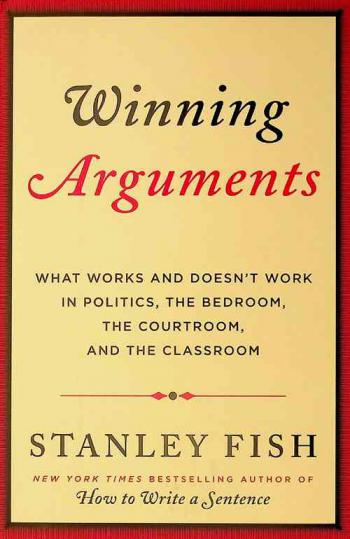
Winning arguments : what works and doesn't work in politics, the bedroom, the courtroom, and the classroom
\"Stanley Fish, the notoriously brash and brilliant English and Law professor, has authored dozens of academic books on subjects ranging from Milton to freedom of speech. In 2011, Fish turned his eye to a more popular subject, the art of writing great sentences. His short, wise book How to Write a Sentence became an instant New York Times Bestseller and continues to be read by students and aspiring writers. Adam Haslet called the book, \"deeper and more democratic than The Elements of Style.\" If great sentences are, in effect, performances at the highest level, Fish acts as a lively sportscaster giving the reader a blow-by-blow. In Winning Arguments, Fish employs this same wit and observational prowess as he guides readers through the \"greatest hits\" of rhetoric including landmark legal cases, arguments drawn from popular film and TV, and even Fish's own career. The success of books like Jay Heinrich's Thank You For Arguing demonstrate a clear audience for fun, intellectually nourishing books that make you feel just a little bit smarter for having read them. Like How to Write a Sentence, Winning Arguments will become a modern classic\"-- Provided by publisher.
Book

“Con la mirada en el cielo y en los hijos que son fruto del amor”: emociones y movilización católica frente al divorcio vincular, Argentina, 1984-198
Objetivo/contexto: este artículo se pregunta por el lugar de las emociones en el debate sobre el divorcio que tuvo lugar en la Argentina en la década de 1980, haciendo foco en la campaña antidivorcista de la Iglesia. Metodología: se basa en un análisis cualitativo de prensa de la época y debates parlamentarios. En ellos se rastrean las referencias a las emociones, así como a prácticas emocionales y devocionales. Originalidad:el texto vuelve sobre los debates en torno de la legislación sobre el divorcio, que han recibido cierta atención de parte de las ciencias sociales, retomando los aportes de la historia de las emociones. Conclusiones: Por un lado, señala que el amor fue un elemento central en el debate sobre el divorcio, aunque definido de dos formas distintas por quienes estaban a favor y en contra de incorporarlo al ordenamiento legal: en el primer caso, defendían una noción de amor vinculada a la “simpatía”, mientras que en el otro estaba asociada a la defensa de Dios, la patria y la familia, cuya contrapartida era el miedo a la desestabilización social a la que podría llevar el cambio familiar. Por otro, el artículo muestra la emergencia de un template emocional en la forma que adoptó la campaña de la Iglesia, y en particular la movilización del 5 de julio de 1986, evidencia la emergencia de un modo específico de sentir político en relación con los derechos relacionados con la familia y la sexualidad, que se sostenía en elementos ligados con la religiosidad popular, y en particular con la devoción a la Virgen.
Journal Article