
Catalogue Search | MBRL


Are you sure you want to remove the book from the shelf?

{{itemTitle}}
210
result(s) for
"DR Congo"
Sort by:

Being Colonized
What was it like to be colonized by foreigners? Highlighting a region in central Congo, in the center of sub-Saharan Africa,
Being Colonized places Africans at the heart of the story. In a richly textured history that will appeal to general readers and students as well as to scholars, the distinguished historian Jan Vansina offers not just accounts of colonial administrators, missionaries, and traders, but the varied voices of a colonized people. Vansina uncovers the history revealed in local news, customs, gossip, and even dreams, as related by African villagers through archival documents, material culture, and oral interviews. Vansina’s case study of the colonial experience is the realm of Kuba, a kingdom in Congo about the size of New Jersey—and two-thirds the size of its colonial master, Belgium. The experience of its inhabitants is the story of colonialism, from its earliest manifestations to its tumultuous end. What happened in Kuba happened to varying degrees throughout Africa and other colonized regions: racism, economic exploitation, indirect rule, Christian conversion, modernization, disease and healing, and transformations in gender relations. The Kuba, like others, took their own active part in history, responding to the changes and calamities that colonization set in motion. Vansina follows the region’s inhabitants from the late nineteenth century to the middle of the twentieth century, when a new elite emerged on the eve of Congo’s dramatic passage to independence.
eBook


Decolonisation and Regional Geopolitics
Decolonisation and Regional Geopolitics argues that as much as the 'Congo Crisis' (1960-1965) was a Cold War battleground, so too was it a battleground for Southern Africa's decolonisation. This book provides a transnational history of African decolonisation, apartheid diplomacy, and Southern African nationalist movements. It answers three central questions. First, what was the nature of South African involvement in the Congo Crisis? Second, what was the rationale for this involvement? Third, how did South Africans perceive the crisis?
Innovatively, the book shifts the focus on the Congo Crisis away from Cold War intervention and centres it around African decolonisation and regional geopolitics.
eBook

Convincing Rebel Fighters to Disarm
One of the key mission objectives of the UN Mission in the Democratic Republic of Congo (MONUC) was to disarm and repatriate foreign combatants in the eastern region of the country. To achieve this, MONUC adopted a \"push and pull\" strategy. This involved applying military pressure while at the same time offering opportunities for voluntary disarmament and repatriation for armed combatants of the elusive but deadly Democratic Forces for the Liberation of Rwanda (FDLR) – a predominantly Rwandan Hutu armed group in eastern DRC. As part of its \"pull\" strategy, MONUC embarked on one of the most sophisticated Information Operations (IO) campaigns in UN history with the core objective of convincing thousands of individual combatants and commanders of the FDLR to voluntarily disarm and join the UN's Demobilization, Disarmament, Repatriation, Resettlement and Reintegration programme (DDRRR). This book is derived from studies of the narratives, coordination and effectiveness of the UN's IO in support of DDRRR and how the UN has integrated IO as part of its Mission peace support operations. This book advances contemporary understanding of the relative importance of communication models and their interactions within conflict settings. It provides instruments with which conflict and communication analysts can compare predictions and rationalize Information impacts for future conflicts. About the author Dr. Jacob Udo-Udo Jacob teaches Communications & Media Studies at the American University of Nigeria. He earned his PhD in Communication Studies from the University of Leeds, United Kingdom
eBook
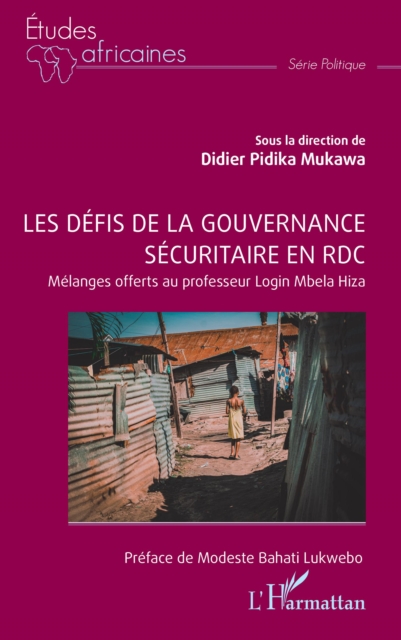
Les défis de la gouvernance sécuritaire en RDC
Réunissant huit contributions d'auteurs, ces mélanges, ordonnés autour du thème de la gouvernance de la sécurité en RDC, donnent à voir une variété de regards sur les défis sécuritaires auxquels ce pays continent est confronté aujourd'hui tant à l'échelle nationale, locale ou urbano-rurale. Cet ouvrage s'adresse donc à toute personne désireuse de mieux comprendre les enjeux sécuritaires qui se dévoilent à travers l'éducation dans le contexte de crise, la porosité des frontières, l'inflation des sociétés de sécurité privée, le conflit foncier dans les Kivus entre les autochtones et les allochtones, l'insécurité causée par les gangs des rues et des chauffeurs des taxis-motos, et l'apport des partenaires bilatéraux et multilatéraux sur la réforme des forces armées.
eBook

Naming Colonialism
What’s in a name? As Osumaka Likaka argues in this illuminating study, the names that Congolese villagers gave to European colonizers reveal much about how Africans experienced and reacted to colonialism. The arrival of explorers, missionaries, administrators, and company agents allowed Africans to observe Westerners’ physical appearances, behavior, and cultural practices at close range—often resulting in subtle yet trenchant critiques. By naming Europeans, Africans turned a universal practice into a local mnemonic system, recording and preserving the village’s understanding of colonialism in the form of pithy verbal expressions that were easy to remember and transmit across localities, regions, and generations. Methodologically innovative,
Naming Colonialism advances a new approach that shows how a cultural process—the naming of Europeans—can provide a point of entry into economic and social histories. Drawing on archival documents and oral interviews, Likaka encounters and analyzes a welter of coded fragments. The vivid epithets Congolese gave to rubber company agents—“the home burner,” “Leopard,” “Beat, beat,” “The hippopotamus-hide whip”—clearly conveyed the violence that underpinned colonial extractive economies. Other names were subtler, hinting at derogatory meaning by way of riddles, metaphors, or symbols to which the Europeans were oblivious. Africans thus emerge from this study as autonomous actors whose capacity to observe, categorize, and evaluate reverses our usual optic, providing a critical window on Central African colonialism in its local and regional dimensions.
eBook

The diplomacy of decolonisation: America, Britain and the United Nations during the Congo crisis 1960-64
This volume reinterprets the role of the UN during the Congo crisis from 1960 to 1964, presenting a multidimensional view of the organisation. Through an examination of the Anglo-American relationship, it reveals how the UN helped position this event as a lightning rod in debates about how decolonisation interacted with the Cold War. By examining the ways in which the various dimensions of the UN came into play in Anglo-American considerations of how to handle the Congo crisis, Alanna O'Malley reveals how the Congo debate reverberated in wider ideological struggles about how decolonisation evolved and what the role of the UN would be in managing this process.
eBook

Formal Peace and Informal War
Northern interventions into African countries at war are dominated by security concerns, bolstered by claims of shared returns and reinforcing processes of development and security. As global security and human security became prominent in development policy, Congo was wracked by violent rule, pillage, internal fighting, and invasion. In 2002, the Global and All-Inclusive Peace was promoted by northern donors, placing a formal peace on the mass of informalised wars.
Formal Peace and Informal War: Security and Development in Congo examines how the security interests of the Congolese population have interacted with those of northern donors. It explores Congo's contemporary wars and the peace agreed on in 2002 from a security perspective and challenges the asserted commonality of the liberal interventions made by northern donors. It finds that the peace framed the multiple conflicts in Congo as a civil war and engineered a power-sharing agreement between elite belligerents. The book argues that the population were politically and economically excluded from the peace and have been subjected to control and containment when their security rests with power and freedom.
eBook

America, the UN and Decolonisation
This book examines the role of the UN in conflict resolution in Africa in the 1960s and its relation to the Cold War.
Focussing on the Congo, this book shows how the preservation of the existing economic and social order in the Congo was a key element in the decolonisation process and the fighting of the Cold War. It links the international aspects of British, Belgian, Angolan and Central African Federation involvement with the roles of the US and UN in order to understand how supplies to and profits from the Congo were producing growing African problems. This large Central African country played a vital, if not fully understood role, in the Cold War and proved to be a fascinating example of complex African problems of decolonisation interacting with international forces, in ways that revealed a great deal about the problems inherent in colonialism and its end.
This book will be of much interest to students of US foreign policy, the UN, Cold War history and international history in general.
'Anglophone historians in the last two decades have done little to place the crises that beset the Democratic Republic of Congo between independence in 1960 and 1964 in the contexts of Cold War diplomatic history. This new book is an important corrective to this negligence. By using US and British diplomatic archives that were closed to researchers in the 1960s, Kent (international relations, London School of Economics) uncovers the extremely complex negotiations between various Congolese actors, US officials, the UN, and the divided Belgian political establishment. [...] An excellent book on African decolonization, the Congo, and 1960s Cold War diplomatic history. Summing Up: Highly recommended. Upper-division undergraduates and above.' -- J. M. Rich , Middle Tennessee State University
John Kent is Reader in International Relations at the London School of Economics.
Introduction 1. The Independence Disaster 1958 - Sept 1960 2. The Dismissal and Murder of Lumumba and the Establishment of the Adoula Government September 1960 - August 1961 3. The Adoula Government and Kitona: the Conflict and Dilemmas Created by US and UN Policy August - December 1961 4. Too Little Too Late January - July 1962 5. The Last Adoula Government of a Divided Congo July – December 1962 6. The End of Secession and the Beginning of the End for the Congo December 1962 - January 1963 7. Unified Nation Building and No Unity to Build On January- Oct 1963 8. The Emerging Chaos and the Forces of Disintegration Bring Tshombe’s Return October 1963 -July 1964. Conclusion
eBook