
Catalogue Search | MBRL


Are you sure you want to remove the book from the shelf?

{{itemTitle}}
74
result(s) for
"DUTCH AUCTIONS"
Sort by:

Auction theory
Auction Theory is the standard reference on auctions and the first source of authoritative information about multi-unit auctions.The book develops the main concepts of auction theory from scratch in a self-contained and theoretically rigorous manner.
eBook
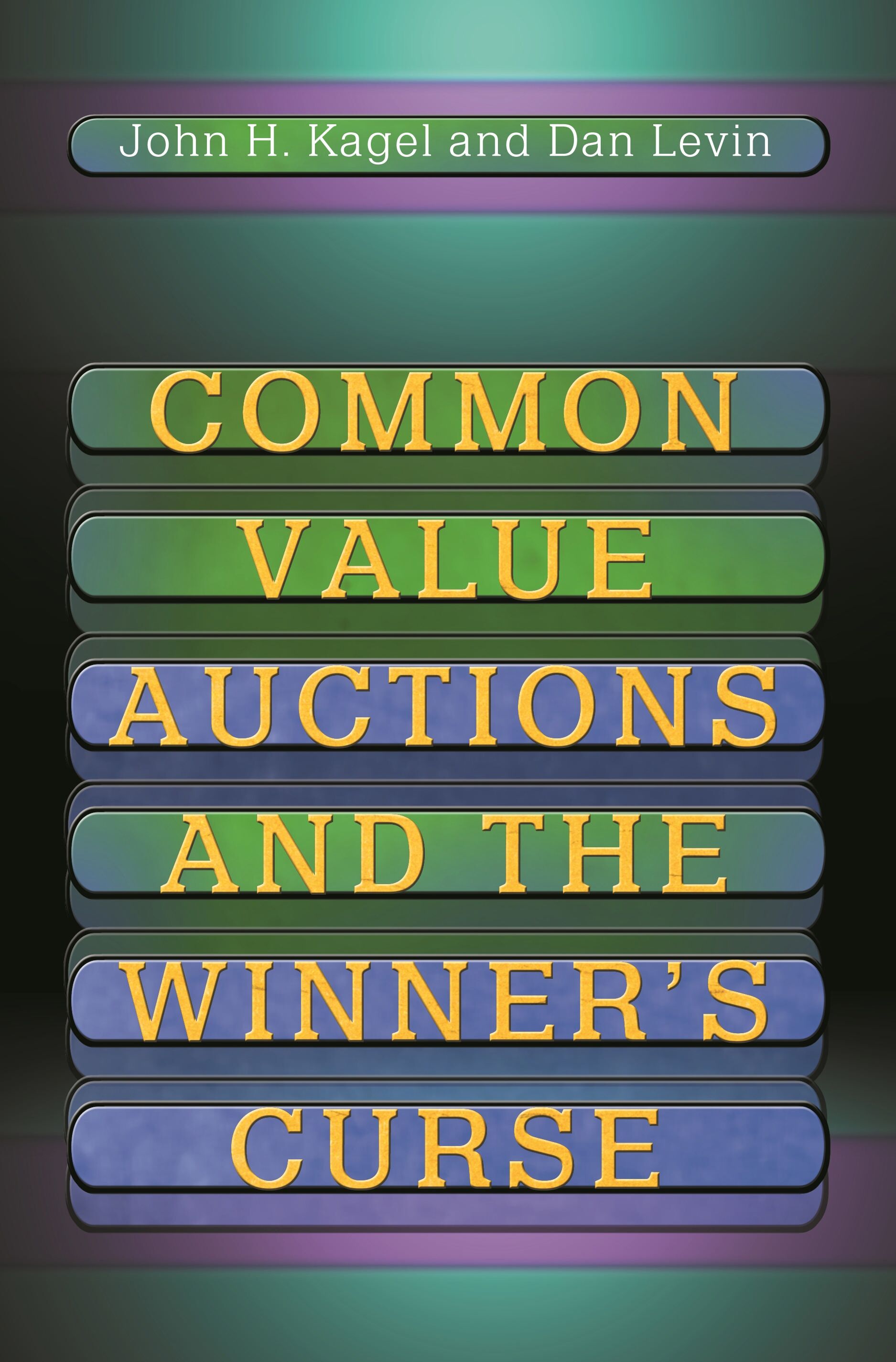
Common Value Auctions and the Winner's Curse
Few forms of market exchange intrigue economists as do auctions, whose theoretical and practical implications are enormous. John Kagel and Dan Levin, complementing their own distinguished research with papers written with other specialists, provide a new focus on common value auctions and the \"winner's curse.\" In such auctions the value of each item is about the same to all bidders, but different bidders have different information about the underlying value. Virtually all auctions have a common value element; among the burgeoning modern-day examples are those organized by Internet companies such as eBay. Winners end up cursing when they realize that they won because their estimates were overly optimistic, which led them to bid too much and lose money as a result.
The authors first unveil a fresh survey of experimental data on the winner's curse. Melding theory with the econometric analysis of field data, they assess the design of government auctions, such as the spectrum rights (air wave) auctions that continue to be conducted around the world. The remaining chapters gauge the impact on sellers' revenue of the type of auction used and of inside information, show how bidders learn to avoid the winner's curse, and present comparisons of sophisticated bidders with college sophomores, the usual guinea pigs used in laboratory experiments. Appendixes refine theoretical arguments and, in some cases, present entirely new data. This book is an invaluable, impeccably up-to-date resource on how auctions work--and how to make them work.
eBook

Overlapping Online Auctions: Empirical Characterization of Bidder Strategies and Auction Prices
Online auctions enable market-level interactions or interdependency of outcomes, which were not observed in physical auctions. One such set of interactions takes place when multiple auctions are conducted to sell identical items by an identical seller in an overlapping manner. This research focuses on overlapping auctions, their interactions, and the related impact on bidder behavior. We introduce the notion of auction \"overlap\" and examine the impact of market-level factors such as the price information revealed from prior auctions, degree of overlap, the auction format, and the overall market supply on a given auction's price. Despite a competitive setting, we find that, ceteris paribus, English auctions, on average, extract roughly 8.6 percent more revenue per unit than multiunit uniform-price Dutch auctions. We discover that the overlapping auctions attract institutional bidders, who bid in a participatory manner across multiple auctions, and that such bidders exert a downward pressure on auction prices. We find that overlap of an auction with other competing auctions has a significant negative influence on prices, and information about following auctions has a stronger negative influence than information about prior closing auctions. By estimating the expected price difference, we provide practitioners, who have private knowledge of their internal holding costs, a benchmark that can be used in deciding between using overlapping single-unit English auctions and multiunit Dutch auctions.
Journal Article
Electricity auctions : an overview of efficient practices
This report assesses the potential of electricity contract auctions as a procurement option for the World Bank's client countries. It focuses on the role of auctions of electricity contracts designed to expand and retain existing generation capacity. It is not meant to be a 'how-to' manual. Rather, it highlights some major issues and options that need to be taken into account when a country considers moving towards competitive electricity procurement through the introduction of electricity auctions. Auctions have played an important role in the effort to match supply and demand. Ever since the 1990s, the use of long-term contract auctions to procure new generation capacity, notably from private sector suppliers, has garnered increased affection from investors, governments, and multilateral agencies in general, as a means to achieve a competitive and transparent procurement process while providing certainty of supply for the medium to long term. However, the liberalization of electricity markets and the move from single-buyer procurement models increased the nature of the challenge facing system planners in their efforts to ensure an adequate and secure supply of electricity in the future at the best price. While auctions as general propositions are a means to match supply with demand in a cost-effective manner, they can also be and have been used to meet a variety of goals.
eBook
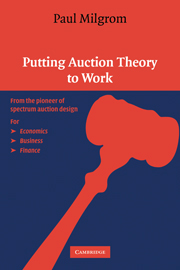
Putting Auction Theory to Work
This book provides a comprehensive introduction to modern auction theory and its important new applications. It is written by a leading economic theorist whose suggestions guided the creation of the new spectrum auction designs. Aimed at graduate students and professionals in economics, the book gives the most up-to-date treatments of both traditional theories of 'optimal auctions' and newer theories of multi-unit auctions and package auctions, and shows by example how these theories are used. The analysis explores the limitations of prominent older designs, such as the Vickrey auction design, and evaluates the practical responses to those limitations. It explores the tension between the traditional theory of auctions with a fixed set of bidders, in which the seller seeks to squeeze as much revenue as possible from the fixed set, and the theory of auctions with endogenous entry, in which bidder profits must be respected to encourage participation.
eBook

Do hybrid auctions always give “the best of both worlds” ? An illustration from asymmetric Anglo–Dutch auctions
The Anglo–Dutch auction of Klemperer (European Economic Review 42(3):757–69, 1998) is the unit-demand precursor of the many two-stage hybrid auctions currently used for the allocation of high value goods such as mobile telephony licenses, bus routes, and public procurement. This breadth of practical applications has been largely matched by an absence of theoretical results regarding the performance of hybrid auctions relative to their simpler component counterparts: the ascending and first-price auctions. To address this imbalance, I analyse an asymmetric discrete private value model that allows a complete revenue ranking between the Anglo–Dutch, ascending and first-price auctions. I find that the Anglo–Dutch auction can revenue-dominate for a small set of parameters, and ranks revenue-last in an even smaller number of cases; for most parameter values it ranks as intermediate. The auction also performs particularly well when bidders face entry costs and the incumbent has small-but-certain value-advantage: a setting where bidder incentives are similar to Klemperer’s notion of “almost common values”. Overall, the Anglo–Dutch auction is rarely best, but even more rarely performs worst—for this reason, it may be a prudent policy choice if the auctioneer is unsure about the magnitude of asymmetries across bidders. While the implications of my basic model do not immediately generalise to more complex settings, they do suggest that the notion that hybrid auctions are naturally “the best of both worlds” need to be evaluated carefully, and cannot be taken for granted.
Journal Article

Bidding Behavior in Dutch Auctions: Insights from a Structured Literature Review
The Dutch auction, also known as the descending-price auction or reverse clock auction, has a long-standing history in practice and in academic literature. In practice, the Dutch auction is commonly used to rapidly sell large quantities of homogeneous goods, such as cut flowers, fish, or tobacco. However, most e-commerce auction sites focus on other auction mechanisms, and overall research on human behavior in Dutch auctions is scant. To facilitate research on Dutch auctions and their applications in electronic commerce, we conduct a structured literature review of experimental studies and establish the current state of research on bidding behavior in single-unit and multi-unit Dutch auctions. The findings are based on an analysis of twenty-nine articles published in the fields of economics, information management, marketing, and operations research and management science between 1970 and 2016. This review reveals (1) the characteristics that make the Dutch auction unique compared to other auction formats, (2) the drivers of bidding behavior in Dutch auctions, and (3) an overview of how Dutch auctions can be employed in practice and to what advantage. Finally, we identify directions for future research on bidding behavior in Dutch auctions.
Journal Article
Excitement Up! Price Down! Measuring Emotions in Dutch Auctions
Recently, Internet auction sites have begun to compete in emotions by advertising the fun and excitement that bidders may experience during auction participation. The implicit conjecture inherent in these advertisements is that consumers derive a hedonic value from auction participation that makes exciting auctions more attractive and possibly induces bidders to stay active longer in the auction. We test this conjecture in a controlled economic laboratory experiment in which we also measure bidders' physiological arousal in terms of heart rate and skin conductivity as proxies for their excitement during auction participation. In particular, we conduct a series of descending price (Dutch) auctions with different clock speeds and find that in fast Dutch auctions bidders (1) are more excited and (2) stay longer in the bidding process. Moreover, the unpleasant event of losing a Dutch auction is experienced more strongly than the rewarding event of winning. Our results show that bidders' excitement is directly reflected in final prices, indicating that Internet auction site sponsors should carefully consider how the emotions elicited on their platforms affect bidding behavior.
Journal Article

Regret under different auction designs: the case of English and Dutch auctions
Studies have shown that users experience regret in online electronic auctions. Our study adds to the research on the antecedents of regret by examining the effects of the major types of auction design on users’ experience of regret. Towards this goal, we analyzed bidders’ experience of regret in English and Dutch auctions. Given that English and Dutch auctions are known to produce different types of bidding behavior and outcomes, we expect that the two types of auction design will also have a differential impact on experiencing regret. We report results from a lab experiment that was implemented as a self-developed mobile application for hotel room reservations. We examined the effects of the two open-bid auction types on the experience of regret, and found that users are more likely to experience regret in Dutch auctions. We point out the theoretical relevance and practical implications of our findings.
Journal Article

CLOCKS AND TREES: ISOMORPHIC DUTCH AUCTIONS AND CENTIPEDE GAMES
We report an experiment on effects of varying institutional format and dynamic structure of centipede games and Dutch auctions. Centipede games with a clock format unravel, as predicted by theory but not reported in previous literature on two-player tree-format centipede games. Dutch auctions with a tree format produce bids close to risk neutral Nash equilibrium bids, unlike previous literature on clock-format Dutch auctions. Our data provide a new, expanded set of stylized facts which may provide a foundation for unified modeling of play in a class of games that includes centipede games and Dutch auctions.
Journal Article