
Catalogue Search | MBRL


Are you sure you want to remove the book from the shelf?

{{itemTitle}}
8
result(s) for
"Daguerreotype United States History 19th century."
Sort by:


The Camera and the Press
Before most Americans ever saw an actual daguerreotype, they encountered this visual form through written descriptions, published and rapidly reprinted in newspapers throughout the land. In The Camera and the Press, Marcy J. Dinius examines how the first written and published responses to the daguerreotype set the terms for how we now understand the representational accuracy and objectivity associated with the photograph, as well as the democratization of portraiture that photography enabled.Dinius's archival research ranges from essays in popular nineteenth-century periodicals to daguerreotypes of Americans, Liberians, slaves, and even fictional characters. Examples of these portraits are among the dozens of illustrations featured in the book. The Camera and the Press presents new dimensions of Nathaniel Hawthorne's The House of the Seven Gables, Herman Melville's Pierre, Harriet Beecher Stowe's Uncle Tom's Cabin, and Frederick Douglass's The Heroic Slave. Dinius shows how these authors strategically incorporated aspects of daguerreian representation to advance their aesthetic, political, and social agendas. By recognizing print and visual culture as one, Dinius redefines such terms as art, objectivity, sympathy, representation, race, and nationalism and their interrelations in nineteenth-century America.
eBook
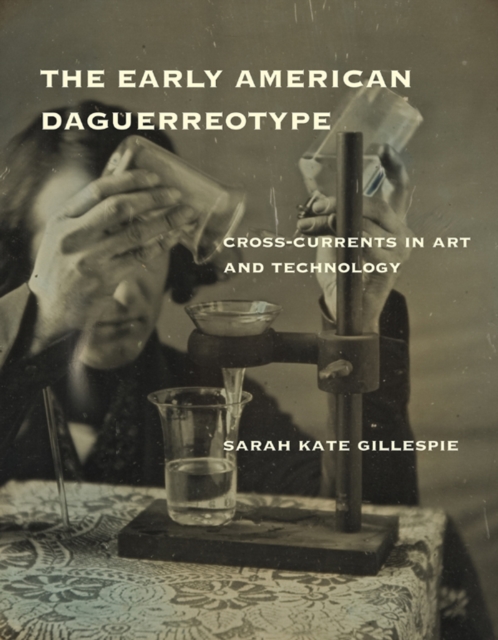
The early American daguerreotype : cross-currents in art and technology
The daguerreotype, invented in France, came to America in 1839. By 1851, this early photographic method had been improved by American daguerreotypists to such a degree that it was often referred to as quot;the American process.quot; The daguerreotype -- now perhaps mostly associated with stiffly posed portraits of serious-visaged nineteenth-century personages -- was an extremely detailed photographic image, produced though a complicated process involving a copper plate, light-sensitive chemicals, and mercury fumes. It was, as Sarah Kate Gillespie shows in this generously illustrated history, something wholly and remarkably new: a product of science and innovative technology that resulted in a visual object. It was a hybrid, with roots in both fine art and science, and it interacted in reciprocally formative ways with fine art, science, and technology.Gillespie maps the evolution of the daguerreotype, as medium and as profession, from its introduction to the ascendancy of the quot;American process,quot; tracing its relationship to other fields and the professionalization of those fields. She does so by recounting the activities of a series of American daguerreotypists, including fine artists, scientists, and mechanical tinkerers. She describes, for example, experiments undertaken by Samuel F. B. Morse as he made the transition from artist to inventor; how artists made use of the daguerreotype, both borrowing conventions from fine art and establishing new ones for a new medium; the use of the daguerreotype in various sciences, particularly astronomy; and technological innovators who drew on their work in the mechanical arts. By the 1860s, the daguerreotype had been supplanted by newer technologies. Its rise (and fall) represents an early instance of the ever-constant stream of emerging visual technologies.
eBook

The Correspondence of Henry D. Thoreau
This is the second volume in the first full-scale scholarly edition of Thoreau's correspondence in more than half a century. When completed, the edition's three volumes will include every extant letter written or received by Thoreau-in all, almost 650 letters, roughly 150 more than in any previous edition, including dozens that have never before been published.Correspondence 2 contains 246 letters, 124 written by Thoreau and 122 written to him. Sixty-three are collected here for the first time; of these, forty-three have never before been published. During the period covered by this volume, Thoreau wrote the works that form the foundation of his modern reputation. A number of letters reveal the circumstances surrounding the publication of A Week on the Concord and Merrimack Rivers in May 1849 and Walden in August 1854, as well as the essays Resistance to Civil Government (1849; now known as Civil Disobedience ) and Slavery in Massachusetts (1854), and two series, An Excursion to Canada (1853) and Cape Cod (1855). Writing and lecturing brought Thoreau a small group of devoted fans, most notably Daniel Ricketson, an independently wealthy Quaker and abolitionist who became a faithful correspondent. The most significant body of letters in the volume are those Thoreau wrote to Harrison Gray Otis Blake, a friend and disciple who elicited intense and complex discussions of the philosophical, ethical, and moral issues Thoreau explored throughout his life.Following every letter, annotations identify correspondents, individuals mentioned, and books quoted, and describe events to which the letters refer. A historical introduction characterizes the letters and connects them with the events of Thoreau's life, a textual introduction lays out the editorial principles and procedures followed, and a general introduction discusses the history of the publication of Thoreau's correspondence. Proper names, publications, events, and ideas found in both the letters and the annotations are included in the index, which provides full access to the contents of the volume.
eBook

Visual Archives in Perspective: Enlarging on Historical Medical Photographs
Examining historical photographs can open paths to improved understanding of the history of most disciplines, including medicine. Images can be \"read\" and advantageously integrated with other historical \"traces.\" Documents, including photographs, are \"orphaned\" when separated from their creators and used out of context. Archivists share with historians the responsibility for considering interpretations of the documentary record. Cultivating subject-specific understanding as well as general historical awareness expands our competency to read photographs and promotes more contextualized and historically grounded uses of information.
Journal Article

Recognizing Lincoln: Image Vernaculars in Nineteenth-Century Visual Culture
This essay studies letters written to McClure's magazine in response to its 1895 publication of a previously unknown photograph of Abraham Lincoln. The letter writers mobilized what I call \"image vernaculars,\" enthymematic arguments grounded in their social knowledge about photography, portraiture, and \"scientific\" discourses of character such as physiognomy. Armed with these image vernaculars, viewers argued the photograph was evidence of Lincoln's superior moral character, and they used it to elaborate an Anglo-Saxon ideal national type at a time when elites were consumed by fin-de-siècle anxieties about the fate of \"American\" identity.
Journal Article

Lincoln's Smile: Ambiguities of the Face in Photography
Abraham Lincoln's face, the most famous photographed face in American history, may be the most overdetermined, the easiest, and at the same time, the most difficult to read as the expression of a person. Like Lincoln's fragile smile, ambiguities of the photographed face find resolution in the narratives imagined by way of explanation.
Journal Article