
Catalogue Search | MBRL


Are you sure you want to remove the book from the shelf?

{{itemTitle}}
9
result(s) for
"Damaskus."
Sort by:

Everyday life & consumer culture in 18th-century Damascus
\"In assessing the magnitude of social change in modern times, we have few benchmarks from the period preceding the onset of modernity in the nineteenth century. This informative study will make possible more precise cultural and economic comparisons between different parts of the world as it stood on the brink of a radically new economic and political order. The book's focus on a little-examined period and region will appeal to scholars and students of urban social history and Arab popular culture.\"--Jacket.
Book

Muslim-Christian relations in Damascus amid the 1860 riot
On 9 July 1860 CE, an outbreak of violence in the inner-city Christian quarter of Damascus created shock waves locally and internationally. This book provides a step-by-step presentation of events and issues to assess the true role of all the players and shapers of events. It critically examines the internal and external politico-socio-economic factors involved and argues that economic interests rather than religious fanaticism were the main causes for the riot of 1860. Furthermore, it argues that the riot was not a sudden eruption but rather a planned and organised affair.
eBook

Über Judentum und Hellenismus hinaus: Die paulinische Theologie als neues Wissenssystem
The new
claims that Paul remained a Jew and loyal to the Torah throughout his entire life. His letters were addressed exclusively to Gentile Christians. However, all the Pauline letters do not give the impression that their contents only applied to certain groups within the different congregations. Without a doubt, Paul remained closely tied to Judaism throughout his life, but numerous texts document a break with the past and a departure towards something new. In addition, the
ignores the theological standpoint and the organizational efforts required by the emerging group of Christians to establish themselves as a religious community. Any group who decides to set up its own meeting places, give itself a new name, develop new rituals and laws, organize its own communal meals, determine a new holy day and celebrate its own worship services based on a new and unique group image cannot be seen as part of another religious group. Ultimately, a new, impressive theological world comes to light, expressed in its own original style and with an extraordinary literary production. Neither the Jews, nor the strict Jewish Christians, nor the Romans of the time perceived the apostle Paul as someone who continued to consider himself and his congregations to be within the framework of Judaism.
Journal Article
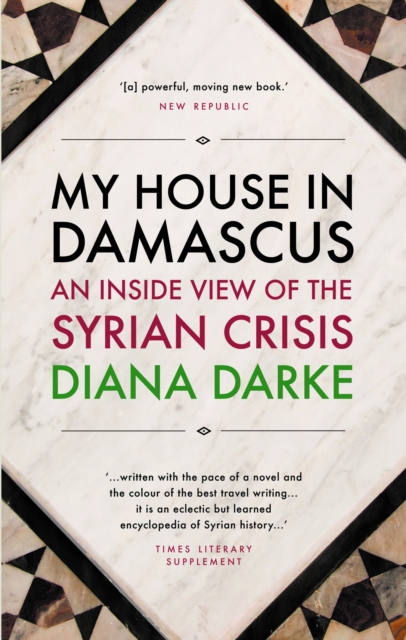
My House in Damascus
The ongoing conflict in Syria has made clear just how limited the general knowledge of Syrian society and history is in the West. For those watching the headlines and wondering what led the nation to this point, and what might come next, this book is a perfect place to start developing a deeper understanding.Based on decades of living and working in Syria,My House in Damascusoffers an inside view of Syria's cultural and complex religious and ethnic communities. Diana Darke, a fluent Arabic speaker who moved to Damascus in 2004 after decades of regular visits, details the ways that the Assad regime, and its relationship to the people, differs from the regimes in Egypt, Tunisia, and Libya-and why it was thus always less likely to collapse quickly, even in the face of widespread unrest and violence. Through the author's firsthand experiences of buying and restoring a house in the old city of Damascus, which she later offered as a sanctuary to friends, Darke presents a clear picture of the realities of life on the ground and what hope there is for Syria's future.
eBook



L'Idéal monastique chez Huysmans et Strindberg, entre réalité et fiction
Strindberg et Huysmans appartiennent à la même période mystique de fin de siècle et partagent le même rêve religieux, celui notamment de fonder une colonie d’artistes de style monastique. Alors que Huysmans réalise une partie de ses rêves en devenant oblat bénédictin et en essayant de regrouper autour de lui quelques artistes, Strindberg échouera. L’écrivain suédois ne verra jamais son rêve prendre forme tel qu’il l’aura défini avec minutie dans sa correspondance. En revanche, au lieu de devenir moine, il mettra son écriture à contribution pour faire vivre ce rêve à travers de nombreux personnages littéraires de son théâtre. Cette étude examine les deux manières différentes par lesquelles Huysmans et Strindberg ont vécu leurs rêves.
Strindberg and Huysmans belong to the same fin de siècle mysticism period and deal with the same religious dream, more specifically one concerning the setting up of a “monastically inspired artistic community”. Whereas Huysmans realized a part of this dream and became a Benedictine oblate while at the same time trying to found a “colony of artists” of his own and to some extent succeeded, Strindberg did not. The Swedish writer could never materialize his plan, several aspects of which were extensively described in his letters. Instead of becoming a monk, he used his own literary writing and incarnated his dream in a number of theatrical pieces. This study investigates the two different modes in which Huysmans and Strindberg respectively lived his own particular dream.
Journal Article
