
Catalogue Search | MBRL


Are you sure you want to remove the book from the shelf?

{{itemTitle}}
18,495
result(s) for
"Dante"
Sort by:

The divine comedy of Dante Alighieri. Vol. 3, Paradiso
\"Reunited with his beloved Beatrice in the Purgatorio, in the Paradiso the poet-narrator journeys with her through the heavenly spheres and comes to know 'the state of blessed souls after death.' As with the previous volumes, the original Italian and its English translation appear on facing pages. Readers will be drawn to Durling's precise and vivid prose, which captures Dante's extraordinary range of expression--from the high style of divine revelation to colloquial speech, lyrical interludes, and scornful diatribes against corrupt clergy. This edition boasts several unique features. Durling's introduction explores the chief interpretive issues surrounding the Paradiso, including the nature of its allegories, the status in the poem of Dante's human body, and his relation to the mystical tradition. The notes at the end of each canto provide detailed commentary on historical, theological, and literary allusions, and unravel the obscurity and difficulties of Dante's ambitious style . An unusual feature is the inclusion of the text, translation, and commentary on one of Dante's chief models, the famous cosmological poem by Boethius that ends the third book of his Consolation of Philosophy. A substantial section of Additional Notes discusses myths, symbols, and themes that figure in all three cantiche of Dante's masterpiece. Finally, the volume includes a set of indexes that is unique in American editions, including Proper Names Discussed in the Notes (with thorough subheadings concerning related themes), Passages Cited in the Notes, and Words Discussed in the Notes, as well as an Index of Proper Names in the text and translation. Like the previous volumes, this final volume includes a rich series of illustrations by Robert Turner.\"-- from Amazon.com.
Book

Virgil the Blind Guide
Virgil the Blind Guide examines the repetition of certain linguistic configurations that have remained hidden because the meanings of the words involved do not relate to Virgil’s competence as guide. Uncovering tropes that have yet to be studied, Howard allows us to see new junctures in the poet’s travels, while highlighting Virgil’s impotence and diminishing his authority as regards other poets, guides, and the demons of Hell’s lower gate. The concealed route revealed by Dante’s figurative signposts establishes Virgil’s traits as foundational to the poem and allows for new perspectives and understandings of this critical character. Using this distinctive strategy, Virgil the Blind Guide helps us to piece together the complex puzzle that is Dante’s pagan guide and suggests new ways of understanding important characters that are applicable to a broad range of poetry and prose.
eBook


The ancient flame : Dante and the poets
While the structure and themes of the Divine Comedy are defined by the narrative of a spiritual pilgrimage guided by Christian truth, Winthrop Wetherbee's remarkable new study reveals that Dante's engagement with the great Latin poets Vergil, Ovid, Lucan, and Statius constitutes a second, complementary narrative centered on psychological and artistic self-discovery.
This fresh, illuminating approach departs from the usual treatment of classical poets in Dante criticism, which assigns them a merely allegorical function. Their true importance to Dante's project is much greater. As Wetherbee meticulously shows, Dante's use of the poets is grounded in an astute understanding of their historical situation and a deeply sympathetic reading of their poetry.
Dante may have been motivated to correct pagan thought and imagery, but more pervasive was his desire to recreate classical style and to restore classical auctoritas to his own times. Dante's journey in the Commedia, beginning with the pilgrim's assumption of a tragic view of the human condition, progresses with the great poetry of the classical past as an intrinsic component of—not just a foil to—the spiritual experience. Dante ultimately recognizes classical poetry as an essential means to his discovery of truth.
A stunning contribution by one of the nation's leading medievalists, Wetherbee's investigation of the poem's classicism makes possible an ethical and spiritual but non-Christian reading of Dante, one that will spur new research and become an indispensable tool for teaching the Commedia.
eBook


The Biblical Dante
Dante Alighieri cited the Bible extensively in his Commedia , but also used his epic poem to meditate on the meaning of the Scriptures as a 'true' text. The Biblical Dante provides close readings of passages from the Commedia to explore how Dante's concept of Biblical truth differs sharply from modern notions.
V. Stanley Benfell examines Dante's argument that the truth of the sacred text could only be revealed when engaged with in a transformative manner - and that a lack of such encounters in his time had led to a rise in greed and corruption, notably within the Church. He also illustrates how the poet put forth a vision for the restoration of a just society using Biblical language and imagery, revealing ideas of both earthly and eternal happiness. The Biblical Dante provides an insightful analysis of attitudes towards both the Bible and how it was read in the Medieval period.
eBook

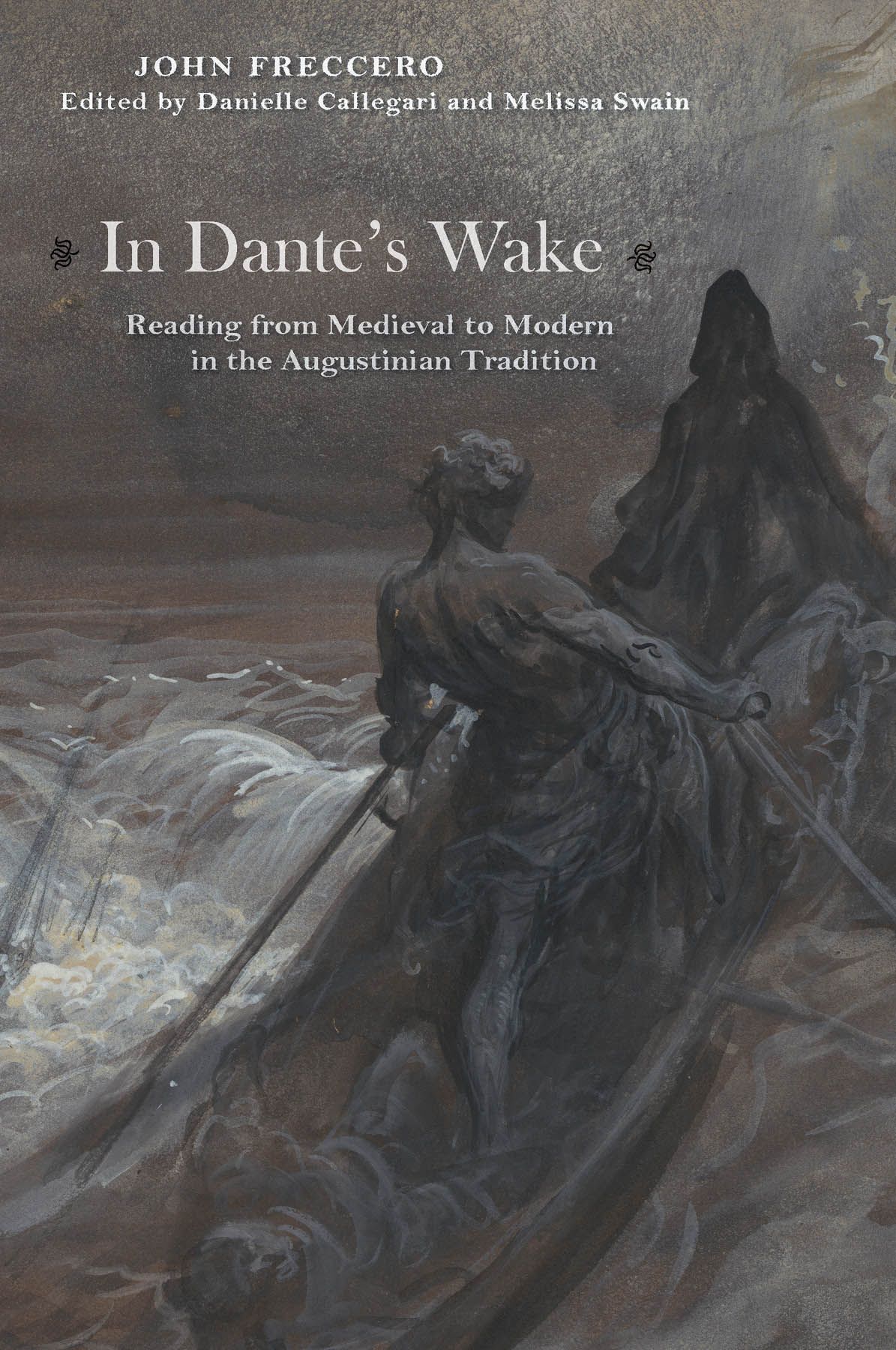
In Dante's Wake: Reading from Medieval to Modern in the Augustinian Tradition
Waking to find himself shipwrecked on a strange shore before a dark wood, the pilgrim of the Divine Comedy realizes he must set his sights higher and guide his ship to a radically different port. Starting on the sand of that very shore with Dante, John Freccero begins retracing the famous voyage recounted by the poet nearly 700 years ago. Freccero follows pilgrim and poet through the Comedy and then beyond, inviting readers both uninitiated and accomplished to join him in navigating this complex medieval masterpiece and its influence on later literature. Perfectly impenetrable in its poetry and unabashedly ambitious in its content, the Divine Comedy is the cosmos collapsed on itself, heavy with dense matter and impossible to expand. Yet Dante's great triumph is seen in the tiny, subtle fragments that make up the seamless whole, pieces that the poet painstakingly sewed together to form a work that insinuates itself into the reader and inspires the work of the next author. Freccero magnifies the most infinitesimal elements of that intricate construction to identify self-similar parts, revealing the full breadth of the great poem. Using this same technique, Freccero then turns to later giants of literature- Petrarch, Machiavelli, Donne, Joyce, and Svevo-demonstrating how these authors absorbed these smallest parts and reproduced Dante in their own work. In the process, he confronts questions of faith, friendship, gender, politics, poetry, and sexuality, so that traveling with Freccero, the reader will both cross unknown territory and reimagine familiar faces, swimming always in Dante's wake.
eBook