
Catalogue Search | MBRL


Are you sure you want to remove the book from the shelf?

{{itemTitle}}
140
result(s) for
"Darwin, Charles, 1809-1882 -- Influence"
Sort by:


Reading Human Nature
As the founder and leading practitioner of \"literary Darwinism,\" Joseph Carroll remains at the forefront of a major movement in literary studies. Signaling key new developments in this approach, Reading Human Nature contains trenchant theoretical essays, innovative empirical research, sweeping surveys of intellectual history, and sophisticated interpretations of specific literary works, including The Picture of Dorian Gray, Wuthering Heights, The Mayor of Casterbridge, and Hamlet. Evolutionists in the social sciences have succeeded in delineating basic motives but have given far too little attention to the imagination. Carroll makes a compelling case that literary Darwinism is not just another \"school\" or movement in literary theory. It is the moving force in a fundamental paradigm change in the humanities—a revolution. Psychologists and anthropologists have provided massive evidence that human motives and emotions are rooted in human biology. Since motives and emotions enter into all the products of a human imagination, humanists now urgently need to assimilate a modern scientific understanding of \"human nature.\" Integrating evolutionary social science with literary humanism, Carroll offers a more complete and adequate understanding of human nature.
eBook

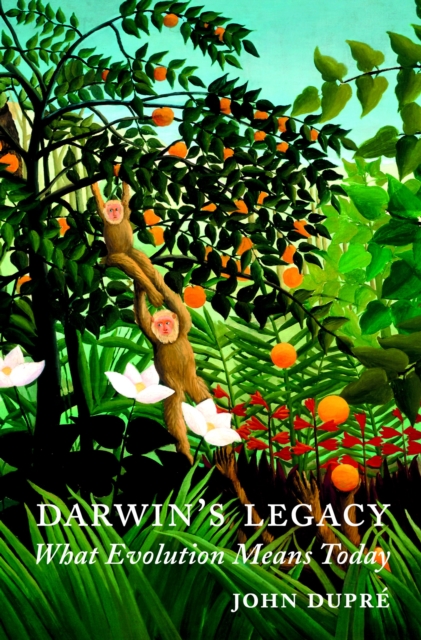
Darwin's Legacy
Charles Darwin transformed our understanding of the universe and our place in it with his development of the theory of evolution. 150 years later, we are still puzzling over the implications. John Dupré presents a lucid, witty introduction to evolution and what it means for our view of humanity, the natural world, and religion. He explains the righ.
eBook

Darwin
\"Charles Darwin can easily be considered one of the most influential scholars of his time. His thoughts, ideas, research and writings have had a far reaching impact and influence on modern thought in the arts, on society, and in science. With contributions from leading scholars, this collection of essays explores how Darwin's work grew out of the ideas of his time, and how its influence spread to contemporary thinking about creationism, the limits of human evolution and the diversification of living species and their conservation. A full account of the legacy of Darwin in contemporary scholarship and thought. With contributions from Janet Browne, Jim Secord, Rebecca Stott, Paul Seabright, Steve Jones, Sean Carroll, Craig Moritz and John Dupre;. This book derives from a highly successful series of public lectures, revised and illustrated for publication under the editorship of Professor William Brown and Professor Andrew Fabian of the University of Cambridge\"-- Provided by publisher.
BOOK

Theatre and evolution from Ibsen to Beckett
Evolutionary theory made its stage debut as early as the 1840s, reflecting a scientific advancement that was fast changing the world. Tracing this development in dozens of mainstream European and American plays, as well as in circus, vaudeville, pantomime, and 'missing link' performances, this study reveals the deep, transformative entanglement among science, art and culture in modern times.
eBook

Angels and ages : a short book about Darwin, Lincoln, and modern life
On February 12, 1809, two men were born an ocean apart: Abraham Lincoln in a one-room Kentucky log cabin; Charles Darwin on an English country estate. Each would see his life's work inspire a stark change in mankind's understanding of itself. In this bicentennial twin portrait, Adam Gopnik shows how these two giants, who never met, altered the way we think about death and time--about the very nature of earthly existence.
BOOK

Darwinistas! The Construction of Evolutionary Thought in Nineteenth Century Argentina
After setting out the intellectual, cultural, and political context of the reception of Darwinism in Argentina, this book presents original translations of central texts in that reception, most of which have never before appeared in English.
eBook


Subversive Seduction
Male-male rivalry and female passive choice, the two principal tenets of Darwinian sexual selection, raise important ethical questions in The Descent of Man--and in the decades since--about the subjugation of women. If female choice is a key component of evolutionary success, what impact does the constraint of women's choices have on society? The elaborate courtship plots of 19th century Spanish novels, with their fixation on suitors and selectors, rivalry, and seduction, were attempts to grapple with the question of female agency in a patriarchal society. By reading Darwin through the lens of the Spanish realist novel and vice versa, Travis Landry brings new insights to our understanding of both: while Darwin's theories have often been seen as biologically deterministic, Landry asserts that Darwin's theory of sexual selection was characterized by an open ended dynamic whose oxymoronic emphasis on \"passive\" female choice carries the potential for revolutionary change in the status of women.
eBook