
Catalogue Search | MBRL


Are you sure you want to remove the book from the shelf?

{{itemTitle}}
132,531
result(s) for
"Data structures"
Sort by:

The stuff of bits : an essay on the materialities of information
\"The central topic of 'The Stuff of Bits' is the materialities of information. This term often brings to mind the materiality of information infrastructures - server farms, air conditioning, fiber optic cable routes, and distributed storage. By contrast, 'The Stuff of Bits' focuses on digital information itself as something with which we - as designers, as users, as citizens, as customers, and as human beings - have a material engagement. The book is anchored by four case studies - one on computer emulation, one on spreadsheets, one on databases, and one on network architectures - organized in terms of the scopes of engagement. Through these cases, a common analytic strategy is to identify not just their materiality but their materialities, that is, not just the brute fact of their material forms but the specific material properties that they display and the consequences of those properties - properties like granularity, transparency, directness, weight, and malleability. The idea is that, in the realm of the digital, everything may be reduced to 'bits' but those bits are not all of equal significance; particular encodings reflect particular needs and expectations of change, adaptation, and evolution. To a certain extent this is similar to 'constraints' and 'affordances' in Don Norman's Six Principles of Design and the driving force behind the Platform Studies series, in that different mediums, or materialities, promote distinct use and reception. As Paul Dourish writes in the Introduction to this book, 'material arrangements of information - how it is represented and how that shapes how it can be put to work - matters significantly for our experience of information and information systems'\"-- Provided by publisher.
Book

SciPy 1.0: fundamental algorithms for scientific computing in Python
SciPy is an open-source scientific computing library for the Python programming language. Since its initial release in 2001, SciPy has become a de facto standard for leveraging scientific algorithms in Python, with over 600 unique code contributors, thousands of dependent packages, over 100,000 dependent repositories and millions of downloads per year. In this work, we provide an overview of the capabilities and development practices of SciPy 1.0 and highlight some recent technical developments.
This Perspective describes the development and capabilities of SciPy 1.0, an open source scientific computing library for the Python programming language.
Journal Article

Countering the cloud : thinking with and against data infrastructures
How do cables and data centers think? This book investigates how information infrastructures enact particular forms of knowledge. It juxtaposes the pervasive logics of speed, efficiency, and resilience with more communal and ecological ways of thinking and being, turning technical solutions back into open questions about what society wants and what infrastructures should do. Moving from data centers in Hong Kong to undersea cables in Singapore and server clusters in China, Munn combines rich empirical material with insights drawn from media and cultural studies, sociology, and philosophy. This critical analysis stresses that infrastructures are not just technical but deeply epistemological, privileging some actions and actors while sidelining others. This innovative exploration of the values and visions at the heart of our technologies will interest students, scholars, and researchers in the areas of communication studies, digital media, technology studies, sociology, philosophy of technology, information studies, and geography.
Book

Spatial regression graph convolutional neural networks: A deep learning paradigm for spatial multivariate distributions
Geospatial artificial intelligence (GeoAI) has emerged as a subfield of GIScience that uses artificial intelligence approaches and machine learning techniques for geographic knowledge discovery. The non-regularity of data structures has recently led to different variants of graph neural networks in the field of computer science, with graph convolutional neural networks being one of the most prominent that operate on non-euclidean structured data where the numbers of nodes connections vary and the nodes are unordered. These networks use graph convolution – commonly known as filters or kernels – in place of general matrix multiplication in at least one of their layers. This paper suggests spatial regression graph convolutional neural networks (SRGCNNs) as a deep learning paradigm that is capable of handling a wide range of geographical tasks where multivariate spatial data needs modeling and prediction. The feasibility of SRGCNNs lies in the feature propagation mechanisms, the spatial locality nature, and a semi-supervised training strategy. In the experiments, this paper demonstrates the operation of SRGCNNs with social media check-in data in Beijing and house price data in San Diego. The results indicate that a well-trained SRGCNN model is capable of learning from samples and performing reasonable predictions for unobserved locations. The paper also presents the effectiveness of incorporating the idea of geographically weighted regression for handling heterogeneity between locations in the model approach. Compared to conventional spatial regression approaches, SRGCNN-based models tend to generate much more accurate and stable results, especially when the sampling ratio is low. This study offers to bridge the methodological gap between graph deep learning and spatial regression analytics. The proposed idea serves as an example to illustrate how spatial analytics can be combined with state-of-the-art deep learning models, and to enlighten future research at the front of GeoAI.
Journal Article

Beginning Java Data Structures and Algorithms
Learning about data structures and algorithms gives you a better insight on how to solve common programming problems. Most of the problems faced everyday by programmers have been solved, tried, and tested. By knowing how these solutions work, you can ensure that you choose the right tool when you face these problems. This book teaches you.
eBook
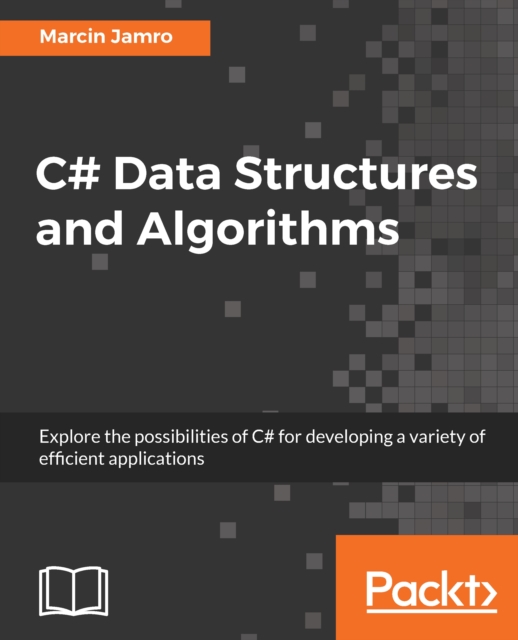
C# Data Structures and Algorithms
Data structures allow organizing data efficiently. Their suitable implementation can provide a complete solution that acts like reusable code. In this book, you will learn how to use various data structures while developing in the C# language as well as how to implement some of the most common algorithms used with such data structures.
eBook

Making sense of sensors : implementing a knowledge pipeline
This book outlines the common architectures used for deriving meaningful data from sensors. In today's world we are surrounded by sensors collecting various types of data about us and our environments. These sensors are the primary input devices for wearable computers, internet-of-things, and other mobile devices. This book provides the reader with the tools to understand how sensor data is converted into actionable knowledge and provides tips for in-depth work in this field. The information is presented in way that allows readers to associate the examples with their daily lives for better understanding of the concepts. Making Sense of Sensors starts with an overview of the general pipeline to extract meaningful data from sensors. It then dives deeper into some commonly used sensors and algorithms designed for knowledge extraction. Practical examples and pointers to more information are used to outline the key aspects of Multimodal recognition. The book concludes with a discussion on relationship extraction, knowledge representation, and management. .
Book

Teaching Practice of Data Structure Based On WeChat Platform
With the development of the mobile communication network, mobile learning is becoming a hot spot in the world. According to the idea of system engineering, this paper describes the teaching design process based on WeChat, which is divided into three parts, i.e. teaching preparation, teaching implementation and teaching evaluation. It also elaborates on the specific activities of each stage. The result shows that teaching activities based on the WeChat platform can promote students’ learning and have certain practical significance.
Journal Article