
Catalogue Search | MBRL


Are you sure you want to remove the book from the shelf?

{{itemTitle}}
73
result(s) for
"Dead Folklore."
Sort by:

Zombies : an anthropological investigation of the living dead
\"Forensic pathologist Philippe Charlier - dubbed the \"Indiana Jones of the graveyards\" - travels to Haiti where rumors claim that some who die may return to life as zombies. Charlier investigates these far-fetched stories and finds that, in Haiti, the dead are a part of daily life. Families, fearing that loved ones may return from the grave, urge pallbearers to take rambling routes to prevent the recently departed from finding their way home from cemeteries. Corpses are sometimes killed a second time...just to be safe. And a person might spend their life preparing their funeral and grave to ensure they will not become a wandering soul after death...Zombies follows Charlier's journey to understand the fascinating and frightening world of Haiti's living dead, inviting readers to believe the unbelievable\"-- Back cover.
Book
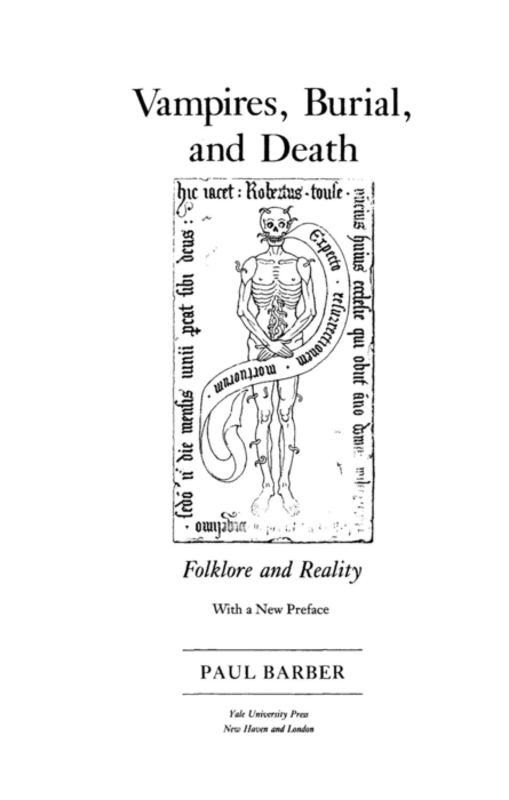
Vampires, Burial, and Death
In this engrossing book, Paul Barber surveys centuries of folklore about vampires and offers the first scientific explanation for the origins of the vampire legends. From the tale of a sixteenth-century shoemaker from Breslau whose ghost terrorized everyone in the city, to the testimony of a doctor who presided over the exhumation and dissection of a graveyard full of Serbian vampires, his book is fascinating reading.
eBook


Vampires, Burial, and Death
In this engrossing book, Paul Barber surveys centuries of folklore about vampires and offers the first scientific explanation for the origins of the vampire legends. From the tale of a sixteenth-century shoemaker from Breslau whose ghost terrorized everyone in the city, to the testimony of a doctor who presided over the exhumation and dissection of a graveyard full of Serbian vampires, his book is fascinating reading.\"This study's comprehensiveness and the author's bone-dry wit make this compelling reading, not just for folklorists, but for anyone interested in a time when the dead wouldn't stay dead.\"-Booklist\"Barber's inquiry into vampires, fact and fiction, is a gem in the literature of debunking… [and] a convincing exercise in mental archaeology.\"-Roy Porter,Nature\"A splendid book about the undead, illuminated by the findings of morbid anatomy…. The main value of this most interesting book is to remind us how far we have come in our ability to explain the world and how this has released us from at least some terrors.\"-Anthony Daniels,Spectator\"This book is fascinating reading for physicians and anthropologists as well as anyone interested in folklore.\"-R. Ted Steinbock, M.D.,Journal of the American Medical Association\"A fascinating and pain-staking (sorry!) thesis, which welds together folklore, epidemic panic, communal stupidity, and forensic and funereal science.\"-Huw Knight,New Scientist
eBook
Obon Festival
\"Second in importance only to New Year's Day, Obon (also Bon or Urabon), is an important annual event in Japan, marking the Buddhist ritual for the dead.\" (CHILDREN'S WORLD) Learn how and when Obon is celebrated in Japan. The tradition of Obon is discussed.
Magazine Article
The dominion of the dead
How do the living maintain relations to the dead? Why do we bury people when they die? And what is at stake when we do? In The Dominion of the Dead, Robert Pogue Harrison considers the supreme importance of these questions to Western civilization, exploring the many places where the dead cohabit the world of the living—the graves, images, literature, architecture, and monuments that house the dead in their afterlife among us. This elegantly conceived work devotes particular attention to the practice of burial. Harrison contends that we bury our dead to humanize the lands where we build our present and imagine our future. As long as the dead are interred in graves and tombs, they never truly depart from this world, but remain, if only symbolically, among the living. Spanning a broad range of examples, from the graves of our first human ancestors to the empty tomb of the Gospels to the Vietnam Veterans Memorial, Harrison also considers the authority of predecessors in both modern and premodern societies. Through inspired readings of major writers and thinkers such as Vico, Virgil, Dante, Pater, Nietzsche, Heidegger, and Rilke, he argues that the buried dead form an essential foundation where future generations can retrieve their past, while burial grounds provide an important bedrock where past generations can preserve their legacy for the unborn. The Dominion of the Dead is a profound meditation on how the thought of death shapes the communion of the living. A work of enormous scope, intellect, and imagination, this book will speak to all who have suffered grief and loss.
eBook

Communication with the Deceased in Dreams: Overcoming the Boundary between This World and the Otherworld or Its Conceptualization Strategy?
Starting from the concept of death in contemporary Serbian culture (in the context of thanatological and anthropological studies), the author focuses on the analysis of communication with the deceased in dreams, which is still perceived as an important form of contact with the otherworldly. The analysis of material collected during field research at various locations in Serbia and in Serbian communities in Romania (from 2017 to 2024), supplemented by dream narratives from the internet, has shown that based on the main messages conveyed by the deceased to the living, dreams can be divided into: (1) dreams about “the unappeased deceased” (who lack something in the otherworld, usually due to an omission by the living related to funerary rituals); (2) dreams in which the deceased show the otherworld and provide verbal assessments of it; (3) dreams in which the deceased inform of their departure or final passing into the world of the dead; (4) dreams in which the deceased demonstrate their presence in the world of the living, i.e., providing information pertaining to the sphere of the dreamer’s social reality; (5) dreams in which the deceased convey their messages, advice or warnings to the living; and (6) dreams interpreted as the deceased person’s call to the dreamer to join them in the otherworld. Basic element analysis of the spatial world image, projected via the dream, highlights the importance of the locus perceived as a border space. Dreams about the deceased seem to be ambivalent in this respect, given that, on the one hand, they are perceived as an important means of communication between this world and the otherworld, and on the other hand, through the ideas on which they are founded and that they further transmit, they are also part of the narrative strategies of the boundary between this concept of two worlds.
Journal Article

Restless dead
During the archaic and classical periods, Greek ideas about the dead evolved in response to changing social and cultural conditions—most notably changes associated with the development of the polis, such as funerary legislation, and changes due to increased contacts with cultures of the ancient Near East. In Restless Dead, Sarah Iles Johnston presents and interprets these changes, using them to build a complex picture of the way in which the society of the dead reflected that of the living, expressing and defusing its tensions, reiterating its values and eventually becoming a source of significant power for those who knew how to control it. She draws on both well-known sources, such as Athenian tragedies, and newer texts, such as the Derveni Papyrus and a recently published lex sacra from Selinous. Topics of focus include the origin of the goes (the ritual practitioner who made interaction with the dead his specialty), the threat to the living presented by the ghosts of those who died dishonorably or prematurely, the development of Hecate into a mistress of ghosts and its connection to female rites of transition, and the complex nature of the Erinyes. Restless Dead culminates with a new reading of Aeschylus' Oresteia that emphasizes how Athenian myth and cult manipulated ideas about the dead to serve political and social ends.
eBook
The Living and the Dead in Slavic Folk Culture: Modes of Interaction between Two Worlds
Slavic folk culture is a fusion of Christian and of pre-Christian, pagan beliefs based on magic. This article is devoted specifically to ancient pre-Christian ideas about death and posthumous existence and the associated magical rituals and prohibitions, which persist to our time. It considers the following interactions between the living and the dead: 1. the measures taken and prohibitions observed by the living to ensure their well-being in the other world; 2. the measures taken by the living to ensure the well-being of their dead relatives in the other world (including funeral rites; memorial rites; cemetery visits; providing the dead with food, clothes, and items necessary for postmortem life; and sending messages to the other world); 3. communication between the living and the dead on certain days (including taking opportunities to meet, see, and hear them; treat them; prepare a bed for them; and wash them); 4. fear of the dead and their return and the desire to placate them to prevent them from causing natural disasters (hail, droughts, floods, etc.), crop failures, cattle deaths, diseases, and death; 5. magical ways for protecting oneself from the “walking dead”; 6. transforming the dead into mythological characters—for example, house-, water-, or forest-spirits and mermaids. The material presented in the article is drawn from published and archival sources collected by folklorists and ethnographers of the XIX and XX centuries in different regions of the Slavic world, as well as from field recordings made by the author and his colleagues in Polesie, the borderland of Belarus and Ukraine, in the 1960–1980s, in the Russian North and in the Carpathian region in the 1990s. It shows that the relationship between the living and the dead in folk beliefs does not fit comfortably within the widespread notion of an “ancestor cult”. It argues that the dead are both venerated and feared and that the living feel a dependence on their ancestors and a desire to strictly observe the boundary between the two worlds.
Journal Article