
Catalogue Search | MBRL


Are you sure you want to remove the book from the shelf?

{{itemTitle}}
428,621
result(s) for
"Debates"
Sort by:


Re-examining the role of population policies in climate action
With the global population surpassing eight billion in November 2022, I revisit the debate over incorporating population strategies in climate change mitigation efforts. In this perspective, I review diverse literature, questioning the efficacy of fertility choices for reducing carbon emissions and examining the moral equivalence of procreative and consumption decisions. I explore historical and contemporary debates, from Malthusian concerns tomodern neo-Malthusian and demographic revisionist views. While larger populations generally lead to higher greenhouse gas emissions, I argue that reducing population growth is insufficient as a standalone climate strategy due to demographic momentum, and because it disregards existing disparities and structural inequalities. Instead, I emphasize the need for justice-centred approaches, advocating for voluntary, rights-based family planning, women's empowerment and equitable resource access and distribution to address both population dynamics and affluent consumption patterns. My perspective calls for integrating ethical, cultural and justice considerations to balance environmental sustainability with human needs.
Journal Article


Distractor inhibition by alpha oscillations is controlled by an indirect mechanism governed by goal-relevant information
The role of alpha oscillations (8–13 Hz) in cognition is intensively investigated. While intracranial animal recordings demonstrate that alpha oscillations are associated with decreased neuronal excitability, it is been questioned whether alpha oscillations are under direct control from frontoparietal areas to suppress visual distractors. We here point to a revised mechanism in which alpha oscillations are controlled by an indirect mechanism governed by the load of goal-relevant information – a view compatible with perceptual load theory. We will outline how this framework can be further tested and discuss the consequences for network dynamics and resource allocation in the working brain.
Journal Article

Arguing with people
Arguing with People brings developments from the field of Argumentation Theory to bear on critical thinking in a clear and accessible way. This book expands the critical thinking toolkit, and shows how those tools can be applied in the hurly-burly of everyday arguing. Gilbert emphasizes the importance of understanding real arguments, understanding just who you are arguing with, and knowing how to use that information for successful argumentation. Interesting examples and partner exercises are provided to demonstrate tangible ways in which the book's lessons can be applied.--Amazon.com.
Book

Repensar los conflictos desde su dimensión transformadora. Entrevista a Patrice Melé
Entrevista realizada luego de la visita de la Dra. Claudia Cirelli y el Dr. Patrice Melé al Centro de Investigaciones Geográficas, IdIHCS (UNLP-CONICET)
Journal Article
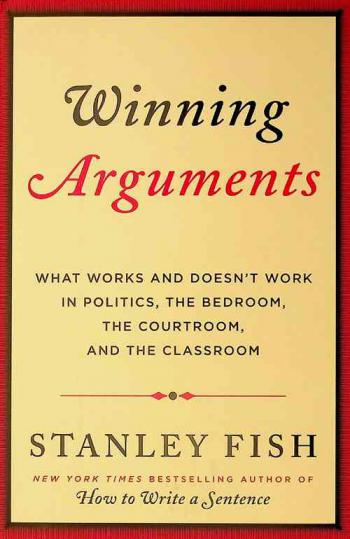
Winning arguments : what works and doesn't work in politics, the bedroom, the courtroom, and the classroom
\"Stanley Fish, the notoriously brash and brilliant English and Law professor, has authored dozens of academic books on subjects ranging from Milton to freedom of speech. In 2011, Fish turned his eye to a more popular subject, the art of writing great sentences. His short, wise book How to Write a Sentence became an instant New York Times Bestseller and continues to be read by students and aspiring writers. Adam Haslet called the book, \"deeper and more democratic than The Elements of Style.\" If great sentences are, in effect, performances at the highest level, Fish acts as a lively sportscaster giving the reader a blow-by-blow. In Winning Arguments, Fish employs this same wit and observational prowess as he guides readers through the \"greatest hits\" of rhetoric including landmark legal cases, arguments drawn from popular film and TV, and even Fish's own career. The success of books like Jay Heinrich's Thank You For Arguing demonstrate a clear audience for fun, intellectually nourishing books that make you feel just a little bit smarter for having read them. Like How to Write a Sentence, Winning Arguments will become a modern classic\"-- Provided by publisher.
Book
