
Catalogue Search | MBRL


Are you sure you want to remove the book from the shelf?

{{itemTitle}}
56,909
result(s) for
"Decentralization"
Sort by:

88 Advancing clinical research accessibility: the role of decentralised trials at NIHR GOSH clinical research facility
Advancing clinical research accessibility is at the core of NIHR Great Ormond Street Hospital (GOSH) Clinical Research Facility (CRF)’s strategic priorities. However, traditional research methodologies and models often create significant barriers to patient engagement and participation. In response to this challenge, our CRF has embraced decentralised clinical trials (DCT) model to break down these barriers and enhance equitable access to research.Some or all trial activities in a DCT not only occur at locations other than sites but also by non-site providers or instruments such as homecare nurses, telephone visits, wearable technology devices, and participants themselves. Using DCT model, NIHR-GOSH-CRF have successfully increased patient access, reach, and diversity, thereby minimising inequality, and fostered inclusivity in research participation. By decentralising trial activities, we have alleviated patient burdens associated with travel time, time off work and/or school or college, and logistical challenges, making participation more feasible and convenient for both patients and our site.Moreover, this model has enabled our CRF teams to optimise their time, allowing them to concentrate on critical patient interactions and enhancing the overall quality of care provided during the research process. For example, GOSHLink facilitated remote independent trials monitoring significantly cut staff time spent on organising and conducting monitoring visits when compared to previous processes.We continue to replicate this model within other research operation areas, such as site file maintenance and self-dosing to empower our teams, best manage resources, and improve efficiency. This positions our CRF at the forefront of promoting accessibility for the benefit of all.Abstract 88 Figure 1Acknowledgements for Funding or Support
This work is supported by the Joint R&D and NIHR GOSH CRF. The views expressed are those of the author(s) and not necessarily those of the NHS, UCL, the NIHR or the Department of Health.
Journal Article


Decentralization and District-Level Decentralization in Amhara Region
This paper examines the process of decentralization and district level decentralization programs in the Amhara region. It addresses the decentralization processes in Imperial, Derg, and EPRDF regimes. The depth and degree of decentralization in the three consecutive regimes were different as the process of decentralization in the current government meant to be deeper and extensive and pushed powers, functions, and roles into the local government. The process of decentralization in the current government has transferred powers and functions to the districts. However, the district level decentralization process has faced many challenges. The paper revealed that unclear assignments of powers and functions, executive dominations, upward accountabilities, top-down planning, lack of skilled manpower, lack participatory systems, failure of the councils in holding the executive accountable, lack of adequate budget, lack of revenue mobilization capacity, lack of responsiveness, and accountability among councils were the main challenges that impede in the process of the DLD process.
Journal Article

Made in Nunavut : an experiment in decentralized government
\"After years of dreams and negotiations, the territory of Nunavut was established in Canada's Eastern and Central Arctic on April 1, 1999. Made in Nunavut provides the first comprehensive account of the planning that led to this remarkable achievement. The authors, leading authorities on the politics of the Canadian Arctic, pay particular attention to the Government of Nunavut's innovative organizational design--especially the decentralization of offices and functions (normally located in a capital) to communities across the territory. They explain how this new government was designed and implemented, and critically assess whether decentralization has delivered \"better\" government for Nunavut.\"-- Provided by publisher.
Book

Political Transformations and Public Finances
How did today's rich states first establish modern fiscal systems? To answer this question, Political Transformations and Public Finances by Mark Dincecco examines the evolution of political regimes and public finances in Europe over the long term. The book argues that the emergence of efficient fiscal institutions was the result of two fundamental political transformations that resolved long-standing problems of fiscal fragmentation and absolutism. States gained tax force through fiscal centralization and restricted ruler power through parliamentary limits, which enabled them to gather large tax revenues and channel funds toward public services with positive economic benefits. Using a novel combination of descriptive, case study and statistical methods, the book pursues this argument through a systematic investigation of a new panel database that spans eleven countries and four centuries. The book's findings are significant for our understanding of economic history and have important consequences for current policy debates.
eBook


Multi-level governance
Seeks to develop understanding of the notion of multi‐level governance through a critical exploration of its definitions and applications by scholars with very different concerns within the broad discipline of Political Studies. Despite the different concerns of different authors, four common strands emerge that provide a parsimonious definition of multi‐level governance that raises clear hypotheses for future research. First, that decision‐making at various territorial levels is characterized by the increased participation of non‐state actors. Second, that the identification of discrete or nested territorial levels of decision‐making is becoming more difficult in the context of complex overlapping networks. Third, that in this changing context, the role of the state is being transformed as state actors develop new strategies of coordination, steering and networking that may protect and, in some cases, enhance state autonomy. Fourth, that in this changing context, the nature of democratic accountability has been challenged and need to be rethought or at least reviewed. The book concludes that future research on multi‐level governance should pay particular attention to the implications for democracy of empirical developments and, related to this, to the design of frameworks of accountability that adopt a positive‐sum gain in relation to the accountability versus efficiency debate.
eBook

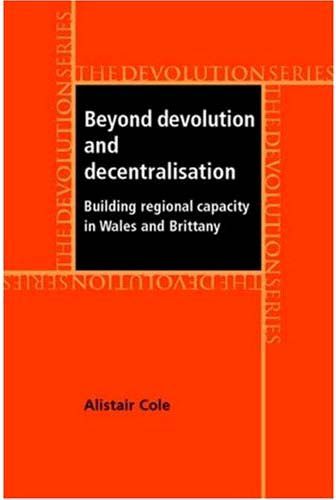
Beyond devolution and decentralisation
Beyond devolution and decentralisation compares the politics, policies and polity building dynamics of devolution in Wales and decentralisation in the French region of Brittany. It develops a general frmaework for understanding regional capacity building.
eBook