
Catalogue Search | MBRL


Are you sure you want to remove the book from the shelf?

{{itemTitle}}
999
result(s) for
"Deception Social aspects."
Sort by:

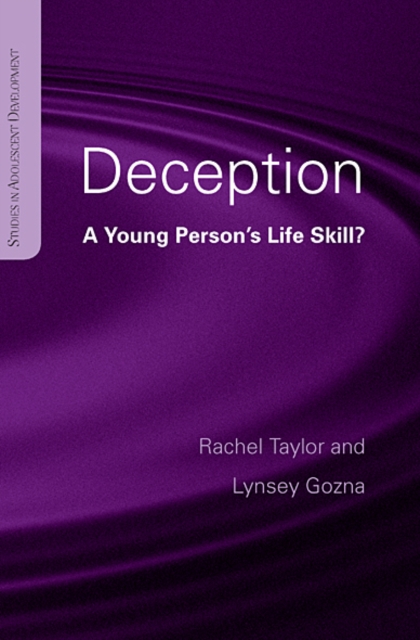
Deception
This book considers the role of deception during adolescence, and explores the factors which underpin adolescents’ choice to deceive, whether these deceptions will be successful, and the ways in which such lies could be detected. While deception is considered to be antisocial or even pathological in some circumstances, the central argument of this book is that lying can be a skilled behaviour which is necessary to allow adolescents to establish autonomy.
Deception builds on the recent influential developmental challenge model (Hendry and Kloep, 2002, 2009), exploring how it can provide a useful explanatory framework for the development of the skill of deception in adolescence. Interpersonal and forensic settings for deceptive behaviour are referred to, and illustrated with reference to both published research and new data obtained from a variety of different interviews and focus groups with young people. It also considers how the choice to communicate truthfully is as important as the choice to communicate deceptively in illuminating the developmental process. It concludes with a discussion of how adolescents’ deceptions could be detected and presents a range of strategies to maximize the effectiveness of interpersonal interactions with suspected deceivers.
By considering everyday, forensic and clinical deception situations, this book is ideal for academic researchers, practitioners working with children and young people, as well as parents. The observations, interviews and focus groups provide a unique insight into the factors influencing young people’s communication choices, and integrate research from developmental, social and forensic psychology.
\"This book accessibly describes the theory and evidence related to strategic deception and its detection in adolescence. The developmental issues covered give it cross-disciplinary appeal, and pointers on deception detection are invaluable to practitioners in forensic and educational psychology, and insightful for students of psychology and the behavioural sciences.\" - Bere Mahoney, Senior Lecturer in Psychological Sciences, University of Worcester UK
\"This groundbreaking book positions deceptive communication as a developmental life skill. Moving beyond simple understandings and utilizing a systems approach, the authors consider deception as embedded within social contexts. It will be required reading for practitioners, researchers and students to understand adolescent deceptive behaviour in both clinical and non-clinical contexts.\" - Angie Williams, Centre for Language and Communication Research , Cardiff University UK
1. The Development of Deceptive Communication 2. Factors Influencing Adolescent Communication 3. Deceptive Interactions and Communications 4. Strategies and Tactics in Interpersonal Interaction 5. Challenges of Conduct and Personality 6. Techniques in Detecting Deceit 7. Conclusions, Thoughts and Future Directions
Rachel Taylor is a Senior Lecturer in Social Psychology at University of Glamorgan with a strong background in deception research, and has presented and published internationally on a range of factors influencing deceptive communication.
Lynsey Gozna is a Senior Lecturer in Forensic Psychology at University of Lincoln, with research interests focusing on interviewing in pre and post-conviction forensic and mental health settings.
eBook


The folly of fools : the logic of deceit and self-deception in human life
Whether it's in a cockpit at takeoff or the planning of an offensive war, a romantic relationship or a dispute at the office, there are many opportunities to lie and self-deceive-but deceit and self-deception carry the costs of being alienated from reality and can lead to disaster. So why does deception play such a prominent role in our everyday lives? In short, why do we deceive? In his bold new work, prominent biological theorist Robert Trivers unflinchingly argues that self-deception evolved in the service of deceit-the better to fool others. We do it for biological reasons-in order to help us survive and procreate. From viruses mimicking host behavior to humans misremembering (sometimes intentionally) the details of a quarrel, science has proven that the deceptive one can always outwit the masses. But we undertake this deception at our own peril. Trivers has written an ambitious investigation into the evolutionary logic of lying and the costs of leaving it unchecked.
eBook


Deceit on the Road to War
In Deceit on the Road to War , John M. Schuessler
examines how U.S. presidents have deceived the American public
about fundamental decisions of war and peace. Deception has been
deliberate, he suggests, as presidents have sought to shift blame
for war onto others in some cases and oversell its benefits in
others. Such deceit is a natural outgrowth of the democratic
process, in Schuessler's view, because elected leaders have
powerful incentives to maximize domestic support for war and retain
considerable ability to manipulate domestic audiences. They can
exploit information and propaganda advantages to frame issues in
misleading ways, cherry-pick supporting evidence, suppress damaging
revelations, and otherwise skew the public debate to their benefit.
These tactics are particularly effective before the outbreak of
war, when the information gap between leaders and the public is
greatest.
When resorting to deception, leaders take a calculated risk that
the outcome of war will be favorable, expecting the public to adopt
a forgiving attitude after victory is secured. The three cases
featured in the book-Franklin Roosevelt and World War II, Lyndon
Johnson and the Vietnam War, and George W. Bush and the Iraq
War-test these claims. Schuessler concludes that democracies are
not as constrained in their ability to go to war as we might
believe and that deception cannot be ruled out in all cases as
contrary to the national interest.
In Deceit on the Road to War , John M. Schuessler
examines how U.S. presidents have deceived the American public
about fundamental decisions of war and peace. Deception has been
deliberate, he suggests, as presidents have sought to shift blame
for war onto others in some cases and oversell its benefits in
others. Such deceit is a natural outgrowth of the democratic
process, in Schuessler's view, because elected leaders have
powerful incentives to maximize domestic support for war and retain
considerable ability to manipulate domestic audiences. They can
exploit information and propaganda advantages to frame issues in
misleading ways, cherry-pick supporting evidence, suppress damaging
revelations, and otherwise skew the public debate to their benefit.
These tactics are particularly effective before the outbreak of
war, when the information gap between leaders and the public is
greatest.When resorting to deception, leaders take a calculated
risk that the outcome of war will be favorable, expecting the
public to adopt a forgiving attitude after victory is secured. The
three cases featured in the book-Franklin Roosevelt and World War
II, Lyndon Johnson and the Vietnam War, and George W. Bush and the
Iraq War-test these claims. Schuessler concludes that democracies
are not as constrained in their ability to go to war as we might
believe and that deception cannot be ruled out in all cases as
contrary to the national interest.
eBook

Gaslighting America : why we love it when Trump lies to us
\"'Can you believe what Donald Trump said?' In [this book], Carpenter breaks down Trump's formula, showing why it's practically foolproof, playing his victims, the media, the Democrats, and the Republican fence-sitters perfectly. She traces how this tactic started with Nixon, gained traction with Bill Clinton, and exploded under Trump ... Where some people see lies, Trump's fierce followers see something different. A commitment to winning at all costs; there is nothing he could say that would erode their support at long as it's in the name of taking down his political enemies\"--Provided by publisher.
BOOK

The anti-vaccination infodemic on social media: A behavioral analysis
Vaccinations are without doubt one of the greatest achievements of modern medicine, and there is hope that they can constitute a solution to halt the ongoing COVID-19 pandemic. However, the anti-vaccination movement is currently on the rise, spreading online misinformation about vaccine safety and causing a worrying reduction in vaccination rates worldwide. In this historical time, it is imperative to understand the reasons of vaccine hesitancy, and to find effective strategies to dismantle the rhetoric of anti-vaccination supporters. For this reason, we analyzed the behavior of anti-vaccination supporters on the platform Twitter. Here we identify that anti-vaccination supporters, in comparison with pro-vaccination supporters, share conspiracy theories and make use of emotional language. We demonstrate that anti-vaccination supporters are more engaged in discussions on Twitter and share their contents from a pull of strong influencers. We show that the movement’s success relies on a strong sense of community, based on the contents produced by a small fraction of profiles, with the community at large serving as a sounding board for anti-vaccination discourse to circulate online. Our data demonstrate that Donald Trump, before his profile was suspended, was the main driver of vaccine misinformation on Twitter. Based on these results, we welcome policies that aim at halting the circulation of false information about vaccines by targeting the anti-vaccination community on Twitter. Based on our data, we also propose solutions to improve the communication strategy of health organizations and build a community of engaged influencers that support the dissemination of scientific insights, including issues related to vaccines and their safety.
Journal Article

Understanding the Reasons, Contexts and Costs of Camouflaging for Autistic Adults
Camouflaging entails ‘masking’ in or ‘passing’ social situations. Research suggests camouflaging behaviours are common in autistic people, and may negatively impact mental health. To enhance understanding of camouflaging, this study examined reasons, contexts and costs of camouflaging. 262 autistic people completed measures of camouflaging behaviours, camouflaging contexts (e.g. work vs. family), camouflaging reasons (e.g. to make friends) and mental health symptoms. Findings indicated a gender difference in reasons for camouflaging, with autistic women more likely to endorse “conventional” reasons (e.g. getting by in formal settings such as work). Both camouflaging highly across contexts and ‘switching’ between camouflaging in some contexts but not in others, related to poorer mental health. These findings have implications for understanding camouflaging in autistic adults.
Journal Article
Mitigating infodemics: The relationship between news exposure and trust and belief in COVID-19 fake news and social media spreading
Misinformation surrounding COVID-19 poses a global public health problem that adversely affects governments' abilities to mitigate the disease and causes accidental deaths and self-harm due to false beliefs about the virus, prevention measures, vaccines and cures. We aim to examine the relationship between exposure to and trust in COVID-19 news (from Television, social media, interpersonal communication) and information sources (healthcare experts, government, clerics) and belief in COVID-19 myths and false information, as well as critical verification practices before posting on social media. We use a cross-sectional researcher-administered phone survey of adults living in Lebanon between March 27 and April 23, 2020. The sample included 56.1% men and 43.9% women, 37.9% with a university degree, 63.0% older than 30, and 7% with media literacy training. Those who trust COVID-19 news from social media [95%CI:(1.05-1.52)] and interpersonal communication [95%CI:(1.25-1.82)], and those who trust information from clerics [95%CI:(1.25-1.82)] were more likely to believe in COVID-19 myths and false information. University graduates [95%CI:(0.25-0.51)] and those who trust information from government [95%CI:(0.65-0.89] were less likely to believe in myths and false information. Those who believe in COVID-19 myths and false information [95%CI:(0.25-0.70)] were less likely to engage in critical social media posting practices. Only those who underwent media literacy training [95%CI:(1.24-6.55)] were more likely to engage in critical social media posting practices. Higher education and trust in information from government contributed to decreasing belief in COVID-19 myths and false information. Trust in news from social media, interpersonal communication and clerics contributed to increasing belief in COVID-19 myths and false information, which in turn contributed to less critical social media posting practices, thereby exacerbated the infodemic. Media literacy training contributed to increasing critical social media posting practices, thereby played a role in mitigating the infodemic.
Journal Article