
Catalogue Search | MBRL


Are you sure you want to remove the book from the shelf?

{{itemTitle}}
927
result(s) for
"Decision making Moral and ethical aspects."
Sort by:

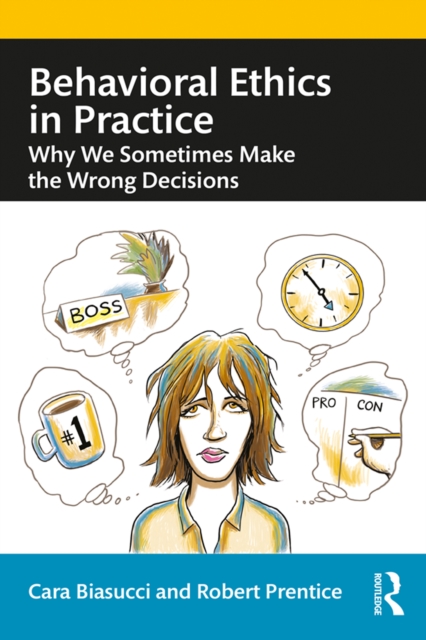
Behavioral Ethics in Practice
This book is an accessible, research-based introduction to behavioral ethics. Often ethics education is incomplete because it ignores how and why people make moral decisions. But using exciting new research from fields such as behavioral psychology, cognitive science, and evolutionary biology, the study of behavioral ethics uncovers the common reasons why good people often screw up.
Scientists have long studied the ways human beings make decisions, but only recently have researchers begun to focus specifically on ethical decision making. Unlike philosophy and religion, which aim to tell people how to think and act about various moral issues, behavioral ethics research reveals the factors that influence how people really make moral decisions. Most people get into ethical trouble for doing obviously wrong things. Aristotle cannot help, but learning about behavioral ethics can. By supplementing traditional approaches to teaching ethics with a clear, detailed, research-based introduction to behavioral ethics, beginners can quickly become familiar with the important elements of this new field. This book includes the bonus of being coordinated with Ethics Unwrapped - a free, online, educational resource featuring award-winning videos and teaching materials on a variety of behavioral ethics (and general ethics) topics.
This book is a useful supplement for virtually every ethics course, and important in any course where incorporating practical ethics in an engaging manner is paramount. The content applies to every discipline - journalism, business ethics, medicine, legal ethics, and others - because its chief subject is the nature of moral decision making. Because the book is research-based yet accessibly written with interesting studies, it could be used in high schools, colleges, graduate schools, and industry.
eBook

Satisficing and Maximizing
How do we think about what we plan to do? One dominant answer is that we select the best possible option available. However, a growing number of philosophers would offer a different answer: since we are not equipped to maximize we often choose the next best alternative, one that is no more than satisfactory. This strategy choice is called satisficing (a term coined by the economist Herb Simon). This collection of essays explores both these accounts of practical reason, examining the consequences for adopting one or the other for moral theory in general and the theory of practical rationality in particular. It aims to address a constituency larger than contemporary moral philosophers and bring these questions to the attention of those interested in the applications of decision theory in economics, psychology and political science.
eBook

Catastrophe ethics : how to choose well in a world of tough choices
\"A warm, personal guide to building a strong ethical and moral compass in the midst of today's confusing, scary, global problems. The moral challenges of today are unfamiliar in the history of philosophy. Climate change is the paradigm example of what Travis Rieder calls \"The Puzzle\" in the way your choices can seem at odds with what the planet urgently needs. How do we decide the right thing to do in the face of a massive collective challenge? Should you drink water from a plastic bottle or not? Drive a Tesla? Or is that just what Elon and all the other corporations want you to think? What makes individual ethics difficult to think about in the case of catastrophic climate change makes ethics difficult to think about in many other contexts as well. The Puzzle, as he explains, is everywhere now. The chapters include a lively, meaningful tour of traditional moral reasoning looking at the contributions of Plato, Hegel, and Kant among others. But they could not grasp The Puzzle we now face. Old fashioned exercises like trolley problems involving sacrificing one person on this track for a bunch of people on the other don't address the huge consequential and complex crises our global community faces today. The tools most of us unthinkingly rely on when we try to do the right thing don't help when it comes to reasoning about individual responsibility for large collective problems. Expanding our suite of ethical concepts is now urgently required. Rieder defines exactly how to change our thinking, addressing mundane issues like bottled water to the biggies like whether to have children. This is a way to live a morally decent life in the scary, always complicated world we and our children live in. It's how to build your own Catastrophe Ethics\"-- Provided by publisher.
Book
Obstacles to Ethical Decision-Making
In commerce, many moral failures are due to narrow mindsets that preclude taking into account the moral dimensions of a decision or action. In turn, sometimes these mindsets are caused by failing to question managerial decisions from a moral point of view, because of a perceived authority of management. In the 1960s, Stanley Milgram conducted controversial experiments to investigate just how far obedience to an authority figure could subvert his subjects' moral beliefs. In this thought-provoking work, the authors examine the prevalence of narrow mental models and the phenomenon of obedience to an authority to analyse and understand the challenges which business professionals encounter in making ethical decisions. Obstacles to Ethical Decision-Making proposes processes - including collaborative input and critique - by which individuals may reduce or overcome these challenges. It provides decision-makers at all levels in an organisation with the means to place ethical considerations at the heart of managerial decision-making.
eBook
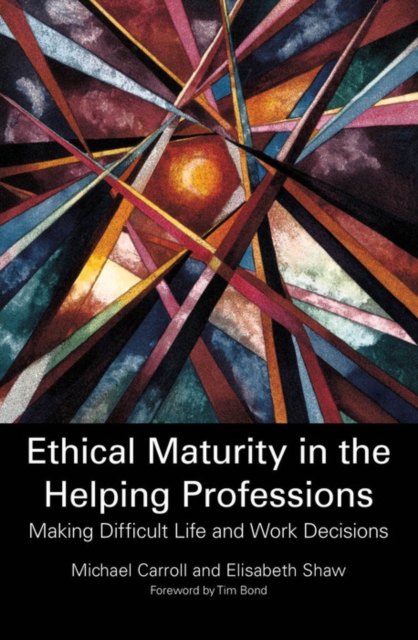
Ethical Maturity in the Helping Professions
How do we, as humans, arrive at what we call morally or ethically good or bad decisions? What processes are involved in making ethical decisions? Is there a way to move towards ethical maturity and how will being ethically mature assist us with any future decisions we might make? Ethical Maturity in the Helping Professions provides a comprehensive overview of the most influential ideas in ethical thinking across the ages and considers the ethical challenges faced in various contexts of educational, research, business and organisational sectors. The book reflects on the history, philosophy and science of ethics through an interdisciplinary approach and encourages the reader to consider their own ethical decision-making and the influences which play a role in shaping them. The authors also introduce a brand new model for becoming an ethically mature professional. This book is essential reading for practising and student psychotherapists, psychologists, counsellors, psychiatrists, social workers, nurses, health care and allied professionals.
eBook


Ethics and Climate Change
Faced with the prospect of global warming, the anticipated rapid rise in global air temperatures due to the release of gases into the atmosphere, we have two choices of how to respond: adaptation or avoidance. With adaptation we keep burning fossil fuels, let global temperatures rise and make whatever changes this requires: move people from environmentally damaged areas, build sea walls, etc. With avoidance we stop warming from occurring, either by reducing our use of fossil fuels or by using technology such as carbon dioxide recovery after combustion to block the warming effect. Yet each strategy has its drawbacks—adaptation may not be able to occur fast enough to accommodate the expected temperature increases, but avoidance would be prohibitively expensive. An ethically acceptable goal must involve some mixture of adaptation and avoidance.
Written by a team of scientists, social scientists, humanists, legal and environmental scholars and corporate researchers, this book offers an ethical analysis of possible responses to the problem. Their analyses of the scientific and technological data and the ethical principles involved in determining whose interests should be considered point to a combination of adaptation and avoidance of greenhouse gas production. They offer assessments of personal, corporate, government and international responsibility and a series of recommendations to aid decision-makers in determining solutions and apportioning responsibility.
eBook