
Catalogue Search | MBRL


Are you sure you want to remove the book from the shelf?

{{itemTitle}}
34,374
result(s) for
"Decision making process"
Sort by:

Decision‐Making Preferences in Times of Crisis
During crises, understanding political decision-making processes and evaluating related preferences are key to the legitimacy of political decisions. Our research focuses on preferences in decision-making processes in times of crisis through the analysis of the representational style most preferred by voters: that is, whether they prefer representation of the public good by the representatives, the party lines, the involvement of experts, or the incorporation of voters’ interests. Within the framework of representative democracy, these decisions are mediated by representatives whose representational style determines whose interest and opinion decision-making processes integrate. In our analysis, we examined representative styles in the context of three different types of crises: economic, social, and environmental. Our results indicate that the type of crisis is indifferent when it comes to preferred political decision-making processes, as Hungarian voters tend to favor processes where they are being consulted by the representatives across different scenarios. Representatives’ commitment to party lines is disfavored when making political decisions and we observed there is no clear preference regarding the involvement of experts in political decisions in times of crisis. These observed preferences strongly contradict the prevailing “strong party discipline” in Hungary. This deviation accentuates both weakening representative linkages and the importance of the performative elements of representation feeding into the populist characteristic of Hungarian democracy.
Journal Article


Building the Electromagnetic Situation Awareness in MANET Cognitive Radio Networks for Urban Areas
This paper presents a solution for building awareness of the electromagnetic situation in cognitive mobile ad hoc networks (MANET) using the cooperative spectrum sensing method. Signal detection is performed using energy detectors with noise level estimation. Based on the evidence theory, the fusion center decides on the particular channel occupancy, which can process incomplete and unambiguous input data. Next, a reinforced machine learning algorithm estimates the usefulness of particular channels for the MANET transmission and creates backup channels list that could be used in case of interferences. Initial simulations were performed using the MATLAB environment, and next an OMNET-based MAENA high fidelity simulator was used. Performed simulations showed a significant increase in sensing efficiency compared to sensing performed using simple data fusion rules.
Journal Article


The Policies of Provision of Assistive and Welfare Technology—A Literature Review
Background: Due to the increasing ageing population worldwide, humanity is facing global demographic challenges. For many people, their later years are often lived with changed functioning and the need for support in daily living activities. Assistive technology and welfare technology (AT/WT) constitute a partial solution to the demographic challenges. Objectives: The purpose of this literature review is to identify the policy features, such as decision models and guidance for the provision of AT/WT as reported in the current scientific literature. Methods: A literature review with a deductive approach using the structure of the Global Cooperation on Assistive Technology (GATE) model was conducted. The data were searched from the databases: PubMed, Cinahl Plus, and the Web of Science, resulting in nine included articles. Results: The findings are presented according to the structure of the eight domains from the GATE model— policy, assessment, procurement, technology, environment, usability, sustainability and rights— which are further grouped into categories exploring the variations in every domain. Conclusion: The review reveals a nascent and growing interest in the area; however, evidence-based decision models and other guidance on AT/WT are lacking. Recent scholarships and policy reforms can form the basis of stronger guidance to organise complex AT/WT systems, but further and future research is needed.
Journal Article

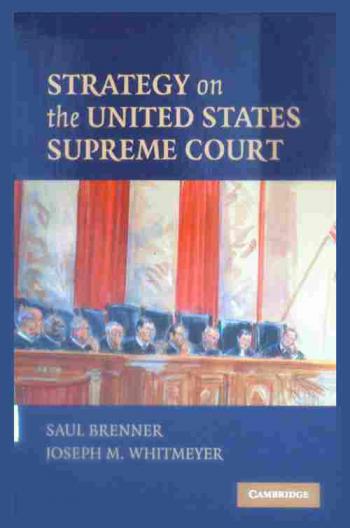
Decision making by the modern Supreme Court
\"There are three general models of Supreme Court decision making: the legal model, the attitudinal model and the strategic model. But each is somewhat incomplete. This book advances an integrated model of Supreme Court decision making that incorporates variables from each of the three models. In examining the modern Supreme Court, since Brown v. Board of Education, the book argues that decisions are a function of the sincere preferences of the justices, the nature of precedent, and the development of the particular issue, as well as separation of powers and the potential constraints posed by the president and Congress. To test this model, the authors examine all full, signed civil liberties and economic cases decisions in the 1953-2000 period. Decision Making by the Modern Supreme Court argues, and the results confirm, that judicial decision making is more nuanced than the attitudinal or legal models have argued in the past\"--Provided by publisher.
BOOK

A novel machine learning‐based web application for field identification of infectious and inflammatory disorders of the central nervous system in cattle
Background Central nervous system (CNS) infections in cattle are a major cause of economic loss and mortality. Machine learning (ML) techniques are gaining widespread application in solving predictive tasks in both human and veterinary medicine. Objectives Our primary aim was to develop and compare ML models that could predict the likelihood of a CNS disorder of infectious or inflammatory origin in neurologically‐impaired cattle. Our secondary aim was to create a user‐friendly web application based on the ML model for the diagnosis of infection and inflammation of the CNS. Animals Ninety‐eight cattle with CNS infection and 86 with CNS disorders of other origin. Methods Retrospective observational study. Six different ML methods (logistic regression [LR]; support vector machine [SVM]; random forest [RF]; multilayer perceptron [MLP]; K‐nearest neighbors [KNN]; gradient boosting [GB]) were compared for their ability to predict whether an infectious or inflammatory disease was present based on demographics, neurological examination findings, and cerebrospinal fluid (CSF) analysis. Results All 6 methods had high prediction accuracy (≥80%). The accuracy of the LR model was significantly higher (0.843 ± 0.005; receiver operating characteristic [ROC] curve 0.907±0.005) than the other models and was selected for implementation in a web application. Conclusion and Clinical Importance Our findings support the use of ML algorithms as promising tools for veterinarians to improve diagnosis. The open‐access web application may aid clinicians in achieving correct diagnosis of infectious and inflammatory neurological disorders in livestock, with the added benefit of promoting appropriate use of antimicrobials.
Journal Article


Decision-Making Processes of Renewable Energy Consumers Compared to Other Categories of Ecological Products
In the scientific discourse on consumption, increasingly more attention is being paid to sustainable development. Regarding the fact that not only various types of enterprises, but also consumers contribute to the excessive consumption of natural resources, it is of crucial importance to reduce the knowledge gap in the field of sustainable consumer behavior and decision-making processes related to the choice of organic products. The paper aims to present the decision-making processes of Polish consumers of renewable energy against the background of other categories of ecological products. Special attention is paid to the extent in which the offer is adjusted to the needs of consumers of renewable energy in Poland, compared to other categories of ecological products. The paper also shows the perception of the consumer of ecological products by buyers of renewable energy and by people who do not buy ecological products. The paper is based on a literature review and the results of a quantitative empirical study. The quantitative research was performed on a nationwide sample of 1032 people, among whom 509 people bought an organic product in the last 3 months, and 523 people did not purchase such a product during this period. The analysis of the results allows us to conclude that in the case of renewable energy, factors such as price, quality and the producer’s certification play a crucial role in the decision-making processes of Polish consumers. The hierarchy of criteria considered in the decision-making process related to the purchase of renewable energy and equipment enabling the use of renewable energy sources is quite similar to the one observed when purchasing electric cars. At the same time, it should be noted that almost every second person purchasing renewable energy compares many offers and spends a relatively long time contemplating their choice.
Journal Article