
Catalogue Search | MBRL


Are you sure you want to remove the book from the shelf?

{{itemTitle}}
21,632
result(s) for
"Decision making. Choice"
Sort by:

Willful : how we choose what we do
A revelatory alternative to the standard economic models of human behavior that proposes an exciting new way to understand decision-making. Why do we do the things we do? The classical view of economics is that we are rational individuals, making decisions with the intention of maximizing our preferences. Behaviorists, on the other hand, see us as relying on mental shortcuts and conforming to preexisting biases. Richard Robb argues that neither explanation accounts for those things that we do for their own sake, and without understanding these sorts of actions, our picture of decision-making is at best incomplete. Robb explains how these choices made seemingly without reason belong to a realm of behavior he identifies as \"for-itself.\" A provocative combination of philosophy and economics that offers a key to many of our quixotic choices, this groundbreaking volume provides a new way to understand everything from how we formulate our desire to work to how we manage daily interactions.
Book

Not Just for Consumers: Context Effects Are Fundamental to Decision Making
Context effects—preference changes that depend on the availability of other options—have attracted a great deal of attention among consumer researchers studying high-level decision tasks. In the experiments reported here, we showed that these effects also arise in simple perceptual-decision-making tasks. This finding casts doubt on explanations limited to consumer choice and high-level decisions, and it indicates that context effects may be amenable to a general explanation at the level of the basic decision process. We demonstrated for the first time that three important context effects from the preferential-choice literature—similarity, attraction, and compromise effects—all occurred within a single perceptual-decision task. Not only do our results challenge previous explanations for context effects proposed by consumer researchers, but they also challenge the choice rules assumed in theories of perceptual decision making.
Journal Article

Awe Expands People's Perception of Time, Alters Decision Making, and Enhances Well-Being
When do people feel as if they are rich in time? Not often, research and daily experience suggest. However, three experiments showed that participants who felt awe, relative to other emotions, felt they had more time available (Experiments 1 and 3) and were less impatient (Experiment 2). Participants who experienced awe also were more willing to volunteer their time to help other people (Experiment 2), more strongly preferred experiences over material products (Experiment 3), and experienced greater life satisfaction (Experiment 3). Mediation analyses revealed that these changes in decision making and well-being were due to awe's ability to alter the subjective experience of time. Experiences of awe bring people into the present moment, and being in the present moment underlies awe's capacity to adjust time perception, influence decisions, and make life feel more satisfying than it would otherwise.
Journal Article


Rats and Humans Can Optimally Accumulate Evidence for Decision-Making
The gradual and noisy accumulation of evidence is a fundamental component of decision-making, with noise playing a key role as the source of variability and errors. However, the origins of this noise have never been determined. We developed decision-making tasks in which sensory evidence is delivered in randomly timed pulses, and analyzed the resulting data with models that use the richly detailed information of each trial's pulse timing to distinguish between different decision-making mechanisms. This analysis allowed measurement of the magnitude of noise in the accumulator's memory, separately from noise associated with incoming sensory evidence. In our tasks, the accumulator's memory was noiseless, for both rats and humans. In contrast, the addition of new sensory evidence was the primary source of variability. We suggest our task and modeling approach as a powerful method for revealing internal properties of decision-making processes.
Journal Article

The myth of choice : personal responsibility in a world of limits
Americans are fixated on the idea of choice. Our political theory is based on the consent of the governed. Our legal system is built upon the argument that people freely make choices and bear responsibility for them. And what slogan could better express the heart of our consumer culture than \"Have it your way\"? In this book, the author poses unsettling questions about the choices we make. What if they are more constrained and limited than we like to think? If we have less free will than we realize, what are the implications for us as individuals and for our society? To uncover the answers, he taps into scholarship on topics ranging from brain science to economics, political theory to sociology. His discoveries, told through an array of news events, personal anecdotes, crime stories, and legal decisions, confirm that many factors, conscious and unconscious, limit our free will. Worse, by failing to perceive them we leave ourselves open to manipulation. But he offers useful suggestions to help us become better decision makers as individuals, and to ensure that in our laws and public policy we acknowledge the complexity of choice.
Book

Like cognitive function, decision making across the life span shows profound age-related changes
It has long been known that human cognitive function improves through young adulthood and then declines across the later life span. Here we examined how decision-making function changes across the life span by measuring risk and ambiguity attitudes in the gain and loss domains, as well as choice consistency, in an urban cohort ranging in age from 12 to 90 y. We identified several important age-related patterns in decision making under uncertainty: First, we found that healthy elders between the ages of 65 and 90 were strikingly inconsistent in their choices compared with younger subjects. Just as elders show profound declines in cognitive function, they also show profound declines in choice rationality compared with their younger peers. Second, we found that the widely documented phenomenon of ambiguity aversion is specific to the gain domain and does not occur in the loss domain, except for a slight effect in older adults. Finally, extending an earlier report by our group, we found that risk attitudes across the life span show an inverted U-shaped function; both elders and adolescents are more risk-averse than their midlife counterparts. Taken together, these characterizations of decision-making function across the life span in this urban cohort strengthen the conclusions of previous reports suggesting a profound impact of aging on cognitive function in this domain.
Journal Article
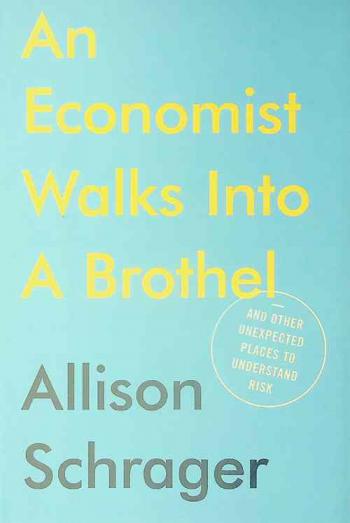
An economist walks into a brothel : and other unexpected places to understand risk
\"Is it worth swimming in shark-infested waters to surf a 50-foot, career-record wave? Is it riskier to make an action movie or a horror movie? Should sex workers forfeit 50 percent of their income for added security or take a chance and keep the extra money? Most people wouldn't expect an economist to have an answer to these questions--or to other questions of daily life, such as who to date or how early to leave for the airport. But those people haven't met Allison Schrager, an economist and award-winning journalist who has spent her career examining how people manage risk in their lives and careers. Whether we realize it or not, we all take risks large and small every day. Even the most cautious among us cannot opt out--the question is always which risks to take, not whether to take them at all. What most of us don't know is how to measure those risks and maximize the chances of getting what we want out of life. In An Economist Walks into a Brothel, Schrager equips readers with five principles for dealing with risk, principles used by some of the world's most interesting risk takers. For instance, she interviews a professional poker player about how to stay rational when the stakes are high, a paparazzo in Manhattan about how to spot different kinds of risk, horse breeders in Kentucky about how to diversify risk and minimize losses, and a war general who led troops in Iraq about how to prepare for what we don't see coming. When you start to look at risky decisions through Schrager's new framework, you can increase the upside to any situation and better mitigate the downsides\"-- Provided by publisher.

Changes of mind in decision-making
Decisions, decisions
How do we change our minds? Theoretical neuroscientists have developed plausible models for how the brain comes to a decision based on 'noisy' and often ambiguous information, but these assume that once that decision is made, it is made for good. Now a series of experiments on subjects who were asked to move a handle to one of two positions dependent on a noisy visual stimulus has been used to develop a new model that accounts for how and when we change our mind after we make a decision. Analysis of the rare occasions where subjects changed their mind half way through selecting their answer shows that even after making a decision the brain continues to process the information it had gathered — information still in the processing pipeline— to either reverse or reaffirm its initial decision. The new theory introduces the acts of vacillation and self correction into the decision-making process.
How do we change our minds? Here, subjects were asked to make decisions about a noisy visual stimulus, which they indicated by moving a handle. By following hand trajectories, it was possible to determine the rare occasions when subjects changed their minds halfway through a trial. The authors extend a model developed to account for the timing and accuracy of the initial decision to explain these subsequent changes of mind.
A decision is a commitment to a proposition or plan of action based on evidence and the expected costs and benefits associated with the outcome. Progress in a variety of fields has led to a quantitative understanding of the mechanisms that evaluate evidence and reach a decision
1
,
2
,
3
. Several formalisms propose that a representation of noisy evidence is evaluated against a criterion to produce a decision
4
,
5
,
6
,
7
,
8
. Without additional evidence, however, these formalisms fail to explain why a decision-maker would change their mind. Here we extend a model, developed to account for both the timing and the accuracy of the initial decision
9
, to explain subsequent changes of mind. Subjects made decisions about a noisy visual stimulus, which they indicated by moving a handle. Although they received no additional information after initiating their movement, their hand trajectories betrayed a change of mind in some trials. We propose that noisy evidence is accumulated over time until it reaches a criterion level, or bound, which determines the initial decision, and that the brain exploits information that is in the processing pipeline when the initial decision is made to subsequently either reverse or reaffirm the initial decision. The model explains both the frequency of changes of mind as well as their dependence on both task difficulty and whether the initial decision was accurate or erroneous. The theoretical and experimental findings advance the understanding of decision-making to the highly flexible and cognitive acts of vacillation and self-correction.
Journal Article