
Catalogue Search | MBRL


Are you sure you want to remove the book from the shelf?

{{itemTitle}}
1,114,830
result(s) for
"Decision-making."
Sort by:

Decisionscape : how thinking like an artist can improve our decision-making
\"This book unpacks the organizing metaphor of the \"decisionscape,\" examining how psychological distance alters our decisions by dictating what we foreground and what we diminish, how our personal worldview influences how we interpret information, how the overall \"composition\" of the decisions we are faced with has an effect on how we react to them, and how our decisions are bounded and framed by the invisible forces of culture and context\"-- Provided by publisher.
BOOK

Shared decision‐making for older adults with cardiovascular disease
Shared decision‐making is appropriate for clinical decisions involving multiple reasonable options, which occur frequently in the cardiovascular care of older adults. The process includes the communication of relevant factual information between the patient and the clinician, elicitation of patient preferences, and a mutual agreement on the best course of action to meet the patient's personal goals. For older adults, there are common challenges and considerations with regard to shared decision‐making, some of which (eg, cognitive impairment) may be biologically linked to cardiovascular disease. There are tools designed to facilitate the shared decision‐making process, known as decision aids, which are broadly effective although have shortcomings when applied to older adults. Novel approaches in clinical research and health systems changes will go some way toward improving shared decision‐making for older adults, but the greatest scope for improvement may be within the grass roots areas of communication skills, interdisciplinary teamwork, and simply asking our patients what matters most.
Journal Article

Financial decision aid using multiple criteria : recent models and applications
This volume highlights recent applications of multiple-criteria decision-making (MCDM) models in the field of finance. Covering a wide range of MCDM approaches, including multiobjective optimization, goal programming, value-based models, outranking techniques, and fuzzy models, it provides researchers and practitioners with a set of MCDM methodologies and empirical results in areas such as portfolio management, investment appraisal, banking, and corporate finance, among others. The book addresses issues related to problem structuring and modeling, solution techniques, comparative analyses, as well as combinations of MCDM models with other analytical methodologies.
Book

Computer knows best? The need for value-flexibility in medical AI
Artificial intelligence (AI) is increasingly being developed for use in medicine, including for diagnosis and in treatment decision making. The use of AI in medical treatment raises many ethical issues that are yet to be explored in depth by bioethicists. In this paper, I focus specifically on the relationship between the ethical ideal of shared decision making and AI systems that generate treatment recommendations, using the example of IBM’s Watson for Oncology. I argue that use of this type of system creates both important risks and significant opportunities for promoting shared decision making. If value judgements are fixed and covert in AI systems, then we risk a shift back to more paternalistic medical care. However, if designed and used in an ethically informed way, AI could offer a potentially powerful way of supporting shared decision making. It could be used to incorporate explicit value reflection, promoting patient autonomy. In the context of medical treatment, we need value-flexible AI that can both respond to the values and treatment goals of individual patients and support clinicians to engage in shared decision making.
Journal Article

Willful : how we choose what we do
A revelatory alternative to the standard economic models of human behavior that proposes an exciting new way to understand decision-making. Why do we do the things we do? The classical view of economics is that we are rational individuals, making decisions with the intention of maximizing our preferences. Behaviorists, on the other hand, see us as relying on mental shortcuts and conforming to preexisting biases. Richard Robb argues that neither explanation accounts for those things that we do for their own sake, and without understanding these sorts of actions, our picture of decision-making is at best incomplete. Robb explains how these choices made seemingly without reason belong to a realm of behavior he identifies as \"for-itself.\" A provocative combination of philosophy and economics that offers a key to many of our quixotic choices, this groundbreaking volume provides a new way to understand everything from how we formulate our desire to work to how we manage daily interactions.
Book

Coaching doctors to improve ethical decision-making in adult hospitalized patients potentially receiving excessive treatment. The CODE stepped-wedge cluster randomized controlled trial
PurposeThe aim of this study was to assess whether coaching doctors to enhance ethical decision-making in teams improves (1) goal-oriented care operationalized via written do-not-intubate and do-not attempt cardiopulmonary resuscitation (DNI-DNACPR) orders in adult patients potentially receiving excessive treatment (PET) during their first hospital stay and (2) the quality of the ethical climate.MethodsWe carried out a stepped-wedge cluster randomized controlled trial in the medical intensive care unit (ICU) and 9 referring internal medicine departments of Ghent University Hospital between February 2022 and February 2023. Doctors and nurses in charge of hospitalized patients filled out the ethical decision-making climate questionnaire (ethical decision-making climate questionnaire, EDMCQ) before and after the study, and anonymously identified PET via an electronic alert during the entire study period. All departments were randomly assigned to a 4-month coaching. At least one month of coaching was compared to less than one month coaching and usual care. The first primary endpoint was the incidence of written DNI-DNACPR decisions. The second primary endpoint was the EDMCQ before and after the study period. Because clinicians identified less PET than required to detect a difference in written DNI-DNACPR decisions, a post-hoc analysis on the overall population was performed. To reduce type I errors, we further restricted the analysis to one of our predefined secondary endpoints (mortality up to 1 year).ResultsOf the 442 and 423 clinicians working before and after the study period, respectively 270 (61%) and 261 (61.7%) filled out the EDMCQ. Fifty of the 93 (53.7%) doctors participated in the coaching for a mean (standard deviation [SD]) of 4.36 (2.55) sessions. Of the 7254 patients, 125 (1.7%) were identified as PET, with 16 missing outcome data. Twenty-six of the PET and 624 of the overall population already had a written DNI-DNACPR decision at study entry, resulting in 83 and 6614 patients who were included in the main and post hoc analysis, respectively. The estimated incidence of written DNI-DNACPR decisions in the intervention vs. control arm was, respectively, 29.7% vs. 19.6% (odds ratio 4.24, 95% confidence interval 4.21–4.27; P < 0.001) in PET and 3.4% vs. 1.9% (1.65, 1.12–2.43; P = 0.011) in the overall study population. The estimated mortality at one year was respectively 85% vs. 83.7% (hazard ratio 2.76, 1.26–6.04; P = 0.011) and 14.5% vs. 15.1% (0.89, 0.72–1.09; P = 0.251). The mean difference in EDMCQ before and after the study period was 0.02 points (− 0.18 to 0.23; P = 0.815).ConclusionThis study suggests that coaching doctors regarding ethical decision-making in teams safely improves goal-oriented care operationalized via written DNI-DNACPR decisions in hospitalized patients, however without concomitantly improving the quality of the ethical climate.
Journal Article

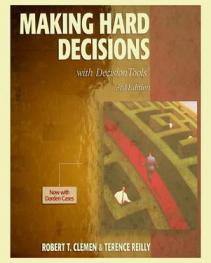
Making hard decisions with DecisionTools
Teaching the fundamental ideas of decision analysis, this text avoids an overly technical explanation of the mathematics used in management science. This new version incorporates and implements the powerful Decision Tools Suite, a toolkit for risk and decision analysis.
Book

Blind Spots
When confronted with an ethical dilemma, most of us like to think we would stand up for our principles. But we are not as ethical as we think we are. In Blind Spots, leading business ethicists Max Bazerman and Ann Tenbrunsel examine the ways we overestimate our ability to do what is right and how we act unethically without meaning to. From the collapse of Enron and corruption in the tobacco industry, to sales of the defective Ford Pinto, the downfall of Bernard Madoff, and the Challenger space shuttle disaster, the authors investigate the nature of ethical failures in the business world and beyond, and illustrate how we can become more ethical, bridging the gap between who we are and who we want to be. Explaining why traditional approaches to ethics don't work, the book considers how blind spots like ethical fading--the removal of ethics from the decision--making process--have led to tragedies and scandals such as the Challenger space shuttle disaster, steroid use in Major League Baseball, the crash in the financial markets, and the energy crisis. The authors demonstrate how ethical standards shift, how we neglect to notice and act on the unethical behavior of others, and how compliance initiatives can actually promote unethical behavior. They argue that scandals will continue to emerge unless such approaches take into account the psychology of individuals faced with ethical dilemmas. Distinguishing our \"should self\" (the person who knows what is correct) from our \"want self\" (the person who ends up making decisions), the authors point out ethical sinkholes that create questionable actions. Suggesting innovative individual and group tactics for improving human judgment, Blind Spots shows us how to secure a place for ethics in our workplaces, institutions, and daily lives.
eBook

Shared Decision-Making Tools Implemented in the Electronic Health Record: Scoping Review
Patient-centered care promotes the involvement of patients in decision-making related to their health care. The adoption and implementation of shared decision-making (SDM) into routine care are constrained by several obstacles, including technical and time constraints, clinician and patient attitudes and perceptions, and processes that exist outside the standardized clinical workflow.
We aimed to understand the integration and implementation characteristics of reported SDM interventions integrated into an electronic health record (EHR) system.
We conducted a scoping review using the methodological framework by Arksey and O'Malley with guidance from the Joanna Briggs Institute. Eligibility criteria included original research and reviews focusing on SDM situations in a real-world clinical setting and EHR integration of SDM tools and processes. We excluded retrospective studies, conference abstracts, simulation studies, user design studies, opinion pieces, and editorials. To identify eligible studies, we searched the following databases on January 11, 2021: MEDLINE, Embase, CINAHL Complete, Cochrane Library including CENTRAL, PsycINFO, Scopus, and Web of Science Core Collection. We systematically categorized descriptive data and key findings in a tabular format using predetermined data charting forms. Results were summarized using tables and associated narratives related to the review questions.
Of the 2153 studies, 18 (0.84%) were included in the final review. There was a high degree of variation across studies, including SDM definitions, standardized measures, technical integration, and implementation strategies. SDM tools that targeted established health care processes promoted their use. Integrating SDM templates and tools into an EHR appeared to improve the targeted outcomes of most (17/18, 94%) studies. Most SDM interventions were designed for clinicians. Patient-specific goals and values were included in 56% (10/18) of studies. The 2 most common study outcome measures were SDM-related measures and SDM tool use.
Understanding how to integrate SDM tools directly into a clinician's workflow within the EHR is a logical approach to promoting SDM into routine clinical practice. This review contributes to the literature by illuminating features of SDM tools that have been integrated into an EHR system. Standardization of SDM tools and processes, including the use of patient decision aids, is needed for consistency across SDM studies. The implementation approaches for SDM applications showed varying levels of planning and effort to promote SDM intervention awareness. Targeting accepted and established clinical processes may enhance the adoption and use of SDM tools. Future studies designed as randomized controlled trials are needed to expand the quality of the evidence base. This includes the study of integration methods into EHR systems as well as implementation methods and strategies deployed to operationalize the uptake of the SDM-integrated tools. Emphasizing patients' goals and values is another key area for future studies.
Journal Article