
Catalogue Search | MBRL


Are you sure you want to remove the book from the shelf?

{{itemTitle}}
250
result(s) for
"Decolonization Europe History."
Sort by:

Decolonising Europe?
Decolonising Europe? Popular Responses to the End of Empire offers a new paradigm to understand decolonisation in Europe by showing how it was fundamentally a fluid process of fluxes and refluxes involving not only transfers of populations, ideas, and sociocultural practices across continents but also complex intra-European dynamics at a time of political convergence following the Treaty of Rome. Decolonisation was neither a process of sudden, rapid changes to European cultures nor one of cultural inertia, but a development marked by fluidity, movement, and dynamism. Rather than being a static process where Europe’s (former) metropoles and their peoples ‘at home’ reacted to the end of empire ‘out there’, decolonisation translated into new realities for Europe’s cultures, societies, and politics as flows, ebbs, fluxes, and cultural refluxes reshaped both former colonies and former metropoles.
The volume’s contributors set out a carefully crafted panorama of decolonisation’s sequels in European popular culture by means of in-depth studies of specific cases and media, analysing the interwoven meaning, momentum, memory, material culture, and migration patterns of the end of empire across eight major European countries.
The revised meaning of ‘decolonisation’ that emerges will challenge scholars in several fields, and the panorama of new research in the book charts paths for new investigations. The question mark in the title asks not only how European cultures experienced the ‘end of empire’ but also the extent to which this is still a work in progress.
eBook

Memories of post-imperial nations : the aftermath of decolonization, 1945-2013
\"Brings together the varying perspectives with historians attempting to bind memory and its experience of different post-imperial nations -- Britain, Netherlands, France, Belgium, Italy, Portugal and Japan\"--Provided by publisher.
Book
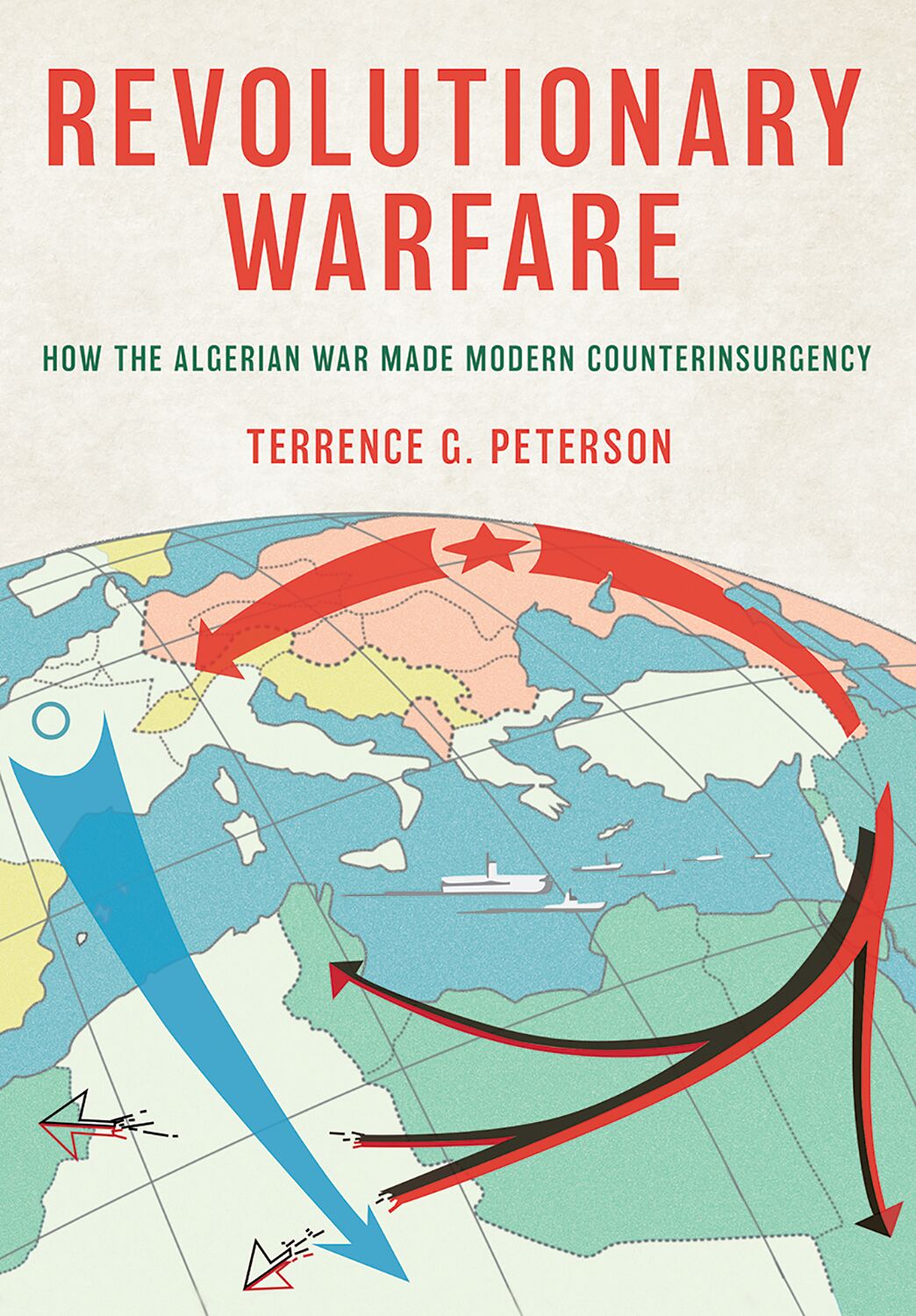
Revolutionary Warfare
Revolutionary Warfare
investigates how efforts to counter a revolution could also
be revolutionary. The Algerian War fractured the French
Empire, destroyed the legitimacy of colonial rule, and helped
launch the Third Worldist movement for the liberation of the Global
South. By tracing how French generals, officers, and civil
officials sought to counter Algerian independence with their own
project of radical social transformation, Terrence G. Peterson
reveals that the conflict also helped to transform the nature of
modern warfare.
The French war effort was never defined solely by repression. As
Peterson details, it also sought to fashion new forms of
surveillance and social control that could capture the loyalty of
Algerians and transform Algerian society. Hygiene and medical aid
efforts, youth sports and education programs, and psychological
warfare campaigns all attempted to remake Algerian social
structures and bind them more closely to the French state. In
tracing the emergence of such programs, Peterson reframes the
French war effort as a project of armed social reform that sought
not to preserve colonial rule unchanged, but to revolutionize it in
order to preserve it against the global challenges of
decolonization.
Revolutionary Warfare demonstrates how French officers'
efforts to transform warfare into an exercise in social engineering
not only shaped how the Algerian War unfolded from its earliest
months, but also helped to forge a paradigm of warfare that
dominated strategic thinking during the Cold War and after:
counterinsurgency.
eBook

Europe between Migrations, Decolonization and Integration (1945–1992)
This monograph addresses mobility and migrations as contributing phenomena in shaping contemporary Europe after 1945, in connection with decolonisation and the creation of the European Community. The disappearing of the colonial empires caused a large movement of people (former colonizers as well as formerly colonized people) from the extra-European countries to the “Old continent”; while the European integration project encouraged the movement of the citizens within the Community. The book retraces how, in both cases, migrations and mobility impacted the way national communities, as well as the European one, have been defining themselves and their real and imaginary boundaries.
eBook

Empires in the sun : the struggle for the mastery of Africa
In this compelling history of the men and ideas that radically changed the course of world history, Lawrence James investigates and analyses how, within a hundred years, Europeans persuaded and coerced Africa into becoming a subordinate part of the modern world. His narrative is laced with the experiences of participants and onlookers and introduces the men and women who, for better or worse, stamped their wills on Africa.
Book

Integral Europe
Over the past 15 years, the project of advanced European integration has followed a complex secular and cosmopolitan agenda. As that agenda has evolved, however, so have various hard-line populist movements with goals diametrically opposed to the ideals of a harmonious European Union. Spearheaded by figures such as Jean-Marie Le Pen, the controversial leader of France's National Front party, these radical movements have become increasingly influential and, because of their philosophical affinities with fascism and national socialism--politically worrisome. In Integral Europe, anthropologist Douglas Holmes posits that such movements are philosophically rooted in integralism, a sensibility that, in its most benign form, enables people to maintain their ethnic identity and solidarity within the context of an increasingly pluralistic society. Taken to irrational extremes by people like Le Pen, integralism is being used to inflame people's feelings of alienation and powerlessness, the by-products of impersonal, transnational \"fast-capitalism.\" The consequences are an invidious politics of exclusion that spawns cultural nationalism, racism, and social disorder. The analysis moves from northern Italy to Strasbourg and Brussels, the two venues of the European Parliament, and finally to the East End of London. This multi-sited ethnography provides critical perspective on integralism as a form of intimate cultural practice and a violent idiom of estrangement. It combines a wide-ranging review of modern and historical scholarship with two years of field research that included personal interviews with right-wing activists, among them Le Pen and neo-Nazis in inner London. Fascinating, provocative, and sobering, Integral Europe offers a rare inside look at one of modern Europe's most unsettling political trends.
eBook


Imperial Portugal in the Age of Atlantic Revolutions
Portugal made great efforts to tie its territories together, but the Luso-Brazilian empire eventually succumbed to revolution like its British, French and Spanish counterparts. This book reveals the links and relationships between Portugal and Brazil that survived the demise of empire and shaped the trajectories of the two countries.
eBook