
Catalogue Search | MBRL


Are you sure you want to remove the book from the shelf?

{{itemTitle}}
92
result(s) for
"Decolonization Southeast Asia."
Sort by:

Secularism, decolonisation, and the Cold War in South and Southeast Asia
\"The intensifying conflicts between religious communities in contemporary South and Southeast Asia signify the importance of gaining a clearer understanding of how societies have historically organised and mastered their religious diversity. Based on extensive archival research in Asia, Europe, and the United States this book suggests a new approach to interpreting and explaining secularism not as a Western concept but as a distinct form of practice in 20th century global history. In six case studies on the contemporary history of India, Indonesia, Malaysia, and Singapore it analyses secularism as a project to create a high degree of distance between the state and religion during the era of decolonisation and the emerging Cold War between 1945 and 1970. To demonstrate the interplay between local and transnational dynamics, the case studies look at patterns of urban planning, the struggle against religious nationalism, conflicts around religious education, and (anti)communism as a dispute over secularism and social reform. The book emphasises in particular the role of non-state actors as key supporters of secular statehood--a role that has thus far not received sufficient attention. A novel approach to studying secularism in Asia, the book discusses the different ways that global transformations such as decolonisation and the Cold War interacted with local relations to re-shape and re-locate religion in society\"-- Provided by publisher.
Book
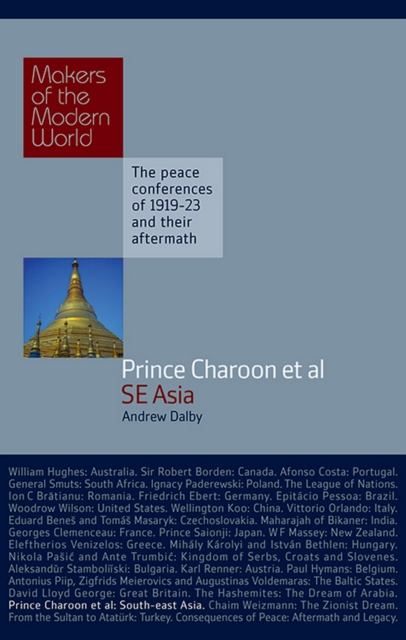
Prince Charoon et al
Southeast Asia needs to be dealt with as a whole, because, although the one national delegation from the region (Siam) took a minor part, nationalist movements in several Southeast Asian countries reached an early climax - significant though inconclusive - in the years 1919-1920. The planned Peace Conference, Wilson's Fourteen Points, and the victory of Communism in Russia, all contributed to this activity, and in spite of national differences it needs to be seen as a whole. The focus of the book will be on developments around 1919; thus it will bring out for the first time the unexpected significance for South-east Asia of the 1919 milestone. It will also have a biographical bias - taking a special interest in the personalities of major figures in this important period, in order to show the influences and the patterns of thought that underlie their activities at the time of the Peace Conference. Following a brief introduction making the link between world events in 1919 and South-east Asia, the book sets the scene in the region. Succeeding chapters deal with the five countries - Siam, Vietnam, Burma, Indonesia, Philippines - in which the years 1919-21 were of special significance, as well as the impact of the peace conferences in relationships with their neighbours, the growth of international Communism and global politics in later years.
eBook


Arc of Containment
Arc of Containment recasts the
history of American empire in Southeast and East Asia from World
War II through the end of American intervention in
Vietnam. Setting aside the classic story of anxiety about
falling dominoes, Wen-Qing Ngoei articulates a new regional history
premised on strong security and sure containment guaranteed by
Anglo-American cooperation.
Ngoei argues that anticommunist nationalism in Southeast Asia
intersected with preexisting local antipathy toward China and the
Chinese diaspora to usher the region from European-dominated
colonialism to US hegemony. Central to this revisionary strategic
assessment is the place of British power and the effects of direct
neocolonial military might and less overt cultural influences based
on decades of colonial rule, as well as the considerable influence
of Southeast Asian actors upon Anglo-American imperial strategy
throughout the post-war period.
Arc of Containment demonstrates that American failure
in Vietnam had less long-term consequences than widely believed
because British pro-West nationalism had been firmly entrenched
twenty-plus years earlier. In effect, Ngoei argues, the Cold War in
Southeast Asia was but one violent chapter in the continuous
history of western imperialism in the region in the twentieth
century.
eBook


Emerging Memory
This incisive volume brings together postcolonial studies, visual culture and cultural memory studies to explain how the Netherlands continues to rediscover its history of violence in colonial Indonesia. Dutch commentators have frequently claimed that the colonial past and especially the violence associated with it has been 'forgotten' in the Netherlands. Uncovering 'lost' photographs and other documents of violence has thereby become a recurring feature aimed at unmasking a hidden truth. The author argues that, rather than absent, such images have been consistently present in the Dutch public sphere and have been widely available in print, on television and now on the internet. Emerging Memory: Photographs of Colonial Atrocity in Dutch Cultural Remembrance shows that between memory and forgetting there is a haunted zone from which pasts that do not fit the stories nations live by keep on emerging and submerging while retaining their disturbing presence.
eBook

He who is made Lord : empire, class, and race in postwar Singapore
In June 1959, the British established the office of Yang di-Pertuan Negara (He Who is Made Lord) to replace the colonial governorship and represent Queen Elizabeth II in Singapore. Muhammad Suhail explores the divergent attempts to invest meaning in the Yang di-Pertuan Negara. In doing so, he weaves a rich story about the contesting ideas of sovereignty during the global age of decolonization. He Who is Made Lord is a captivating take on Singapore's emergence as a postcolonial nation, providing a gateway into the island's past as part of the Malay World, the British Empire and the Commonwealth of Nations._x000B__x000B_The Yang di-Pertuan Negara is a subject that has received only passing mentions in the Singapore Story. This book is the first detailed study to reveal not only the politics of its creation but also the cultural significance of the office. By delving into its multifaceted meanings, this insightful account offers readers a fascinating treatise on the office's connection with the momentous final years of British rule in the colony and Singapore's brief interlude in Malaysia. —Associate Professor Albert Lau, Department of History, National University of Singapore_x000B__x000B_The end of the British Empire wrought considerable change across the globe, but it also left many legacies and questions such as what or who would replace the omnipotent Crown. He Who is Made Lord examines the neglected but fascinating story of how Singapore grappled with this issue, which was more delicate, nuanced and far reaching than most supposed. Muhammad Suhail has made an original, well-researched, and valuable study of the position of Head of State in Singapore during the last stages of colonialism and shows vividly that far from being of ceremonial or administrative interest, it touched on wider and deeper issues in Singaporean and Southeast Asian history and society, reflecting tensions of identity and hopes for the future. —Dr Harshan Kumarasingham, School of Social and Political Science, University of Edinburgh_x000B__x000B_In this ground-breaking book, Muhammad Suhail has meticulously scoured, scrutinized, and synthesized archival official records, newspaper articles, government publications, pictures, and websites to peel and expose the many layers of the hitherto overlooked office of the Yang di-Pertuan Negara of Singapore to reveal the contradictions, contestations, and constructions of the created office in the context of the tumultuous period of decolonization. Suhail also has laid bare the complex personality of the man who held this office, Yusof Ishak, exposing the myriad of faces, appearances, and roles he represented and was made to represent, appreciating his triumphs and weaknesses, but most importantly, humanizing him. —Associate Professor Sher Banu A.L. Khan, Department of Malay Studies, National University of Singapore
eBook

Tourism and Nation Building at the War Remnants Museum in Ho Chi Minh City, Vietnam
Using evidence from what is probably Vietnam's most visited tourism site, the War Remnants Museum in Ho Chi Minh City, this article explores the presentation of the \"American War\" in the construction of nationhood. The article has three objectives. First, I illustrate how nation-building in a postcolonial and postimperial context is generated through tourism, specifying how the Communist Party communicates Vietnam to lay international tourist audiences. Tourism's political instrumentality for the party is highlighted here. Second, I show how the United States is imaginatively constructed to shape Vietnam's identity. Finally, I use the conclusion to reflect on the implications for the \"Asian Century\" when considering Vietnam's multifaceted connections to the United States and the West.
Journal Article