
Catalogue Search | MBRL


Are you sure you want to remove the book from the shelf?

{{itemTitle}}
21
result(s) for
"Deedat, Ahmed"
Sort by:
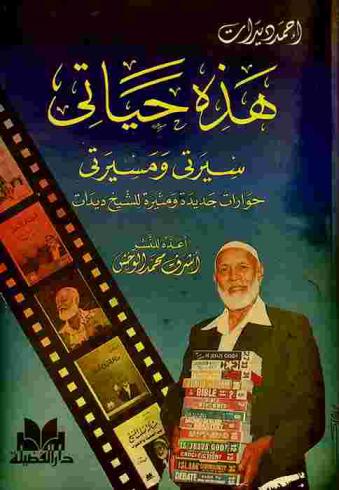

Ahmed Deedat, Internationalisation, and Transformations of Islamic Polemic
Abstract
The South African preacher, Ahmed Deedat, has developed a specific discourse on the nature of relations between Muslims and Other religions through polemic and public debates. This paper describes the mechanisms of the circulation of his thought and activities and its political character. Deedat is a relevant actor in 'Muslim politics' who has not been thoroughly studied in the field of Muslim proselytism. His political activities were inscribed first in the long history of munazara (debate, dispute) in India and then in the desire to internationalise his religious ideas in public platforms and media. His ideology has also been reappropriated by other television preachers, especially in Mumbai, through the example of Zakir Naïk. The historical and the political approaches of this paper provide a better understanding of the internationalisation and transformations of Islamic polemics.
Journal Article

The Effective Factors of Contemporary Dialogue (In the Light of Sheikh Ahmed Deedat's Dialouge) | أسباب فاعلية الحوار الدعوي المعاصر على ضوء حوار الشيخ أحمد ديدات
Muslim Scholars and du'at exerted exhaustive efforts for dialogue betweenIslam and other religions, not just for sharing ideas, understanding, andbuilding exclusive relations between religion’s followers, but for good result forIslamic propagation. The research deals with Sheikh Deedat’s long-experimentson debates and dialogues with Christians, Jews, and Hindus etc. His longexperiences proved that Islam far from being an extremist religion thatencourages violence, it is the religion of moderation, tolerance and mercy for allpeople and living beings. This study came to the essentiality of reasons fordialogue effectiveness in contemporary period. It emphasized the necessity ofinculcating islamic values and good habits for du'at as debater and dialogist. Italso emphasized the importance of planning and organizing, financing supportand communication multimedia for contemporary da’wah.
Journal Article
AHMED DEEDAT'S THEOLOGY OF RELIGION: APOLOGETICS THROUGH POLEMICS
Within Africa, as well as outside the continent, the writings and videocassettes of Ahmed Deedat have been, and still are, most influential. In this article, Deedat's great interest in religious polemics, especially against Christianity, has been interpreted primarily as an apologetical endeavour influenced largely by the marginal and exposed situation of the small minority of Muslims in the strongly Christian-dominated South Africa. Deedat's main task was to provide Muslims with theological tools for defending themselves against the intense missionary strivings of many Christian denominations. He spoke and wrote for the Muslim masses rather than for learned scholars, and the fact that he used English instead of Arabic or some other 'Muslim' language further increased the availability of his writings among, for instance, Muslim minorities in Europe and North America.
Journal Article

Pakistani-Israeli relations: a true opening, or merely a trial balloon?
Announcements from Islamabad Pakistan and Tel Aviv Israel on Sep 1 alerted the world to the meeting in Istanbul that day between their foreign ministers, Khurshid Qasuri and Silvan Shalom, respectively, the first formal encounter between the two countries. Pakistan insisted that the meeting is a result of Israel's withdrawal from the Gaza Strip, and that it will not officially recognize the Jewish state until a sovereign state of Palestine is established. Ali investigates on both countries' diplomatic relations.
Journal Article
SAfrican family said receives message from Bin-Ladin's brother over his death
In the brief message to Yousuf Deedat -the son of Durban Islamic propagandist Ahmed Deedat, who died in 2005 -[Usamah Bin-Ladin]'s brother spoke of the family's sadness following the US Navy SEALs' raid before dawn on Monday, Pakistan time, in which Bin-Ladin was killed. In it, Bin-Ladin's brother pays tribute to Deedat snr: \"I hope you and your family are well. The late shaykh Ahmed Deedat has been an inspiration for us all, and we were humbled by his wisdom.\" \"Usamah was taken aback by my father,\" said Deedat of their first meeting. That was shortly after the [Jimmy Swaggart] debate, when father and son went to Saudi Arabia, not for the first time, to drum up support for the IPCI.
Newsletter
Muslim life in SA is as good as it gets
\"While Muslims around the world are invariably seen as immigrant communities, the history of Muslims in South Africa goes back more than 350 years. SA Muslims therefore do not grapple with issues of integration and their identity as South Africans. Muslims in the country seem to enjoy a high standard of tolerance comparable to other faiths, given their small numbers. For example, almost every food brand boasts the \"halal\" certification logo - an important validation for the Muslim diet - with many businesses viewing the buying power of Muslims as important. Names like Yusuf Dadoo, Fatima Meer, Ahmed Kathrada, Naledi Pandor, Essop and Aziz Pahad, \"Moulvi\" Cachalia, Hashim Amla and the like continue to reverberate in political, sporting and academic circles for their spirit of \"ubuntu\" and active contributions towards a democratic South Africa.
Newspaper Article
Muslim scholar
He was born on July 1, 1918, in the Surat district of India. [Ahmed Deedat]'s father was a tailor and his mother died soon after his birth. The family emigrated to South Africa in 1927. Ahmed began schooling when he was nine years old, but due to impoverishment and lack of financial support he left school after he completed Standard Six. Over the next four decades, Ahmed immersed himself in several activities like conducting bible classes, lecturing and debating all over the world. He established the first Islamic seminary, Assalaam Educational Institute, in Southern Africa to train propagators of Islam. He was the founder of the largest Islamic dakwah organisation in the world, the Islamic Propagation Centre International (IPCI) and became its president.
Newspaper Article
South African Muslims reject anti-Hindu DVD
[Ahmed Deedat] senior also said in the video that Indian Muslims were \"fortunate\" that their Hindu forefathers \"saw the light\" and converted to Islam when Muslim rulers dominated some areas of India.
Newspaper Article