
Catalogue Search | MBRL


Are you sure you want to remove the book from the shelf?

{{itemTitle}}
376
result(s) for
"Definite integrals"
Sort by:


Some Novel Formulas of the Telephone Polynomials Including New Definite and Indefinite Integrals
In this article, we present new theoretical findings on specific polynomials that generalize the concept of telephone numbers, namely, Telephone polynomials (TelPs). Several new formulas are developed, including expressions for higher-order derivatives, repeated integrals, and moment formulas of TelPs. Moreover, we derive explicit connections between the derivatives of TelPs and the two classes of symmetric and non-symmetric polynomials, producing many formulas between these polynomials and several celebrated polynomials such as Hermite, Laguerre, Jacobi, Fibonacci, Lucas, Bernoulli, and Euler polynomials. The inverse formulas are also obtained, expressing the derivatives of well-known polynomial families in terms of TelPs. Furthermore, some novel linearization formulas (LFs) with some classes of polynomials are established. Finally, some new definite and indefinite integrals of TelPs are established using some of the developed relations.
Journal Article

Differential Quadrature and Differential Quadrature Based Element Methods
Differential Quadrature and Differential Quadrature Based Element Methods: Theory and Applications is a comprehensive guide to these methods and their various applications in recent years.
eBook

RETRACTED: Using elements of c ++ programming language in teaching informatics with mathematics
See the retraction notice E3S Web of Conferences 538 , 00001 (2024), https://doi.org/10.1051/e3sconf/202453800001
Journal Article
On Convolved Fibonacci Polynomials
This work delves deeply into convolved Fibonacci polynomials (CFPs) that are considered generalizations of the standard Fibonacci polynomials. We present new formulas for these polynomials. An expression for the repeated integrals of the CFPs in terms of their original polynomials is given. A new approach is followed to obtain the higher-order derivatives of these polynomials from the repeated integrals formula. The inversion and moment formulas for these polynomials, which we find, are the keys to developing further formulas for these polynomials. The derivatives of the moments of the CFPs in terms of their original polynomials and different symmetric and non-symmetric polynomials are also derived. New product formulas of these polynomials with some polynomials, including the linearization formulas of these polynomials, are also deduced. Some closed forms for definite and weighted definite integrals involving the CFPs are found as consequences of some of the introduced formulas.
Journal Article
Experimental Mathematics: Some Mathematical Problems Arising from the Integration of Rational Functions
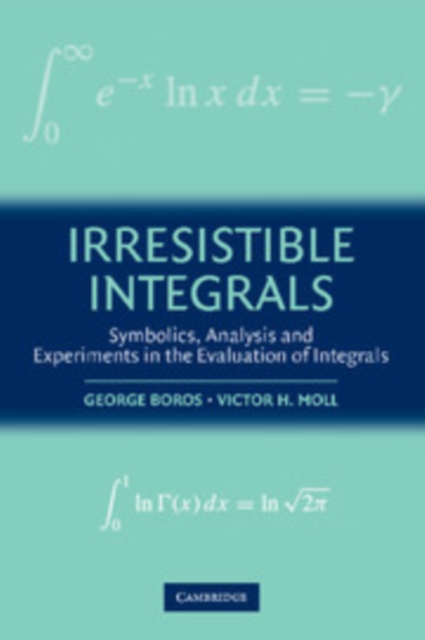
The problem of evaluating integrals is well known to every student who has had a year of calculus. It was an especially important subject in 19th century analysis and it has now been revived with the appearance of symbolic languages. In this book, the authors use the problem of exact evaluation of definite integrals as a starting point for exploring many areas of mathematics. The questions discussed in this book, first published in 2004, are as old as calculus itself. In presenting the combination of methods required for the evaluation of most integrals, the authors take the most interesting, rather than the shortest, path to the results. Along the way, they illuminate connections with many subjects, including analysis, number theory, algebra and combinatorics. This will be a guided tour of exciting discovery for undergraduates and their teachers in mathematics, computer science, physics, and engineering.
eBook

Hypoelliptic Laplacian and Orbital Integrals (AM-177)
This book uses the hypoelliptic Laplacian to evaluate semisimple orbital integrals in a formalism that unifies index theory and the trace formula. The hypoelliptic Laplacian is a family of operators that is supposed to interpolate between the ordinary Laplacian and the geodesic flow. It is essentially the weighted sum of a harmonic oscillator along the fiber of the tangent bundle, and of the generator of the geodesic flow. In this book, semisimple orbital integrals associated with the heat kernel of the Casimir operator are shown to be invariant under a suitable hypoelliptic deformation, which is constructed using the Dirac operator of Kostant. Their explicit evaluation is obtained by localization on geodesics in the symmetric space, in a formula closely related to the Atiyah-Bott fixed point formulas. Orbital integrals associated with the wave kernel are also computed.
Estimates on the hypoelliptic heat kernel play a key role in the proofs, and are obtained by combining analytic, geometric, and probabilistic techniques. Analytic techniques emphasize the wavelike aspects of the hypoelliptic heat kernel, while geometrical considerations are needed to obtain proper control of the hypoelliptic heat kernel, especially in the localization process near the geodesics. Probabilistic techniques are especially relevant, because underlying the hypoelliptic deformation is a deformation of dynamical systems on the symmetric space, which interpolates between Brownian motion and the geodesic flow. The Malliavin calculus is used at critical stages of the proof.
eBook

Compatibility of the method of brackets with classical integration rules
The method of brackets is a symbolic approach to the computation of integrals over
based on a deep result by Ramanujan. Its usefulness to obtain new and difficult integrals has been demonstrated many times in the last few years. This article shows that this method is consistent with most classical rules for the computation of integrals, such as the fundamental theorem of calculus, the Laplace transform, the reduction formula for the integration of functions with spherical symmetry, the Cauchy-Schlömilch transformation, and explicit evaluations for multivariate integrals of product of Bessel functions as obtained by Exton and Srivastava. This work is part of a program dedicated to the derivation of solid theoretical grounds for the use of this attractive integration method.
Journal Article

New expressions for certain polynomials combining Fibonacci and Lucas polynomials
We establish a new sequence of polynomials that combines the Fibonacci and Lucas polynomials. We will refer to these polynomials as merged Fibonacci-Lucas polynomials (MFLPs). We will show that we can represent these polynomials by combining two certain Fibonacci polynomials. This formula will be essential for determining the power form representation of these polynomials. This representation and its inversion formula for these polynomials are crucial to derive new formulas about the MFLPs. New derivative expressions for these polynomials are given as combinations of several symmetric and non-symmetric polynomials. We also provide the inverse formulas for these formulas. Some new product formulas involving the MFLPs have also been derived. We also provide some definite integral formulas that apply to the derived formulas.
Journal Article

Encapsulation of the defined integral mathematical object of university students: a view from APOS theory
Understanding the concept of definite integrals is a persistent challenge in university mathematics education, largely attributable to traditional teaching practices that prioritise mechanical procedures over conceptual depth. Many students experience a disconnect between the algebraic, geometric, and conceptual representations of the definite integral, leading to a fragmented understanding of the concept. Therefore, this study seeks an alternative to the difficulties students face in understanding the definite integral from a conceptual perspective. To address this issue, the article aims to strengthen students’ understanding of the definite integral in the Bachelor of Mathematics programme at the University of Quindío, using APOS theory. This theory conceives mathematical understanding as a progressive construction of mental schemas, facilitated by cognitive mechanisms such as internalisation, coordination, and encapsulation. The study is framed within a qualitative methodology and a hermeneutic-interpretive approach. Didactic sequences, problem-solving analysis, and focus groups were used as research instruments. The findings indicate that an approach focused on students’ conceptual development, supported by appropriate teacher intervention, promotes deeper and more lasting learning. Consequently, teaching planning that incorporates genetic decomposition, contextualised activities, classroom reflection, and guided exercises improves understanding of the definite integral and supports connections among different representations.
Journal Article