
Catalogue Search | MBRL


Are you sure you want to remove the book from the shelf?

{{itemTitle}}
3,982
result(s) for
"Defoe, Daniel"
Sort by:


Daniel Defoe, Contrarian
A highly conscious wordsmith, Daniel Defoe used expository styles in his fiction and non-fiction that reflected his ability to perceive material and intellectual phenomena from opposing, but not contradictory perspectives. Moreover, the boundaries of genre within his wide-ranging oeuvre can prove highly fluid. In this study, Robert James Merrett approaches Defoe’s body of work using interdisciplinary methods that recognize dialectic in his verbal creativity and cognitive awareness.
Examining more than ninety of Defoe’s works, Merrett contends that this author’s literariness exploits a conscious dialogue that fosters the reciprocity of traditional and progressive authorial procedures. Along the way, he discusses Defoe’s lexical and semantic sensibility, his rhetorical and aesthetic theories, his contrarian theology, and more. Merrett proposes that Defoe’s contrarian outlook celebrates a view of consciousness that acknowledges the brain’s bipartite structure, and in so doing illustrates how cognitive science may be applied to further explorations of narrative art.
eBook

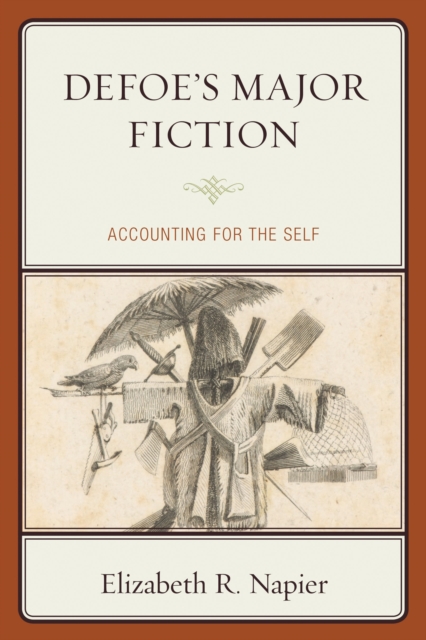
Defoe's major fiction
This book focuses on the pervasive concern with narrativity and self-construction that marks Defoe's first-person fictional narratives. Defoe's fictions focus obsessively and elaborately on the act of storytelling—not only in his creation of idiosyncratic voices preoccupied with the telling (and often the concealing) of their own life stories but also in his narrators' repeated adversion to other, untold stories that compete for attention with their own. Defoe's narratives raise profound questions about selfhood and agency (as well as demonstrate competing attitudes about narration) in his fictive worlds. His canon exhibits a broad range of first-person fictional accounts, from pseudo-memoir (A Journal of the Plague Year, Memoirs of a Cavalier) to criminal autobiography (Moll Flanders) to confession (Roxana), and the narrators of these accounts (secretive, compulsive, fractive) exhibit an array of resistances to the telling of their life stories. Such experiments with narration evince Defoe's deep involvement in projects of self-description and -delineation, as he interrogates the boundaries of the self and dramatizes the arduousness of self-accounting. Defoe's fictions are emphatically consciousness-centered and the significance of such a focus to the development of the novel is patently as great as is his \"realistic\" style. Defoe's narrative project, in fact, challenges current views on the moment at which inwardness and interiority begin, as Lukács argued, to comprise the subject matter of the novel, implicitly attributing to identity and consciousness a place of signal and complex importance in the new genre.
eBook


The bi-sexuality of daniel defoe
Daniel Defoe (1660-1731) is known to many only by his first novel, \"Robinson Crusoe\", astonishingly written as he approached his sixtieth year. Acknowledged as the first of English novelists, he has also been awarded accolades for being the 'Father of Journalism', the most successful spy in British history, the precursor to contemporary depth psychologists, the most daring of early feminists, the most devious of confidence tricksters and fraudulent entrepreneurs, the unsurpassed travelogue presenter, the first spin-doctor and speech-writer to a king. Hurling his defiances against the Established Church and Roman Catholicism, he was also the intrepid upholder of dissenting beliefs.The author deploys his forensic skills as a distinguished criminal lawyer and reforming parliamentarian to present an intriguing and novel Freudian overview of all Defoe's major works.
eBook

The life of Daniel Defoe : a critical biography
A critical study of the writing of Daniel Defoe, author of 'Robinson Crusoe' and 'Moll Flanders'. It examines the entire range of his work in the context of what is known about his life.
BOOK
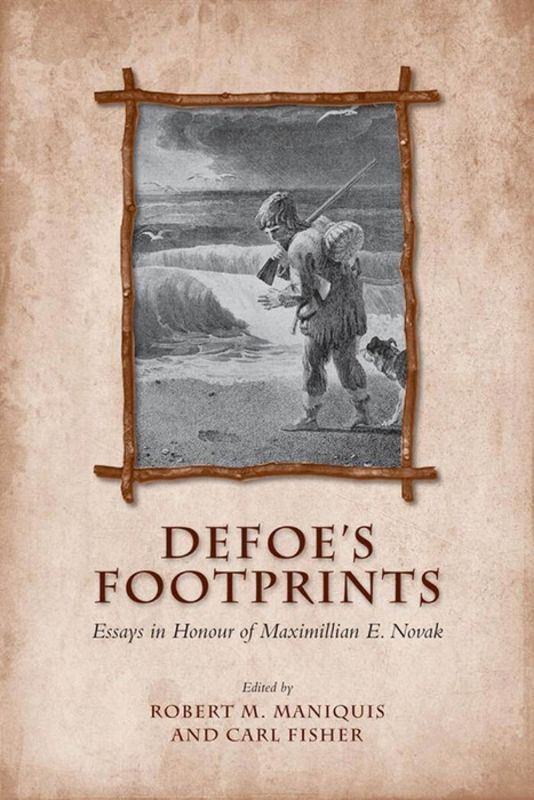
Defoe's Footprints
With attention to Defoe's neglected writings as well as to his important works, this volume uncovers his distance from and influence on modern literature, paying tribute to Maximillian E. Novak by presenting new ideas about, and new readings of, Daniel Defoe.
eBook

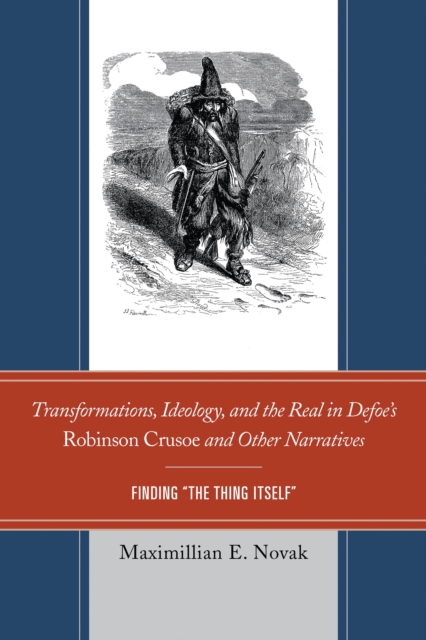
Transformations, ideology, and the real in Defoe's Robinson Crusoe and other narratives : finding \the thing itself\
This book explores significant problems in the fiction of Daniel Defoe.Maximillian E.Novak investigates a number of elements in Defoe's work by probing his interest in rendering of reality (what Defoe called \"the Thing itself\").
eBook