
Catalogue Search | MBRL


Are you sure you want to remove the book from the shelf?

{{itemTitle}}
397
result(s) for
"Democracy Cambodia."
Sort by:

Cambodia's curse : the modern history of a troubled land
Nobel Prize winning reporter Joel Brinkley illuminates the country, its people, and the deep historical roots of its modern-day behavior.
BOOK
Cambodia's Neoliberal Order
Neoliberal economics have emerged in the post-Cold War era as the predominant ideological tenet applied to the development of countries in the global south. For much of the global south, however, the promise that markets will bring increased standards of living and emancipation from tyranny has been an empty one. Instead, neoliberalisation has increased the gap between rich and poor and unleashed a firestorm of social ills.
This book deals with the post-conflict geographies of violence and neoliberalisation in Cambodia. Applying a geographical analysis to contemporary Cambodian politics, the author employs notions of neoliberalism, public space, and radical democracy as the most substantive components of its theoretical edifice. He argues that the promotion of unfettered marketisation is the foremost causal factor in the country’s inability to consolidate democracy following a United Nations sponsored transition. The book demonstrates Cambodian perspectives on the role of public space in Cambodia's process of democratic development and explains the implications of violence and its relationship with neoliberalism.
Taking into account the transition from war to peace, authoritarianism to democracy, and command economy to a free market, this book offers a critical appraisal of the political economy in Cambodia.
1. Introduction: Setting the Stage for Neoliberalisation 2. Caught in the Headlights of Culture and Neoliberalism: Public Space as a Vision for Democracy and Development from Below in the Global South 3. From Genocide to Elections to Coup d’État: Public Space in Cambodia’s Transitional Political Economy 4. Cambodia’s Battle for Public Space: The Neoliberal Doctrine or Order versus the Democratic Expression of the People’s Will 5. Conclusion: Sowing the Seeds of a New Revolution?
Simon Springer is Assistant Professor in the Department of Geography at the National University of Singapore. His ongoing research focuses on the intersections between neoliberalism and violence.
eBook

Local leadership in democratic transition : competing paradigms in international peacebuilding
\"Since the end of the Cold War, the United Nations has become increasingly involved in peacebuilding. However, the often questionable results have led to much mistrust of the methods employed by international organizations. The current transition paradigm assumes that local leaders which participate in the process will assist in the democratic transition and are themselves an output of the process. This assumption appears to be fundamentally wrong. This book examines whether the inclusion of non-democratic leadership in post-conflict transition induces democratic principles and sustainable peace, or if it in fact undermines the values which the international community attempts to promote and contribute towards the solidification of non-democratic regimes. Using an in-depth analysis of local leadership before, during and after democratic transition in three key case studies, namely Burundi, Cambodia and Liberia, the author provides a unique insight into the type of leadership required for transitioning a country to democracy. Delivering a new framework that assists scholars, policymakers and practitioners in understanding the roles of local leaders in democratic transition, it also includes recommendations for future peacebuilding operations. \"-- Provided by publisher.
Book
Cambodia and the Politics of Aesthetics
Illuminating developments in contemporary Cambodia with political and aesthetic theory, this book analyses the country's violent transition from socialism to capitalism through an innovative method that combines the aesthetic approach and critical theory.
To understand the particularities of the country's transition and Cambodia's unfolding encounter with neoliberal capitalism, the book pursues the circuits of desire connecting the constellation of objects and relations, which is identified as Cambodia. Chapters focus on the pre-colonial empire of Angkor, the invasions of Siam and Vietnam in the nineteenth century, the devastation of the Khmer Rouge genocide and the subsequent Vietnamese occupation, and the present rapacity of Hun Sen's neoliberal government.
A creative combination of auto-ethnography, critical theory, and area studies and the analysis of a historical moment, the book is of interest to academics working on comparative politics, Asian studies, holocaust studies, critical theory, and in the politics of aesthetics.
eBook
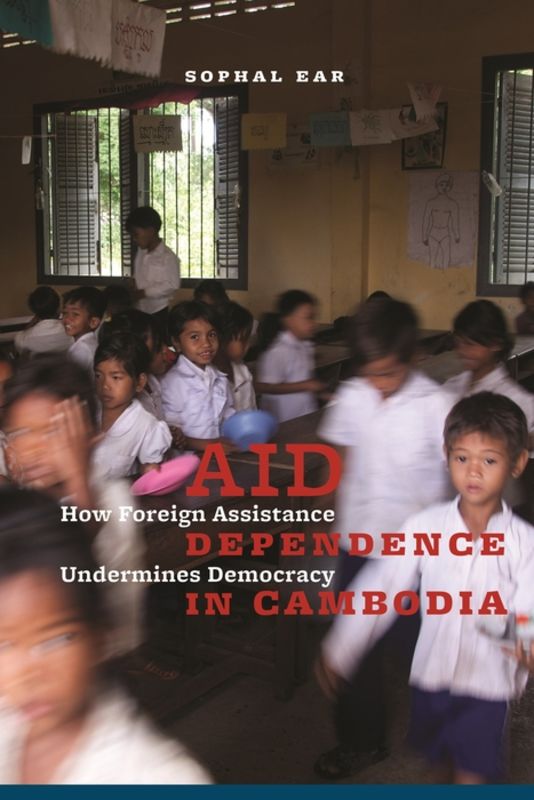
Aid dependence in Cambodia
International intervention liberated Cambodia from pariah state status in the early 1990s and laid the foundations for more peaceful, representative rule. Yet the country's social indicators and the integrity of its political institutions declined rapidly within a few short years, while inequality grew dramatically. Conducting an unflinching investigation into these developments, Sophal Ear reveals the pernicious effects of aid dependence and its perversion of Cambodian democracy. International intervention and foreign aid resulted in higher maternal (and possibly infant and child) mortality rates and unprecedented corruption by the mid-2000s. Similarly, in example after example, Ear finds the more aid dependent a country, the more distorted its incentives to develop sustainably. Contrasting Cambodia's clothing sector with its rice and livestock sectors and internal handling of the avian flu epidemic, he showcases the international community's role in preventing Cambodia from controlling its national development. A postconflict state unable to refuse aid, Cambodia is rife with trial-and-error donor experiments and their unintended consequences, such as bad governance and poor domestic and tax revenue performance—a major factor curbing sustainable, nationally owned growth. By outlining the terms through which countries can achieve better ownership of their development, Ear offers alternatives for governments still on the brink of collapse, despite ongoing dependence on foreign intervention and aid.
eBook
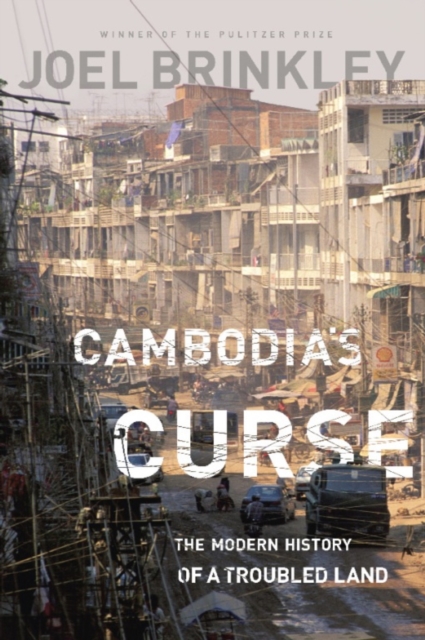
Cambodia's curse : the modern history of a troubled land
A generation after the Khmer Rouge, Cambodia shows every sign of having overcome its history--the streets of Phnom Penh are paved; skyscrapers dot the skyline. But under this façade lies a country still haunted by its years of terror. Joel Brinkley won a Pulitzer Prize for his reporting in Cambodia on the fall of the Khmer Rouge regime that killed one quarter of the nation's population during its years in power. In 1992, the world came together to help pull the small nation out of the mire. Cambodia became a United Nations protectorate--the first and only time the UN tried something so ambitious. What did the new, democratically-elected government do with this unprecedented gift? In 2008 and 2009, Brinkley returned to Cambodia to find out. He discovered a population in the grip of a venal government. He learned that one-third to one-half of Cambodians who lived through the Khmer Rouge era have P.T.S.D.--and its afflictions are being passed to the next generation. His extensive close-up reporting in Cambodia's Curse illuminates the country, its people, and the deep historical roots of its modern-day behavior.
eBook

The Political Economy of Cambodia's Transition, 1991-2001
Cambodia underwent a triple transition in the 1990s: from war to peace, from communism to electoral democracy, and from command economy to free market. This book addresses the political economy of these transitions, examining how the much publicised international intervention to bring peace and democracy to Cambodia was subverted by the poverty of the Cambodian economy and by the state's manipulation of the move to the free market. This analysis of the material basis of obstacles to Cambodia's democratisation suggests that the long-established theoretical link between economy and democracy stands, even in the face of new strategies of international democracy promotion.
eBook

Electoral Politics in Cambodia
This monograph is based on a conference paper presented at the 14th KAS Law Talk on Fairness and Integrity of the Electoral Process in Cambodia, organized by Konrad Adenauer Stiftung's Cambodia Office on 17-18 June 2016.
eBook

Factors affecting forest area change in Southeast Asia during 1980-2010
While many tropical countries are experiencing rapid deforestation, some have experienced forest transition (FT) from net deforestation to net reforestation. Numerous studies have identified causative factors of FT, among which forest scarcity has been considered as a prerequisite for FT. In fact, in SE Asia, the Philippines, Thailand and Viet Nam, which experienced FT since 1990, exhibited a lower remaining forest area (30±8%) than the other five countries (68±6%, Cambodia, Indonesia, Laos, Malaysia, and Myanmar) where forest loss continues. In this study, we examined 1) the factors associated with forest scarcity, 2) the proximate and/or underlying factors that have driven forest area change, and 3) whether causative factors changed across FT phases (from deforestation to net forest gain) during 1980-2010 in the eight SE Asian countries. We used production of wood, food, and export-oriented food commodities as proximate causes and demographic, social, economic and environmental factors, as well as land-use efficiency, and wood and food trade as underlying causes that affect forest area change. Remaining forest area in 1990 was negatively correlated with population density and potential land area of lowland forests, while positively correlated with per capita wood production. This implies that countries rich in accessible and productive forests, and higher population pressures are the ones that have experienced forest scarcity, and eventually FT. Food production and agricultural input were negatively and positively correlated, respectively, with forest area change during 1980-2009. This indicates that more food production drives deforestation, but higher efficiency of agriculture is correlated with forest gain. We also found a U-shaped response of forest area change to social openness, suggesting that forest gain can be achieved in both open and closed countries, but deforestation might be accelerated in countries undergoing societal transition. These results indicate the importance of environmental, agricultural and social variables on forest area dynamics, and have important implications for predicting future tropical forest change.
Journal Article

Cambodia in 2020
In 2020, Cambodia experienced its sharpest economic contraction in more than a quarter-century as COVID-19 crippled its tourism industry, hampered foreign investment, and reduced demand for exports from its crucial garment and textile sectors. Wary of simmering popular unrest, the government of long-serving Prime Minister Hun Sen sought to support the battered economy with one hand while stifling domestic political dissent with the other. Domestic crackdowns brought further erosion of Cambodia’s ties with the European Union, and relations with the United States and some Southeast Asian neighbors remained tense as Cambodia drifted closer into a dependent relationship with China.
Journal Article