
Catalogue Search | MBRL


Are you sure you want to remove the book from the shelf?

{{itemTitle}}
1,064
result(s) for
"Democracy Germany History."
Sort by:


Institutions And The Fate Of Democracy
As democracy has swept the globe, the question of why some democracies succeed while others fail has remained a pressing concern. In this theoretically innovative, richly historical study, Michael Bernhard looks at the process by which new democracies choose their political institutions, showing how these fundamental choices shape democracy's survival.
Offering a new analytical framework that maps the process by which basic political institu-tions emerge, Bernhard investigates four paradigmatic episodes of democracy in two countries: Germany during the Weimar period and after World War II, and Poland between the world wars and after the fall of communism.
Students of democracy will appreciate the broad applicability of Bernhard's findings, while area specialists will welcome the book's accessible and detailed historical accounts.
eBook

Terror and democracy in West Germany
\"In 1970, the Red Army Faction declared war on West Germany. The militants failed to bring down the state, but this book argues that the decade-long debate they inspired helped shape a new era. After 1945, West Germans answered long-standing doubts about democracy's viability and fears of authoritarian state power with a 'militant democracy' empowered against its enemies and a popular commitment to anti-fascist resistance. In the 1970s, these postwar solutions brought Germans into open conflict, fighting to protect democracy from both terrorism and state overreaction. Drawing on diverse sources, Karrin Hanshew shows how Germans, faced with a state of emergency and haunted by their own history, managed to learn from the past and defuse this adversarial dynamic. This negotiation of terror helped them to accept the Federal Republic of Germany as a stable, reformable polity and to reconceive of democracy's defence as part of everyday politics\"-- Provided by publisher.
Book
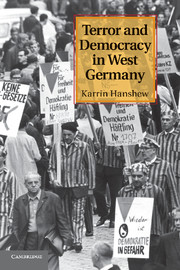
Terror and Democracy in West Germany
In 1970, the Red Army Faction declared war on West Germany. The militants failed to bring down the state, but this book argues that the decade-long debate they inspired helped shape a new era. After 1945, West Germans answered long-standing doubts about democracy's viability and fears of authoritarian state power with a 'militant democracy' empowered against its enemies and a popular commitment to anti-fascist resistance. In the 1970s, these postwar solutions brought Germans into open conflict, fighting to protect democracy from both terrorism and state overreaction. Drawing on diverse sources, Karrin Hanshew shows how Germans, faced with a state of emergency and haunted by their own history, managed to learn from the past and defuse this adversarial dynamic. This negotiation of terror helped them to accept the Federal Republic of Germany as a stable, reformable polity and to reconceive of democracy's defence as part of everyday politics.
eBook

Open architecture : migration, citizenship, and the urban renewal of Berlin-Kreuzberg by IBA-1984/87
The International Building Exhibition 1984/87 in Berlin constitutes one of the most remarkable examples to discuss \"open architecture\". Almost 10,000 dwellings were constructed or restored in the Kreuzberg districts adjacent to the Berlin Wall, inhabited about halfway by immigrants. The renowned author Esra Akcan, related in many ways to Turkey, Berlin and the USA, narrates the history and reverberations of this architectural-political event.
Book

The Origins of Christian Democracy
This book is a pioneering contribution to the history of the founding of the West German political system after the Second World War. The political cooperation between Catholics and Protestants that resulted in the formation of the Christian Democratic Union (CDU) in occupied and early West Germany represented a significant change from a long history of hostility in confessional relations. Given that the CDU went on to dominate politics in West Germany well into the 1960s, Maria D. Mitchell argues that an understanding of what made this interconfessional party possible is crucial to an exploration of German history in the postwar period. She examines the political history of party formation as well as the religious beliefs and motivations that shaped the party's philosophy and positions. She provides an authoritative guide to the complex processes of maneuvering and negotiation that produced the CDU during 1945-46. The full range of political possibilities is discussed, including the suppressed alternatives to the Adenauer/Erhard axis that eventually defined the party's trajectory during the 1950s and the abortive Christian Socialism associated with Jacob Kaiser.
eBook

The death of democracy : Hitler's rise to power and the downfall of the Weimar Republic
\"A riveting account of how the Nazi Party came to power and how the failures of the Weimar Republic and the shortsightedness of German politicians allowed it to happen. Why did democracy fall apart so quickly and completely in Germany in the 1930s? How did a democratic government allow Adolf Hitler to seize power? In [this book], Benjamin Carter Hett answers these questions, and the story he tells has disturbing resonances for our own time. To say that Hitler was elected is too simple. He would never have come to power if Germany's leading politicians had not responded to a spate of populist insurgencies by trying to co-opt him, a strategy that backed them into a corner from which the only way out was to bring the Nazis in. Hett lays bare the misguided confidence of conservative politicians who believed that Hitler and his followers would willingly support them, not recognizing that their efforts to use the Nazis actually played into Hitler's hands. They had willingly given him the tools to turn Germany into a vicious dictatorship. Benjamin Carter Hett is a leading scholar of twentieth-century Germany and a gifted storyteller whose portraits of these feckless politicians show how fragile democracy can be when those in power do not respect it. He offers a powerful lesson for today, when democracy once again finds itself embattled and the siren song of strongmen sounds ever louder\"--Dust jacket.
Book

Crowds and Democracy
Between 1918 and 1933, the masses became a decisive preoccupation of European culture, fueling modernist movements in art, literature, architecture, theater, and cinema, as well as the rise of communism, fascism, and experiments in radical democracy. Spanning aesthetics, cultural studies, intellectual history, and political theory, this volume unpacks the significance of the shadow agent known as \"the mass\" during a critical period in European history. It follows its evolution into the preferred conceptual tool for social scientists, the ideal slogan for politicians, and the chosen image for artists and writers trying to capture a society in flux and a people in upheaval. This volume is the second installment in Stefan Jonsson's epic study of the crowd and the mass in modern Europe, building on his work inA Brief History of the Masses, which focused on monumental artworks produced in 1789, 1889, and 1989.
eBook

Borrowing Constitutional Designs
After the collapse of communism, some thirty countries scrambled to craft democratic constitutions. Surprisingly, the constitutional model they most often chose was neither the pure parliamentary model found in most of Western Europe at the time, nor the presidential model of the Americas. Rather, it was semi-presidentialism--a rare model known more generally as the \"French type.\" This constitutional model melded elements of pure presidentialism with those of pure parliamentarism. Specifically, semi-presidentialism combined a popularly elected head of state with a head of government responsible to a legislature.
Borrowing Constitutional Designsquestions the hasty adoption of semi-presidentialism by new democracies. Drawing on rich case studies of two of the most important countries for European politics in the twentieth century--Weimar Germany and the French Fifth Republic--Cindy Skach offers the first theoretically focused, and historically grounded, analysis of semi-presidentialism and democracy. She demonstrates that constitutional choice matters, because under certain conditions, semi-presidentialism structures incentives that make democratic consolidation difficult or that actually contribute to democratic collapse. She offers a new theory of constitutional design, integrating insights from law and the social sciences. In doing so, Skach challenges both democratic theory and democratic practice. This book will be welcomed not only by scholars and practitioners of constitutional law but also by those in fields such as comparative politics, European politics and history, and international and public affairs.
eBook

Germany's second chance : trust, justice, and democratization
Analyzes responses to problems of political reconciliation when democratization follows dictatorship, focusing on the post-World War II era in West Germany, and after reunification of East and West Germany in 1989. Topics include citizens' movements and the reconciliation debate, 1989-90, legitimacy, successor justice, the Stolpe case, and the PDS and party politics.
eBook