
Catalogue Search | MBRL


Are you sure you want to remove the book from the shelf?

{{itemTitle}}
1,109
result(s) for
"Democracy Japan History."
Sort by:

Building democracy in Japan
\"This book explains how Japan became a democracy. It offers a grassroots perspective and holistic understanding of Japan's democratization process and what it means for the nation today\"-- Provided by publisher.
Book

Japan's multilayered democracy
This book introduces a multilayered approach to the study of democracy, combining specific knowledge of Japan with theoretical insights from the literature on democratization. It examines different aspects of Japanese democracy—historical, institutional, and sociocultural—to provide a conscious understanding of the nature and practice of democracy, both in Japan and beyond. The book's chapters give testimony to the dynamic nature and continuity of Japanese democracy and analyze its strengths and weaknesses.
The central argument of this book is that Japan's democratization should be seen as a multilayered experience shaped by the gradual process of absorbing democratic ideas, forming democratic institutions, and practicing democratic behaviors and rituals at various levels of society. As the case of Japan shows, democracy is neither a structured formula nor only a set of democratic laws and institutions, but a continuous, gradual process.
eBook

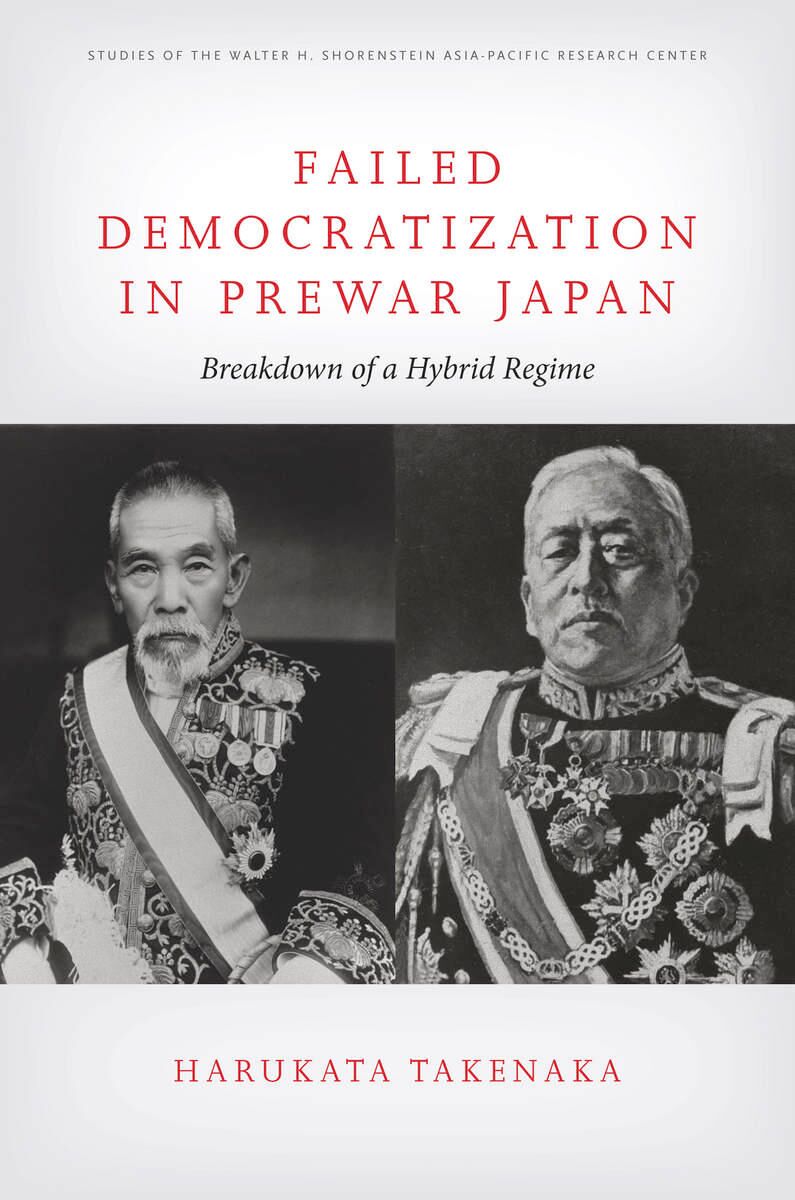
Failed Democratization in Prewar Japan
Failed Democratization in Prewar Japan presents a compelling case study on change in political regimes through its exploration of Japan's transition to democracy. Within a broad-ranging examination of Japan's \"semi-democratic\" political system from 1918 to 1932, when political parties tended to dominate the government, the book analyzes in detail why this system collapsed in 1932 and discusses the implications of the failure.
By reference to comparable cases-prewar Argentina, prewar Germany, postwar Brazil, and 1980s Thailand-Harukata Takenaka reveals that the factors responsible for the breakdown of the Taisho democracy in Japan replicated those that precipitated the collapse of democracy in Europe, Latin America, and elsewhere in Asia.
While most literature on these transitions focuses on successful cases, Takenaka explores democratic failure to answer questions about how and why political parties and their leaders can behave in ways that undermine the democratic institutions that serve as the basis for their formal authority.
eBook


Building Democracy in Japan
How is democracy made real? How does an undemocratic country create new institutions and transform its polity such that democratic values and practices become integral parts of its political culture? These are some of the most pressing questions of our times, and they are the central inquiry of Building Democracy in Japan. Using the Japanese experience as starting point, this book develops a new approach to the study of democratization that examines state-society interactions as a country adjusts its existing political culture to accommodate new democratic values, institutions and practices. With reference to the country's history, the book focuses on how democracy is experienced in contemporary Japan, highlighting the important role of generational change in facilitating both gradual adjustments as well as dramatic transformation in Japanese politics.
eBook


Nationalism, Political Realism and Democracy in Japan
Masao Maruyama was the most influential and respected political thinker in post-WWII Japan. He believed that the collective mentality, inherent in the traditional Japanese way of thinking, was a key reason for the defeat in WWII and was convinced that such thought needed to be modernized. In this book Fumiko Sasaki argues that the cause of the prolonged political, economic and social decline in Japan since the early 1990s can be explained by the same characteristics Maruyama identified after 1945.
Using Maruyama's thought Sasaki explores how the Japanese people see their role in their nation, the democracy imposed by the US, and the relationship between power and international relations. Further, Sasaki also considers what the essence of national security is and how much it has been forgotten in current Japanese political thought. The book solves the puzzle of how Maruyama, a teacher of political realism who emphasized the importance of power, could insist on the policy of unarmed neutrality for Japan's national security, and in doing so, illuminates how traditional Japanese thought has impacted development in Japan.
Despite his status within Japan, there are few English language books available on Maruyama and his thought on national security. This book therefore will be an essential resource for students and scholars of Japanese Politics and Political Thought.
eBook

Ruffians, Yakuza, Nationalists
Violence and democracy may seem fundamentally incompatible, but the two have often been intimately and inextricably linked. InRuffians, Yakuza, Nationalists, Eiko Maruko Siniawer argues that violence has been embedded in the practice of modern Japanese politics from the very inception of the country's experiment with democracy.
As soon as the parliament opened its doors in 1890, brawls, fistfights, vandalism, threats, and intimidation quickly became a fixture in Japanese politics, from campaigns and elections to legislative debates. Most of this physical force was wielded by what Siniawer calls \"violence specialists\": ruffians and yakuza. Their systemic and enduring political violence-in the streets, in the halls of parliament, during popular protests, and amid labor strife-ultimately compromised party politics in Japan and contributed to the rise of militarism in the 1930s.
For the post-World War II years, Siniawer illustrates how the Japanese developed a preference for money over violence as a political tool of choice. This change in tactics signaled a political shift, but not necessarily an evolution, as corruption and bribery were in some ways more insidious, exclusionary, and undemocratic than violence. Siniawer demonstrates that the practice of politics in Japan has been dangerous, chaotic, and far more violent than previously thought. Additionally, crime has been more political.
Throughout the book, Siniawer makes clear that certain yakuza groups were ideological in nature, contrary to the common understanding of organized crime as nonideological.Ruffians, Yakuza, Nationalistsis essential reading for anyone wanting to comprehend the role of violence in the formation of modern nation-states and its place in both democratic and fascist movements.
eBook