
Catalogue Search | MBRL


Are you sure you want to remove the book from the shelf?

{{itemTitle}}
1,265
result(s) for
"Democracy Pakistan."
Sort by:


India, Pakistan, and Democracy
The question of why some countries have democratic regimes and others do not is a significant issue in comparative politics. This book looks at India and Pakistan, two countries with clearly contrasting political regime histories, and presents an argument on why India is a democracy and Pakistan is not. Focusing on the specificities and the nuances of each state system, the author examines in detail the balance of authority and power between popular or elected politicians and the state apparatus through substantial historical analysis.
India and Pakistan are both large, multi-religious and multi-lingual countries sharing a geographic and historical space that in 1947, when they became independent from British rule, gave them a virtually indistinguishable level of both extreme poverty and inequality. All of those factors militate against democracy, according to most theories, and in Pakistan democracy did indeed fail very quickly after Independence. It has only been restored as a façade for military-bureaucratic rule for brief periods since then. In comparison, after almost thirty years of democracy, India had a brush with authoritarian rule, in the 1975-76 Emergency, and some analysts were perversely reassured that the India exception had been erased. But instead, after a momentous election in 1977, democracy has become stronger over the last thirty years.
Providing a comparative analysis of the political systems of India and Pakistan as well as a historical overview of the two countries, this textbook constitutes essential reading for students of South Asian History and Politics. It is a useful and balanced introduction to the politics of India and Pakistan.
1. Introduction: Why India is a Democracy and Pakistan is not (yet?) a Democracy Part 1 : The First Thirty Years of Independence 2. Inheritances of Colonial rule 3. Constitutional & Political Choices, in the initial years 4. Institutionalizing Democracy 5. Who (Really) Governs? Part 2: From 1977 to the present 6. 1977 as a Turning Point? 7. Religion as an Explanation 8. External Influences 9. Clearly Diverging Paths 10. Prospects for Path Convergence in the Next Decades 11. Conclusion
Philip Oldenburg is a Research Scholar at the South Asia Institute of Columbia University, where he has taught political science since 1977. He has done field research in India on local self-government, and on national elections and has been editor or co-editor of ten books in the India Briefing series.
'This book deals with a most interesting and rather unexplored problem: why has India become a robust democracy and Pakistan ended up by being a military-ruled country while both of them share similar cultural features and emerged from the same history (including the colonial experience)?
Philip Oldenburg has not only chosen an excellent topic, he is also very well informed and gets his facts right. To present such an ambitious comparison in this format is a tour de force.' -- Christophe Jaffrelot, Senior Research Fellow CNRS, France
'This fine book, full of insight and wisdom, reflects Philip Oldenburg’s long scholarly engagement with the study of South Asian politics, and offers a magisterial synthesis of a wide literature in developing what will surely stand as the definitive comparative analysis of the political systems of India and Pakistan.' -- John Harriss, School for International Studies, Simon Fraser University, Canada
'This is the first major attempt to solve the puzzle of democratic divergence by looking at two countries with near-identical cultural, political, and social origins. Dr. Oldenburg's book is uniquely informed by deep familiarity with both India and Pakistan, and by a solid grasp of the relevant scholarly literature. It is a landmark in both regional studies and comparative political analysis, and will inform all future work on the democratization process.' -- Stephen P. Cohen, Brookings Institution, USA
\"It's impossible for this review to do full justice to this richly-detailed, cool-headed, well-grounded must read for anyone interested in South Asia--or in the study of democracy.\" -- Patricia Lee Sharpe, Whirled View
\"The book is carefully researched, well documented, and clearly argued...Policy analysts, journalists, and students interested in the contemporary politics of India and Pakistan will benefit considerably from a careful perusal of this book.\" -- Sumit Ganguly, H-Asia
\"This book offers a nuanced assessment which shows that while India and Pakistan have not converged on an authoritarian model, they have much in common... Thoughtful questions are asked, difficult issues considered and a large amount of material is synthesised. Scholars, students and teachers alike will find this book very useful.\" - Andrew Wyatt, University of Bristol, UK; Pacific Affairs: Volume 85, No. 2 - June 2012
eBook


Pakistan's Enduring Challenges
From the start of the U.S. war in Afghanistan in 2001 to the withdrawal of U.S. troops in 2014, Pakistan's military cooperation was critical to the United States. Yet Pakistani politics remain a source of anxiety for American policymakers. Despite some progress toward democratic consolidation over the last ten years, Pakistan's military still asserts power over the country's elected government. Pakistan's western regions remain largely ungoverned and home to the last remnants of al-Qaeda's original leadership as well as multiple militant groups that have declared war on the Pakistani state. The country's economy is in shambles, and continuing tensions with India endanger efforts to bring a durable peace to a region haunted by the distant threat of nuclear war.
Pakistan's Enduring Challengessurveys the political and economic landscape of Pakistan in the wake of U.S. military withdrawal. Experts in the domestic and international affairs of the region consider the country's prospects from a variety of angles, including security issues and nuclear posture, relations with Afghanistan, India, and the United States, Pakistan's Islamist movements, and the CIA's use of drone warfare in Pakistan's tribal areas. This timely volume offers a concise, accessible, and expert guide to the currents that will shape the country's future.
Contributors: Christopher Clary, C. Christine Fair, Daveed Gartenstein-Ross, Karl Kaltenthaler, Feisal Khan, William J. Miller, Aparna Pande, Paul Staniland, Stephen Tankel, Tara Vassefi, Sarah J. Watson, Joshua T. White, Huma Yusef.
eBook

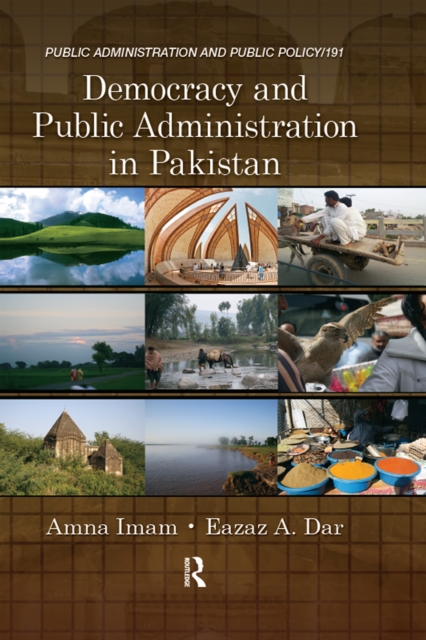
Democracy and Public Administration in Pakistan
This book explores the role of the grass roots public administrative institution of DC & DM in historical context for Pakistan, and its viability for a meaningful democracy and stability of the country. The authors contend that Pakistan's democracy to-date lacks firm foundation, as evidenced by the country's disintegration in 1971, violence and drugs in the 80s, crime infested communities in the 90s, terrorism in the 2000s, and the current volatile situation in Balochistan and FATA, as well as high crime rate and lacking sense of security among the communities of Pakistan.
eBook
No Sign of Democracy in Pakistan
In a military coup led by Gen. Pervez Musharraf, the prime minister of Pakistan was overthrown and the military took control of the government. A review of Pakistani history reveals that \"whenever the powerful military judges civilian governments too inept and corrupt, the generals intervene\" (LOS ANGELES TIMES). The future of Pakistan under the leadership of Gen. Pervez Musharraf is discussed.
Newspaper Article

A Difficult Country: Pakistan and the Case for Developmental Realism
\"The difficulty that Pakistan presents to U.S. policymakers...goes beyond that of tactics. This country challenges some dominant and paradigmatic American ways of seeing the world and thinking about history, democracy and progress...Pakistan is likely to remain a kind of client state of the American empire, sometimes cooperative and sometimes recalcitrant, and U.S. policy will have to be calibrated accordingly.\" (National Interest) In this article, the author discusses American foreign policy and Pakistan and asserts that \"the United States will never have any choice but to work with and through a Pakistani government--almost any Pakistani government--if it wishes to exert any wider control over the fight against terrorism and extremism in Pakistan.\"
Magazine Article

Pakistan: Dictating Democracy
\"The Taliban collapse next door has put pressure on Pakistan. Gen. Pervaiz Musharraf, wrestling with Islamic extremism and tensions with India, is banking on a balance of military rule and democracy to hold his country together--and hold on to power.\" (Far Eastern Economic Review) This article describes the tasks ahead for Musharraf, who must deal with the U.S.-led war on terrorism, tensions with India and Muslim extremism at home. Included is a look at how the United States is trying to maintain a coalition with Pakistan and its rival neighbor, India.
Magazine Article
Precedented
\"In a ceremony at Islamabad's presidential palace on June 20 [2001], Gen. Pervaiz Musharraf became Pakistan's fourth military ruler to appoint himself president.\" (FAR EASTERN ECONOMIC REVIEW) This article speculates on how Musharraf's move will affect negotiations with India over the disputed Kashmir region and upcoming elections in Pakistan.
Magazine Article