
Catalogue Search | MBRL


Are you sure you want to remove the book from the shelf?

{{itemTitle}}
149
result(s) for
"Democracy Peru History."
Sort by:


Resource Extraction and Protest in Peru
Natural resource extraction has fueled protest movements in Latin America and existing research has drawn considerable scholarly attention to the politics of antimarket contention at the national level, particularly in Ecuador, Bolivia, and Argentina. Despite its residents reporting the third-highest level of protest participation in the region, Peru has been largely ignored in these discussions.In this groundbreaking study, Moisés Arce exposes a longstanding climate of popular contention in Peru. Looking beneath the surface to the subnational, regional, and local level as inception points, he rigorously dissects the political conditions that set the stage for protest. Focusing on natural resource extraction and its key role in the political economy of Peru and other developing countries, Arce reveals a wide disparity in the incidence, forms, and consequences of collective action.Through empirical analysis of protest events over thirty-one years, extensive personal interviews with policymakers and societal actors, and individual case studies of major protest episodes, Arce follows the ebb and flow of Peruvian protests over time and space to show the territorial unevenness of democracy, resource extraction, and antimarket contentions. Employing political process theory, Arce builds an interactive framework that views the moderating role of democracy, the quality of institutional representation as embodied in political parties, and most critically, the level of political party competition as determinants in the variation of protest and subsequent government response. Overall, he finds that both the fluidity and fragmentation of political parties at the subnational level impair the mechanisms of accountability and responsiveness often attributed to party competition. Thus, as political fragmentation increases, political opportunities expand, and contention rises. These dynamics in turn shape the long-term development of the state.Resource Extraction and Protest in Peruwill inform students and scholars of globalization, market transitions, political science, contentious politics and Latin America generally, as a comparative analysis relating natural resource extraction to democratic processes both regionally and internationally.
eBook

Determinants of Democratization
What are the determinants of democratization? Do the factors that move countries toward democracy also help them refrain from backsliding toward autocracy? This book attempts to answer these questions through a combination of a statistical analysis of social, economic, and international determinants of regime change in 165 countries around the world in 1972–2006, and case study work on nine episodes of democratization occurring in Argentina, Bolivia, Hungary, Nepal, Peru, the Philippines, South Africa, Turkey, and Uruguay. The findings suggest that democracy is promoted by long-term structural forces such as economic prosperity, but also by peaceful popular uprisings and the institutional setup of authoritarian regimes. In the short-run, however, elite actors may play a key role, particularly through the importance of intra-regime splits. Jan Teorell argues that these results have important repercussions both for current theories of democratization and for the international community's effort in developing policies for democracy promotion.
eBook

The Fujimori Legacy
President Alberto Fujimori’s sudden resignation in November 2000 brought an end to a highly controversial period in Peruvian history. His meteoric rise to power in 1990 fueled by widespread popular support, followed by his decision to dissolve Congress and rule by decree in 1992, has made his regime a focus of special attention by scholars trying to understand this complex and contradictory presidency.This book offers a comprehensive assessment of Fujimori’s regime in the context of Latin America’s struggle to consolidate democracy after years of authoritarian rule. Setting the regime conceptually in a discussion of alternative forms of government—delegative democracy, neopopulism, and electoral authoritarianism—the essays study it from two different perspectives: external (in its relations with political parties, Lima’s mayors, public opinion, women, the U.S. government) and internal (examining economic policies as determined by governing coalitions, networks of corruption, and Fujimori’s unsavory relationship with his security advisor Vladimiro Montesinos). Overall, The Fujimori Legacy helps illuminate the persistent obstacles that Latin American countries face in establishing democracy.In addition to the editor, contributors are Robert Barr, Maxwell Cameron, Catherine Conaghan, Henry Dietz, Philip Mauceri, Cynthia McClintock, David Scott Palmer, Kenneth Roberts, Gregory Schmidt, John Sheahan, Kurt Weyland, and Carol Wise.
eBook

The fate of Peruvian democracy : political violence, human rights, and the legal left
Tamara Feinstein investigates the bloody Shining Path conflict's effect on the legal Left in late-twentieth-century Peru, illustrating the catastrophic impact state and insurgent violence can have on the growth and resilience of democratic political actors during times of war. In this engaging historical study, Tamara Feinstein chronicles the late-twentieth-century Shining Path conflict and argues that it significantly contributed to the rupture and disintegration of the noninsurgent legal Left in Peru by deepening preexisting divisions and eradicating an entire generation of leaders. Using a combination of oral histories, archival documents, contemporary media accounts, and participant observation of commemorations, Feinstein maps the trajectory of the Peruvian Left's rise and fall by analyzing two emblematic human rights cases that occurred at the Left's zenith and nadir: the state-based violence of the 1986 Lima prison massacres and the 1992 Shining Path assassination of leftist shantytown leader María Elena Moyano. The lessons found in The Fate of Peruvian Democracy reach beyond Peru to connect with other Latin American countries. Peru's story illustrates the difficulties of accumulating political force during times of violence, underscores how struggles for self-defense can complicate ideological stances on violence, and helps explain the unevenness of the resurgence of the Left (the so-called \"pink tide\") in Latin America in the twenty-first century. The book contributes to debates on memory and human rights in Peru and Latin America where divisions over how to remember the war retraced the fault lines of earlier debates over democracy and violence.
eBook

Universality and Utopia
This book explores the intersection between philosophical and literary universalism in Latin America, tracing its configuration within the twentieth-century Peruvian socialist indigenista tradition, following from the work of José Carlos Mariátegui and elaborated in the literary works of César Vallejo and José MaríaArguedas. Departing from conventional accounts that interpret indigenismo as part of a regionalist literature seeking to describe and vindicate the rural Indian in particular, I argue that Peruvian indigenista literature formed part of a historical sequence through which urban mestizo intellectuals sought to imagine a future for Peruvian society as a whole. Going beyond the destiny of acculturation imagined by liberal writers, such as Manuel González Prada, in the late nineteenth century, I show how the socialist indigenista tradition imagined a bilateral process of appropriation and mediation between the rural Indian and mestizo, integrating pre-Hispanic, as well as Western cultural and economic forms, so as to give shape to a process of alternative modernity apposite to the Andean world. In doing so, indigenista authors interrogated the foundations of European Marxism in light of the distinctiveness of Peruvian society and its history, expressing ever more nuanced figurations of the emancipatory process and the forms of its revolutionary agency.
eBook

An opportunity for a different Peru : prosperous, equitable, and governable
For the first time in the republican history of Peru, the presidential transition takes place in democracy, social peace, fast economic growth and favorable world markets. In other words, there has never been a better chance to build a different Peru - a richer country, more equal and governable. There are multiple ways to achieve that goal. New reforms must stem from a widespread and participatory debate, one of a common vision conceived for and by Peruvians. This book aims at making a technical and independent contribution to such debate; it summarizes the knowledge available about the challenges to be faced by the new administration. The study does not recommend silver bullets, but suggests policy options. It is based on the analysis of the current reality and in six decades of relationships with Peru, in which the Bank has implemented more than 100 projects and prepared more than 500 technical reports covering the wide range of development topics. When necessary, the study provides lessons that the Bank has learned elsewhere. The study provides a conceptual framework to the analysis of the country's 34 economic sectors and the two historical perspectives behind them. In doing so, it offers a comprehensive reform agenda that sheds light on possible priorities and courses of action.
eBook

Democratic Socialism in Chile and Peru: Revisiting the “Chicago Boys” as the Origin of Neoliberalism
In the 1950s and 1960s, the U.S. government paid the economics department at the University of Chicago, known for its advocacy of free markets and monetarism, to train Chilean graduate students. These students became known as the “Chicago Boys,” who implemented the first and most famous neoliberal experiment in Chile after 1973. Peruvian, Mexican, and other Latin American economics students followed a similar path and advocated a turn to neoliberal policies in their own countries. The Chicago Boys narrative has become an origin story for global neoliberalism. However, the focus on this narrative has obscured other transnational networks whose ideas possess certain superficial, but misleading, similarities with neoliberalism. I examine Chilean and Peruvian engagements with Yugoslavia's unique form of socialism, its worker self-management socialism, which was part of a worldwide discussion of anti-authoritarian socialism. I first introduce the Yugoslav socialist model that inspired those in Chile and Peru. I then examine socialist discussions in Chile and Peru that called for decentralized, democratic socialism and looked to Yugoslavia for advice. I conclude by examining the 1990s postponement of socialism in the name of a very narrow democracy and realization of neoliberalism. The Chicago Boys story assumes the easy global victory of neoliberalism and erases what was at stake in the 1988–1994 period: radically democratic socialism on a global scale.
Journal Article
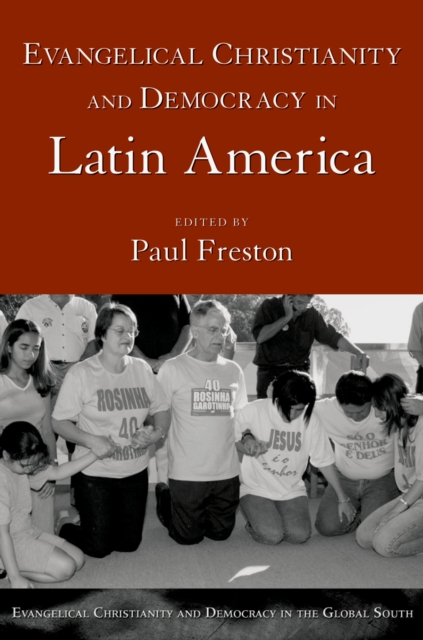
Evangelical Christianity and Democracy in Latin America
This book seeks to answer the question: What happens when a revivalist religion based on scriptural orthodoxy participates in the volatile politics of the Third World? Is the result a democratic politics of the ballot box, or is it more like an authoritarian politics of command from on high? Does the evangelical faith of the Bible hinder or promote a politics of the ballot box? At a time when the global-political impact of another revivalist and scriptural religion—Islam—fuels vexed debate among analysts the world over, this book aims to offer an unusual comparative perspective on a critical issue: The often combustible interaction of resurgent religion and the developing world's unstable politics. This book considers the case of Latin America, where evangelical Protestantism is increasingly challenging the historical Catholic hegemony in the religious sphere. In Latin America, Protestant identity was forged in relation to the dominant Catholicism, producing an “adversarial” style of Protestantism. This necessarily colors the role of evangelicalism in Latin America civil society. The Introduction to this book offers a historical overview of evangelicalism in the region. The book then offers individual case studies of five countries: Brazil, Peru, Mexico, Guatemala, and Nicaragua.
eBook

Intervention without intervening? : the OAS defense and promotion of democracy in the Americas
This book looks at the evolution of the Organization of American States (OAS) multilateralism for democracy and the lessons its experience holds for other multilateral contexts. It also tackles the theoretical challenge of bridging the traditional divide between international relations and comparative politics.
eBook