
Catalogue Search | MBRL


Are you sure you want to remove the book from the shelf?

{{itemTitle}}
1,034
result(s) for
"Democracy Soviet Union History."
Sort by:

The picnic : an escape to freedom and the collapse of the iron curtain
In August 1989, a group of Hungarian activists did the unthinkable: they entered the forbidden militarised zone of the Iron Curtain - and held a picnic. Word had spread of what was going to happen. On wisps of rumour, thousands of East German 'holiday-makers' had made their way to the border between Hungary and Austria and packed the nearby camping sites, awaiting an opportunity, fearing prison, surveilled by lurking Stasi agents. The highest state authorities were choosing to turn a blind eye - but that could change at any moment. The stage was set for the greatest border breach in Cold War history: that day hundreds would cross from the Communist East to the longed-for freedom of the West. The fall of the Berlin Wall, the end of the Soviet Union - the so-called end of history - all would flow from those dramatic hours.
Book

The Russian quest for peace and democracy
In The Russian Quest for Peace and Democracy, Metta Spencer recounts the political and military changes that have occurred in Russia up to mid-2010. Using hundreds of interviews she conducted with officials, dissidents, and liberal intellectuals, she describes the various groups, forces, and individuals that worked to liberalize the totalitarian Soviet Union and its fellow nations behind the Iron Curtain, and which ultimately brought about the dissolution of those repressive governments. Spencer identifies four political orientations to describe Soviet society: \"Sheep,\" ordinary citizens who accepted the undemocratic regime they lived in without challenging it; \"Dinosaurs,\" hard-line Communist officials; \"Termites,\" including Mikhail Gorbachev and his advisers and government; and \"Barking Dogs,\" a few hundred dissidents who made \"a lot of noise\" protesting, hoping to awaken a grass-roots demand for democracy. The strange rivalry between the Termites and Barking Dogs would ultimately doom perestroika. Spencer's research dispels the widely-held perception that US President Ronald Reagan \"won\" the Cold War by standing firm until the Soviet Union \"blinked first.\" There are vitally important lessons to be learned from the Soviet period, about how to assist citizens of totalitarian and authoritarian regimes around the world. The irony is that transnational civil society organizations, major sources of the progress in Soviet Russia, are still needed today in authoritarian Russia, under Vladimir Putin and Dmitry Medvedev, for totalitarianism remains a potential social trap. In The Russian Quest for Peace and Democracy, Metta Spencer suggests new ways of building urgently-needed social capital in today's Russia, where democracy has yet to flourish.
eBook

The policy-making process and social learning in Russia : the case of housing policy
\"In a relevant and cutting edge analysis, this book examines policy-making in Russia as a process of social learning, using the case of housing policy. Centering its study around three explanatory variables - actors, institutions and ideas - it argues that Russia's hybrid institutional environment reduces the competition of policy ideas, both at the stage of policy elaboration by the community of state and non-state policy experts, and also at the stage of policy adoption by parliament. Consequently policies only partially satisfy key societal needs, and require frequent revisions of the paradigmatic basis of policy. The book also highlights the importance of gradual institutional evolution, as a mode of policy development that produces fundamental transformation of policy over time and changes in government which can result in abrupt shift in policy\"-- Provided by publisher.
Book

The Socialist Way of Life in Siberia
The Buryats are a Mongolian population in Siberian Russia, the largest indigenous minority. The Socialist Way of Life in Siberia presents the dramatic transformation in their everyday lives during the late twentieth century. The book challenges the common notion that the process of modernization during the later Soviet period created a Buryat national assertiveness rather than assimilation or support for the state.
eBook

America's mission
America's Missionargues that the global strength and prestige of democracy today are due in large part to America's impact on international affairs. Tony Smith documents the extraordinary history of how American foreign policy has been used to try to promote democracy worldwide, an effort that enjoyed its greatest triumphs in the occupations of Japan and Germany but suffered huge setbacks in Latin America, Vietnam, and elsewhere. With new chapters and a new introduction and epilogue, this expanded edition also traces U.S. attempts to spread democracy more recently, under presidents Clinton, Bush, and Obama, and assesses America's role in the Arab Spring.
eBook

Socialist Fun
Most narratives depict Soviet Cold War cultural activities and youth groups as drab and dreary, militant and politicized. In this study Gleb Tsipursky challenges these stereotypes in a revealing portrayal of Soviet youth and state-sponsored popular culture.The primary local venues for Soviet culture were the tens of thousands ofklubswhere young people found entertainment, leisure, social life, and romance. Here sports, dance, film, theater, music, lectures, and political meetings became vehicles to disseminate a socialist version of modernity. The Soviet way of life was dutifully presented and perceived as the most progressive and advanced, in an attempt to stave off Western influences. In effect, socialist fun became very serious business. As Tsipursky shows, however, Western culture did infiltrate these activities, particularly at local levels, where participants and organizers deceptively cloaked their offerings to appeal to their own audiences. Thus, Soviet modernity evolved as a complex and multivalent ideological device.Tsipursky provides a fresh and original examination of the Kremlin's paramount effort to shape young lives, consumption, popular culture, and to build an emotional community-all against the backdrop of Cold War struggles to win hearts and minds both at home and abroad.
eBook

Russia and the Long Transition from Capitalism to Socialism
Out of early twentieth-century Russia came the world's first
significant effort to build a modern revolutionary society.
According to Marxist economist Samir Amin, the great upheaval that
once produced the Soviet Union has also produced a movement away
from capitalism - a long transition that continues even today. In
seven concise, provocative chapters, Amin deftly examines the
trajectory of Russian capitalism, the Bolshevik Revolution, the
collapse of the Soviet Union, the possible future of Russia - and,
by extension, the future of socialism itself.
Amin manages to combine an analysis of class struggle with
geopolitics - each crucial to understanding Russia's singular and
complex political history. He first looks at the development (or
lack thereof) of Russian capitalism. He sees Russia's geopolitical
isolation as the reason its capitalist empire developed so
differently from Western Europe, and the reason for Russia's
perceived \"backwardness.\" Yet Russia's unique capitalism proved to
be the rich soil in which the Bolsheviks were able to take power,
and Amin covers the rise and fall of the revolutionary Soviet
system. Finally, in a powerful chapter on Ukraine and the rise of
global fascism, Amin lays out the conditions necessary for Russia
to recreate itself, and perhaps again move down the long road to
socialism. Samir Amin's great achievement in this book is not only
to explain Russia's historical tragedies and triumphs, but also to
temper our hopes for a quick end to an increasingly insufferable
capitalism.
This book offers a cornucopia of food for thought, as well as an
enlightening means to transcend reductionist arguments about
\"revolution\" so common on the left. Samir Amin's book - and the
actions that could spring from it - are more necessary than ever,
if the world is to avoid the barbarism toward which capitalism is
hurling humanity.
eBook

The Socialist Sixties
The 1960s have reemerged in scholarly and popular culture as a protean moment of cultural revolution and social transformation. In this volume socialist societies in the Second World (the Soviet Union, East European countries, and Cuba) are the springboard for exploring global interconnections and cultural cross-pollination between communist and capitalist countries and within the communist world. Themes explored include flows of people and media; the emergence of a flourishing youth culture; sharing of songs, films, and personal experiences through tourism and international festivals; and the rise of a socialist consumer culture and an esthetics of modernity. Challenging traditional categories of analysis and periodization, this book brings the sixties problematic to Soviet studies while introducing the socialist experience into scholarly conversations traditionally dominated by First World perspectives.
eBook

From Eastern Bloc to European Union
More than 25 years after the fall of the Soviet Union, European integration remains a work in progress, especially in those Eastern European nations most dramatically reshaped by democratization and economic liberalization. This volume assembles detailed, empirically grounded studies of eleven states—Estonia, Latvia, Lithuania, Poland, the Czech Republic, Slovakia, Hungary, Romania, Bulgaria, Slovenia, and the former East Germany—that went on to join the European Union. Each chapter analyzes the political, economic, and social transformations that have taken place in these nations, using a comparative approach to identify structural similarities and assess outcomes relative to one another as well as the rest of the EU.
eBook
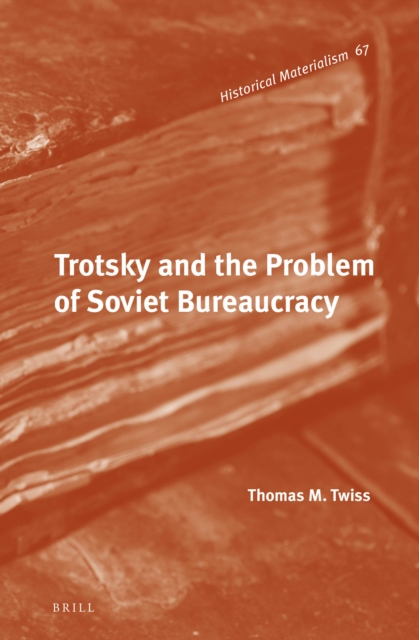
Trotsky and the Problem of Soviet Bureaucracy
In Trotsky and the Problem of Soviet Bureaucracy, Thomas M. Twiss traces the development of Trotsky's thinking on the issue of post-revolutionary bureaucracy from the first years after the Bolshevik Revolution through the Moscow Trials of the 1930s.
eBook