
Catalogue Search | MBRL


Are you sure you want to remove the book from the shelf?

{{itemTitle}}
1,772
result(s) for
"Democracy Turkey."
Sort by:


Turkey in Africa
This book offers a comprehensive and multidisciplinary analysis of Turkey-Africa relations.
Bringing together renowned authors to discuss various dimensions of Turkey's African engagement while casting a critical analysis on the sustainability of Turkey-Africa relations, this book draws upon the rising power literature to examine how Turkish foreign policy has been conceptualized and situated theoretically. Moving from an examination of the economic and military dimensions of Turkey's policy including trade relations, business practices, security cooperation and peacekeeping discourse, it then illuminates the multilateral dimension of Turkey's Africa policy with a focus on soft power instruments of public diplomacy, humanitarian/development assistance, religious activities and airline diplomacy. Overall, it shows how Turkey's African opening can be integrated into its wider interest in gaining global power status and its desire to become a strong regional power.
This book will be of key interest to scholars and students of Turkish foreign policy/politics, African politics, and more broadly to international relations.
eBook


Turkey under Erdogan
An incisive account of Erdogan's Turkey - showing how its troubling transformation may be short-lived Since coming to power in 2002 Recep Tayyip Erdogan has overseen a radical transformation of Turkey. Once a pillar of the Western alliance, the country has embarked on a militaristic foreign policy, intervening in regional flashpoints from Nagorno-Karabakh to Libya. And its democracy, sustained by the aspiration to join the European Union, has given way to one-man rule. Dimitar Bechev traces the political trajectory of Erdogan's populist regime, from the era of reform and prosperity in the 2000s to the effects of the war in neighboring Syria. In a tale of missed opportunities, Bechev explores how Turkey parted ways with the United States and Europe, embraced Putin's Russia and other revisionist powers, and replaced a frail democratic regime with an authoritarian one. Despite this, he argues that Turkey's democratic instincts are resilient, its economic ties to Europe are as strong as ever, and Erdogan will fail to achieve a fully autocratic regime.
eBook

The relationship between democracy and education
This e-book offers readers insights into knowledge related to maternal habits or disorders that could affect fetal development and lead to disability later in childhood and adulthood. It is written in a multidisciplinary context and would be a handy reference to a wide spectrum of readers including students, clinicians (obstetricians, neonatologists, pediatricians) and basic scientists in gynecology.
eBook

EU-Turkey relations : civil society and depoliticization
\"This book focuses on the hidden but ever-present civil society dimension of the EU's policies towards Turkey and uncovers the pitfall of EU-Turkey relations. It establishes the growing depoliticization of Turkish civil society (in contrast to what the EU's policies aimed for) and engages with the questions of why and how Turkish civil society depoliticized. It discusses how Turkey's retreating democracy, and the intense polarization in Turkish political and social life make rights-based activism more difficult. Finally, this book investigates what implications Turkish civil society's depoliticization bears for EU-Turkey relations, reveals the diminishing leverage of the EU's policies and discusses how this reflects on Turkey's already closing civic space. It explains why and how EU-Turkey relations deteriorated over the last decade, examines the current stalemate, and discusses why civil society matters. This text will be of key interest to scholars and students in the field of EU-Turkey relations, Turkish studies and civil society studies as well as more broadly to NGOs, European studies and politics, and International Relations\"-- Provided by publisher.
Book
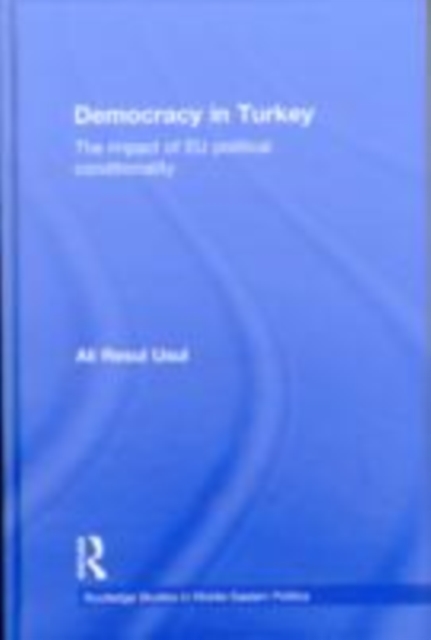
Democracy in Turkey
This book examines the impact of European political conditionality on the process of democratization in Turkey over a twenty year period. Employing theoretical and conceptual approaches to the issue of EU conditionality, the author compares the case of Turkey to that of other European nations.
Arguing that Turkey became vulnerable to the European conditionality when it applied for membership in 1987, he shows how the political reforms demanded of Turkey were not fully carried out as the EU had not in essence accepted Turkey as an official candidate during this period. The EU has started to exert real ‘active leverage’ since Turkey was declared an official candidate in 1999, and the author explores how these conditions have exerted a positive influence on democratic consolidation in Turkey. However, its effectiveness in this regard has diminished to a significant extent due to a number of problems that have continued to remain central in EU-Turkey relations.
This comprehensive analysis of Turkey-EU political relations and democratization places the case of Turkey within an international context. As such, it will be of interest not only to those studying Turkish politics, government and democracy, but anyone working in the area of international relations and the EU.
Introduction 1. International Politics of Democratic Consolidation: Theoretical and Conceptual Perspectives 2. The Nature and Impact of the EU Political Conditionality 3. The EU Conditionality and Democracy in Turkey: Pre-Helsinki Period 4. The EU Conditionality and Democracy in Turkey: Post-Helsinki Period 5. The Impact of the EU Conditionality in Turkey. Conclusion
Ali Resul Usul is an Associate Professor at Bahcesehir University in Istanbul, Turkey. He completed his BA, MA and PhD studies at Bogazici University (in Istanbul), Bilkent University (in Ankara) and University of Essex, and has published extensively on Turkey-EU relations.
eBook