
Catalogue Search | MBRL


Are you sure you want to remove the book from the shelf?

{{itemTitle}}
105
result(s) for
"Democratization Ghana."
Sort by:

Authoritarian origins of democratic party systems in Africa
\"Faced with a transition to multiparty democracy, many assume that breaking the power of incumbents is necessary to develop a stable, highly institutionalized party system. But, in fact, across Sub-Saharan Africa, the incumbent's demise is sufficient to ensure a highly volatile, weakly institutionalized party system in the democratic era. A strong authoritarian incumbent produces a more coherent, stable party competition, with the unintended consequences of promoting national territorial coverage; stronger partisan identities; opposition cohesion; and, ultimately, democratic accountability. In Ghana, for example, the incumbent military leader and authoritarian revolutionary J. J. Rawlings and his National Democratic Congress (NDC) party swept the founding elections in 1992. Since that time, Ghana has developed a highly institutionalized party system with low levels of volatility and an alternating majority between stable parties. Ghana has experienced two democratic turnovers, and the two major parties, the NDC and the New Patriotic Party (NPP), are deeply connected to their constituencies, they organize across the national territory to compete in every constituency, they mobilize participation during and beyond elections, and they aggregate coalitions of diverse citizens and interests. The NDC and the NPP alike are enduring entities that help shape individual partisan identities and structure national, regional, and local competition\"-- Provided by publisher.
Book
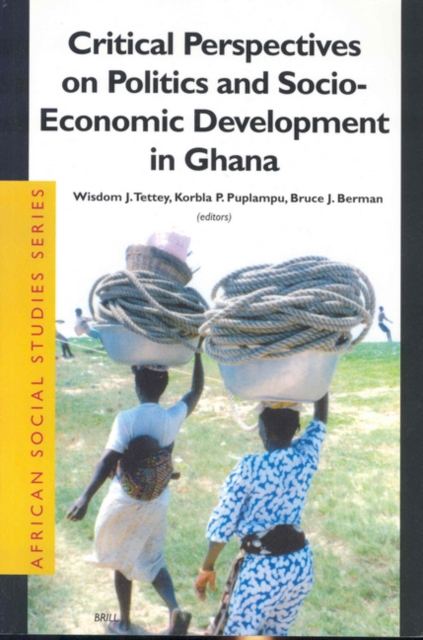
Critical perspectives in politics and socio-economic development in Ghana
This volume provides a comprehensive and integrated analysis of contemporary Ghanaian politics and economy and their relationship to culture. It combines rich, recent, empirical material with sophisticated theoretical analyses, bringing fresh and unique interdisciplinary perspectives to bear on the issues examined.
eBook

Democracy and the rise of women's movements in Sub-Saharan Africa
Despite a late and fitful start, democracy in Africa, Latin America, and Eastern Europe has recently shown promising growth. Kathleen M. Fallon discusses the role of women and women's advocacy groups in furthering the democratic transformation of formerly autocratic states.
Using Ghana as a case study, Fallon examines the specific processes women are using to bring about political change. She assesses information gathered from interviews and surveys conducted in Ghana and assays the existing literature to provide a focused look at how women have become involved in the democratization of sub-Saharan nations. The narrative traces the history of democratic institutions in the region—from the imposition of male-dominated mechanisms by western states to latter-day reforms that reflect the active resurgence of women's political power within many African cultures—to show how women have made significant recent political gains in Ghana and other emerging democracies.
Fallon attributes these advances to a combination of forces, including the decline of the authoritarian state and its attendant state-run women's organizations, newly formed constitutions, and newfound access to good-governance funding. She draws the study into the larger debate over gendered networks and democratic reform by exploring how gender roles affect and are affected by the state in Africa, Latin America, and Eastern Europe.
In demonstrating how women's activism is evolving with and shaping democratization across the region, Democracy and the Rise of Women's Movements in Sub-Saharan Africa reveals how women's social movements are challenging the barriers created by colonization and dictatorships in Africa and beyond.
eBook

Does Public Support for Judicial Power Depend on Who is in Political Power? Testing a Theory of Partisan Alignment in Africa
Judicial power is central to democratic consolidation and the rule of law. Public support is critical for establishing and protecting it. Conventional wisdom holds that this support is rooted in apolitical factors and not dependent on who is in political power. By contrast, we argue that support may be driven by instrumental partisan motivations and therefore linked to partisan alignment with the executive. We test the argument with survey evidence from 34 African countries. To provide causal evidence, we conduct difference-in-differences analyses leveraging Ghana’s three presidential transitions since 2000. Across Africa, support for judicial power is high, while trust in courts is lower. However, presidential copartisans are less supportive of horizontal judicial power over the president and more supportive of vertical power over the people. The article demonstrates the importance of partisan alignment with the executive in shaping support for judicial power, with implications for judicial behavior and legitimacy.
Journal Article

The role of International Civil Society Organizations in democratization: A crisp-set QCA approach to anti-corruption in Ghana
An anti-corruption strategy is essential in the process of continuous democratisation for effective governance. The objective of our study is to examine the mechanisms that contribute to an effective anticorruption strategy in a case study of civil society organisations in Ghana. These CSO cases illustrate the efforts of non-state actors to promote democracy in their interactions with Ghana’s government. A model of anticorruption strategy and the crisp-set qualitative comparative analysis (cs-QCA) method were employed to examine 264 cases of local civil societies in Ghana that responded to questions on the conditions for an effective anticorruption strategy. Our results indicate that no single condition is sufficient as an anti-corruption strategy. However, the role of international civil society organisations (RISCO) is necessary for any anticorruption strategy. RISCO has to be combined with freedom of expression, good leadership, fear of punishment, and training to provide an effective strategy. On the other hand, despite the fear of punishment, social trust and leadership, rules and regulations, and training, the absence of RISCO explains all ineffective anticorruption strategies. Therefore, Ghana’s anti-corruption strategy must always consider the role of organisations such as Amnesty International (AI), Transparency International (TI), and the Global Organization of Parliamentarians against Corruption (GOPAC) in mitigating corruption. Policymakers should therefore promote the presence of international civil society in Ghana because they ultimately contribute to democratization in addition to all government effort.
Journal Article

The Effects of Corruption Tolerance on Support for Democracy: Evidence from Africa
This article contributes to the literature on democracy in Africa, using the concept of “corruption tolerance” to understand the citizenry’s support for democracy. Using data from rounds 3 and 7 of the Afrobarometer in eighteen and thirty-four African countries, respectively, the study contends that those who are used to solving problems through corruption believe they are effective within the current system and that strengthening democratic institutions can shut down the channels through which corrupt people pursue their interests. Therefore, people’s tolerance for corruption is expected to decrease their support for democracy. Empirical models consistently confirm this expectation, highlighting the role of “corruption tolerance” in explaining African citizens’ lack of support for democracy and democratization. This sheds light on the perspective of African studies.
Journal Article

Revolutionary populism and democracy in Ghana
The article examines two decades of Jerry Rawlings’ rule in Ghana. It seeks to explain why Rawlings’ revolutionary populism did not develop in the direction that he envisaged: a new kind of popular democracy. Instead, Rawlings oversaw the reintroduction of Ghana's popularly preferred political system: ‘Western-style’ multi-party democracy, despite his avowed intention of not doing so. To what extent was this outcome surprising or puzzling? The article explains that it was neither surprising nor puzzling as Rawlings’ regime, the PNDC, lacked the capacity to introduce a radical new political system, despite his desire to do so. His aim – to craft a new kind of popular democracy – was not achievable as both internal and external opposition forces were stronger in their desire for multi-party democracy and a neo-liberal economic system.
Journal Article

THE POLITICS OF DEVELOPMENT UNDER COMPETITIVE CLIENTELISM: INSIGHTS FROM GHANA'S EDUCATION SECTOR
Debates over whether democracy or political clientelism would drive the politics of development in Africa have increasingly given way to more nuanced readings that seek to capture the dynamic interplay of these forms of politics. However, most current analyses struggle to identify the specific causal mechanisms through which politics shapes the actual distribution of resources. A political settlements approach, which emphasizes the distribution of 'holding power' -the ability to engage and survive in political struggles -within ruling coalitions, and how this shapes institutional functioning, can bring greater clarity to these debates. Our analysis shows that patterns of resource allocation within Ghana's education sector during 1993-2008 were closely shaped by the incentives generated by Ghana's competitive clientelistic political settlement, which overrode rhetorical concerns with national unity and inclusive development. This had particularly negative implications for the poorest northern regions, which have lacked holding power within successive ruling coalitions.
Journal Article

“The President's Prerogative”? The Cabinet Appointment Process in Ghana and the Implications for Gender Parity
This article seeks to understand why Ghana, unlike several other African countries, has seen relatively few women appointed as ministers to the cabinet since the transition to democracy. We draw on Annesley, Beckwith, and Franceschet's 2019 book Cabinets, Ministers and Gender, which provides an in-depth analysis of the cabinet appointment process in seven democracies (but no African cases) and demonstrates that the cabinet appointment process is gendered—that is, men and women have different (and unequal) opportunities to be appointed as cabinet ministers. This article covers Ghana's Fourth Republic, during which women's presence in cabinets has increased slowly but steadily. We rely on media reports from five recent presidential administrations and semistructured, in-depth interviews with selected informants, as well as other primary and secondary sources. We find that while Ghana has a fairly empowered president who could appoint a gender parity cabinet, the formal and informal rules governing the selection of cabinet ministers—for example, those related to regional balance and “minister MPs”—work against more women in the cabinet.
Journal Article

A Return to Khaki Rule? Democracy and Africa's Lost History of Military Government
Much of West Africa (and particularly the Sahel) may be once falling again under military government. This essay asks what, if anything, historians of Africa can contribute to an understanding of this phenomenon. I argue that writing the history and understanding the memory of military government will entail a renewed approach to political history and social theory. It will also entail confronting — just as so many citizens are currently doing — the peculiar failures of democracy in Africa's neoliberal era.
Journal Article