
Catalogue Search | MBRL


Are you sure you want to remove the book from the shelf?

{{itemTitle}}
72
result(s) for
"Democratization Kuwait."
Sort by:

The resilience of parliamentary politics in Kuwait : rentierism, ideology, and mobilization
\"This book is the first English language political history of Kuwaiti parliament. It also provides the first holistic treatment of grassroots contemporary Kuwaiti politics in English in over two decades, incorporating the country's political dynamics into broader debates about the limits of authoritarianism and the practice of democracy in the Arab world, particularly in oil-wealthy states. This book uses the lens of parliamentary elections as a means of understanding the political ideologies that have dominated in Kuwait since independence. As such, it situates the dynamics of Kuwaiti politics within broader political science debates about whether democratic institutions in \"hybrid regimes\" are meaningful arenas for popular contestation or only serve to enhance autocratic rule. Given the varying portrayals of Kuwait as robust authoritarianism, \"upgraded\" authoritarianism, or a noteworthy site of democratic participation, this book focuses on the ideologies that have mobilized political blocs, rather than solely focusing on the institutions of political power themselves. The book also assesses and examines the institutional setting that Kuwait presents and traces the dominant ideological strands in the country, as well as consider the comparative mobilizational potential of ascriptive identities like tribe and sect. The book includes extensive fieldwork and the use of Arabic and English primary sources\"-- Provided by publisher.
Book

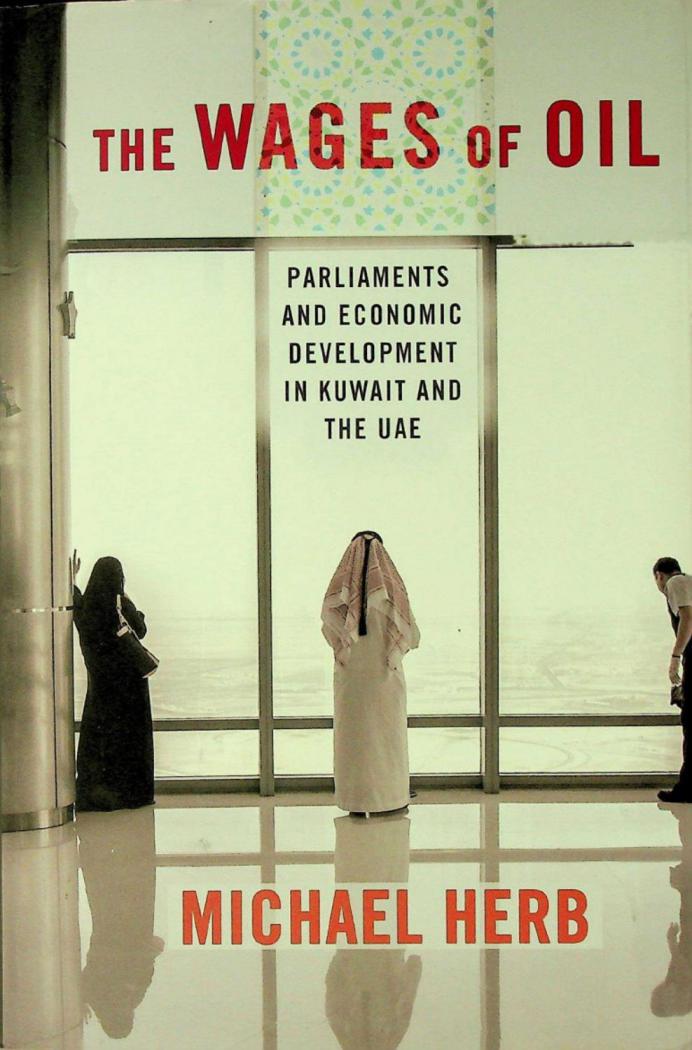
The Wages of Oil
The contrast between Kuwait and the UAE today illustrates the vastly different possible futures facing the smaller states of the Gulf. Dubai's rulers dream of creating a truly global business center, a megalopolis of many millions attracting immigrants in great waves from near and far. Kuwait, meanwhile, has the most spirited and influential parliament in any of the oil-rich Gulf monarchies.
InThe Wages of Oil, Michael Herb provides a robust framework for thinking about the future of the Gulf monarchies. The Gulf has seen enormous changes in recent years, and more are to come. Herb explains the nature of the changes we are likely to see in the future. He starts by asking why Kuwait is far ahead of all other Gulf monarchies in terms of political liberalization, but behind all of them in its efforts to diversify its economy away from oil. He compares Kuwait with the United Arab Emirates, which lacks Kuwait's parliament but has moved ambitiously to diversify.
This data-rich book reflects the importance of both politics and economic development issues for decision-makers in the Gulf. Herb develops a political economy of the Gulf that ties together a variety of issues usually treated separately: Kuwait's National Assembly, Dubai's real estate boom, the paucity of citizen labor in the private sector, class divisions among citizens, the caste divide between citizens and noncitizens, and the politics of land.
eBook

A NATION OF BUREAUCRATS: POLITICAL PARTICIPATION AND ECONOMIC DIVERSIFICATION IN KUWAIT AND THE UNITED ARAB EMIRATES
Not long ago, two safe generalizations could be made about the Gulf monarchies: ruling families dominated their politics, and oil dominated their economies. In recent years that has begun to change. In Kuwait the parliament challenges the political predominance of the ruling family. Meanwhile, Dubai and, increasingly, the other emirates of the United Arab Emirates (UAE) have made real progress in diversifying their economies away from oil—at least until the recent economic crisis. Yet political liberalization and economic diversification have not gone hand in hand: Kuwait's economy remains dependent on oil, and the United Arab Emirates remains resolutely authoritarian. This is no accident. Kuwait's high level of political participation encourages its dependence on oil while the UAE's economic diversification requires a lack of political participation by citizens. The reasons for this are specific to the peculiar political economy of these labor markets: in these richest of rentier-states, there is little need for the class compromise between capitalists and workers on which capitalist democracy usually rests.
Journal Article


Democracy and Education through the Eyes of Kuwaiti Politicians: A Phenomenological Study
Kuwait’s Constitution defines the small Arab Gulf nation as a constitutional democracy led by a hereditary emirate, although outside observers have questioned the degree to which it is indeed democratic. Despite such scepticism, Kuwait has undoubtedly taken some steps to promote democratization, including the introduction of the Constitution and Human Rights (CHR) module to the national curriculum to teach high students about civics, democracy and rights. While previous studies have explored the perspectives of Kuwaiti students and teachers towards democracy in general and the CHR in particular, the perspectives of Kuwaiti politicians have not been previously explored. To better understand their perspectives of and experiences towards democracy and education for democracy, this study employed a phenomenological approach involving 15-to-30-min semi-structured interviews with five Kuwait politicians who have served as either Members of the Kuwaiti National Assembly or Ministers or both. The themes that emerged included Active Versus Passive Democracy, Homegrown Versus Imported Democracy, Culture and Democracy and Education for Democracy, which are discussed in greater detail in the article.
Journal Article

Print Media Liberalization and Electoral Coverage Bias in Kuwait
The article discusses the political effect of print media liberalization in Kuwait based on content analysis of Arabic language newspapers in the 2009 parliamentary election. The analysis found no systematic favoring of pro-government candidates in electoral coverage, but did find a
statistically significant bias for candidates from the ruling, non-Bedouin hadari class, at the expense of the Bedouin tribal population. This article points to there being structural obstacles to democracy in Kuwait that cannot be overcome only by the liberalization of the press through
legislation.
Journal Article
Democratic Paradoxes: Women's Rights and Democratization in Kuwait
The 1999 decree by Kuwait's emir granting women electoral rights, and its subsequent parliamentary rejection, is more than just an instance of women's oppression in action. It also demonstrates a potential paradox between two axes of democratization: liberalization, the existence of
a sphere of meaningful public contestation, and participation, that the right to participate in that sphere is extended to all. In Kuwait, 1999 represents an instance where those two axes were in direct competition. This article explores the 1999 enfranchisement as a way of understanding this
democratic paradox and then follows these issues through the successful 2005 enfranchisement and the election of female Assembly members in 2007 and in the 2012, post-Arab Spring elections.
Journal Article

Iraq
With each day that passed after the 2003 invasion, the United States seemed to sink deeper in the treacherous quicksand of Iraq's social discord, floundering in the face of deep ethno-sectarian divisions that have impeded the creation of a viable state and the molding of a unified Iraqi identity. Yet as Adeed Dawisha shows in this superb political history, the story of a fragile and socially fractured Iraq did not begin with the American-led invasion--it is as old as Iraq itself.
Dawisha traces the history of the Iraqi state from its inception in 1921 following the collapse of the Ottoman Empire and up to the present day. He demonstrates how from the very beginning Iraq's ruling elites sought to unify this ethnically diverse and politically explosive society by developing state governance, fostering democratic institutions, and forging a national identity. Dawisha, who was born and raised in Iraq, gives rare insight into this culturally rich but chronically divided nation, drawing on a wealth of Arabic and Western sources to describe the fortunes and calamities of a state that was assembled by the British in the wake of World War I and which today faces what may be the most serious threat to survival that it has ever known.
Featuring Dawisha's insightful new afterword on recent political developments,Iraqis required reading for anyone seeking to make sense of what's going on in Iraq today, and why it has been so difficult to create a viable government there.
eBook

Embattled Garrisons
The overseas basing of troops has been a central pillar of American military strategy since World War II--and a controversial one. Are these bases truly essential to protecting the United States at home and securing its interests abroad--for example in the Middle East-or do they needlessly provoke anti-Americanism and entangle us in the domestic woes of host countries? Embattled Garrisons takes up this question and examines the strategic, political, and social forces that will determine the future of American overseas basing in key regions around the world. Kent Calder traces the history of overseas bases from their beginnings in World War II through the cold war to the present day, comparing the different challenges the United States, Britain, France, and the Soviet Union have confronted. Providing the broad historical and comparative context needed to understand what is at stake in overseas basing, Calder gives detailed case studies of American bases in Japan, Italy, Turkey, the Philippines, Spain, South Korea, the Balkans, Afghanistan, and Iraq. He highlights the vulnerability of American bases to political shifts in their host nations--in emerging democracies especially--but finds that an American presence can generally be tolerated when identified with political liberation rather than imperial succession. Embattled Garrisons shows how the origins of basing relationships crucially shape long-term prospects for success, and it offers a means to assess America's prospects for a sustained global presence in the future.
eBook