
Catalogue Search | MBRL


Are you sure you want to remove the book from the shelf?

{{itemTitle}}
550
result(s) for
"Democratization Mexico."
Sort by:

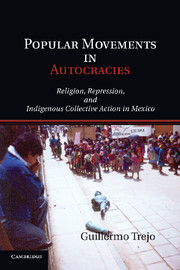
Popular Movements in Autocracies
This book presents a new explanation of the rise, development and demise of social movements and cycles of protest in autocracies; the conditions under which protest becomes rebellion; and the impact of protest and rebellion on democratization. Focusing on poor indigenous villages in Mexico's authoritarian regime, the book shows that the spread of US Protestant missionaries and the competition for indigenous souls motivated the Catholic Church to become a major promoter of indigenous movements for land redistribution and indigenous rights. The book explains why the outbreak of local rebellions, the transformation of indigenous claims for land into demands for ethnic autonomy and self-determination, and the threat of a generalized social uprising motivated national elites to democratize. Drawing on an original dataset of indigenous collective action and on extensive fieldwork, the empirical analysis of the book combines quantitative evidence with case studies and life histories.
eBook

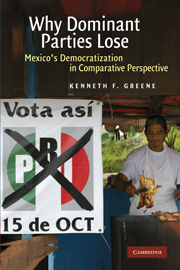
Why Dominant Parties Lose
Why have dominant parties persisted in power for decades in countries spread across the globe? Why did most eventually lose? Why Dominant Parties Lose develops a theory of single-party dominance, its durability, and its breakdown into fully competitive democracy. Greene shows that dominant parties turn public resources into patronage goods to bias electoral competition in their favor and virtually win elections before election day without resorting to electoral fraud or bone-crushing repression. Opposition parties fail because their resource disadvantages force them to form as niche parties with appeals that are out of step with the average voter. When the political economy of dominance erodes, the partisan playing field becomes fairer and opposition parties can expand into catchall competitors that threaten the dominant party at the polls. Greene uses this argument to show why Mexico transformed from a dominant party authoritarian regime under PRI rule to a fully competitive democracy.
eBook

The Zapatista movement and Mexico's democratic transition : mobilization, success, and survival
\"Transitions from authoritarian to democratic governments can provide ripe scenarios for the emergence of new, insurgent political actors and causes. In peaceful transitions such movements may become influential political players and gain representation for previously neglected interests and sectors of the population. But for this to happen insurgent social movements need both opportunities for mobilization and opportunities to succeed and survive. What happens to insurgent social movements that emerge during a democratic transition but fail to achieve their goals? How influential are they? To answer these questions, Maria Inclan looks at Mexico's Zapatista movement, whose emergence she argues was caught between 'sliding doors' of mobilization opportunity. The Zapatistas were able to mobilize sympathy and support for the indigenous agenda inside and outside of the country, yet failed to achieve their goals vis-لa-vis the Mexican state. Nevertheless, the movement has survived and sustained its autonomy despite lacking legal recognition. Inclan examines the vitality of the movement during various tests of the emergent democracy (during more competitive elections, under various political parties, and amid various repressive measures). She also looks at state responsiveness to movement demands and the role of transnational networks in the movement's survival. She extends these into a more general test of the quality of young democracies, to identify the extent to which emerging political forces incorporate dissident and previously excluded political actors into democratic polities\"-- Provided by publisher.
Book
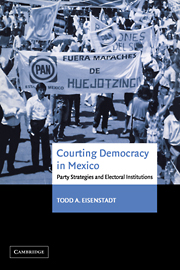
Courting Democracy in Mexico
This book documents Mexico's gradual transition to democracy, written from a perspective which pits opposition activists' post-electoral conflicts against their usage of regime-constructed electoral courts at the centre of the democratization process. It addresses the puzzle of why, during key moments of Mexico's 27-year democratic transition, opposition parties failed to use autonomous electoral courts established to mitigate the country's often violent post-electoral disputes, despite formal guarantees of court independence from the Party of the Institutional Revolution (PRI), Mexico's ruling party for 71 years (preceeding the watershed 2000 presidential elections). Drawing on hundreds of author interviews throughout Mexico over a three-year period and extensive archival research, the author explores choices by the rightist National Action Party (PAN) and the leftist Party of the Democratic Revolution (PRD) between post-electoral conflict resolution via electoral courts and via traditional routes - mobilization and bargaining with the PRI-state.
eBook

Defusing democracy
Many of today's new democracies are constrained by institutional forms designed by previous authoritarian rulers. In this timely and provocative study, Delia M. Boylan traces the emergence of these vestigial governance structures to strategic behavior by outgoing elites seeking to protect their interests from the vicissitudes of democratic rule. One important outgrowth of this political insulation strategy—and the empirical centerpiece of Boylan's analysis—is the existence of new, highly independent central banks in countries throughout the developing world. This represents a striking transformation, for not only does central bank autonomy remove a key aspect of economic decision making from democratic control; in practice it has also kept many of the would-be expansionist governments that hold power today from overturning the neoliberal policies favored by authoritarian predecessors. To illustrate these points, Defusing Democracy takes a fresh look at two transitional polities in Latin America—Chile and Mexico—where variation in the proximity of the democratic \"threat\" correspondingly yielded different levels of central bank autonomy. Boylan concludes by extending her analysis to institutional contexts beyond Latin America and to insulation strategies other than central bank autonomy. Defusing Democracy will be of interest to anyone—political scientists, economists, and policymakers alike—concerned about the genesis and consolidation of democracy around the globe.
eBook

Democratization without representation : the politics of small industry in Mexico
When countries become more democratic, new opportunities arise for individuals and groups to participate in politics and influence the making of policy. But democratization does not ensure better representation for everyone, and indeed some sectors of society are ill-equipped to take advantage of these new opportunities. Small industry in Mexico, Kenneth Shadlen shows, is an excellent example of a sector whose representation decreased during democratization.
Shadlen's analysis focuses on the basic characteristics of small firms that complicate the process of securing representation in both authoritarian and democratic environments. He then shows how increased pluralism and electoral competition served to exacerbate the political problems facing the sector during the course of democratization in Mexico. These characteristics created problems for small firms both in acting collectively through interest associations and civil society organizations and in wielding power within political parties. The changes that democratization effected in the structure of corporatism put small industry at a significant disadvantage in the policy-making arena even while there was general agreement on the crucial importance of this sector in the new neoliberal economy, especially for generating employment. The final chapter extends the analysis by making comparisons with the experience of small industry representation in Argentina and Brazil.
Shadlen uses extensive interviews and archival research to provide new evidence and insights on the difficult challenges of interest aggregation and representation for small industry. He conducted interviews with a wide range of owners and managers of small firms, state and party officials, and leaders of business associations and civil society organizations. He also did research at the National Archives in Mexico City and in the archives of the most important business organizations for small industry in the post-World War II period.
eBook

Dual transitions from authoritarian rule : institutionalized regimes in Chile and Mexico, 1970-2000
Latin America’s region-wide 1982 economic collapse had a drastic effect on governments throughout Central and South America, leading many to the verge of failure and pushing several of the most stridently authoritarian—Argentina, Bolivia, Brazil, and Uruguay—over the brink. Surprisingly though, Chile’s repressive military dictatorship and Mexico’s hegemonic civilian regime endured amid the economic chaos that rocked the region.
Dual Transitions from Authoritarian Rule explains why the regimes in these two nations survived the financial upheaval of the early 1980s and how each progressed toward a more open, democratic, market-driven system in later years. Using an in-depth comparative analysis of Chile and Mexico, Francisco González explains that the two governments—though quite different ideologically—possessed a common type of institutionalized authoritarian rule that not only served to maintain the political status quo but, paradoxically, also aided proponents of political and economic liberalization.
Featuring a discussion of parallel phenomena in Brazil, Hungary, Taiwan, and South Korea, Dual Transitions from Authoritarian Rule presents a cogent challenge to the received wisdom that sociopolitical and economic change within authoritarian nations must be approached separately. This book will interest scholars of Latin American politics, democratization studies, market reform, and comparative politics and international relations.
eBook
