
Catalogue Search | MBRL


Are you sure you want to remove the book from the shelf?

{{itemTitle}}
70
result(s) for
"Democratization Taiwan History."
Sort by:

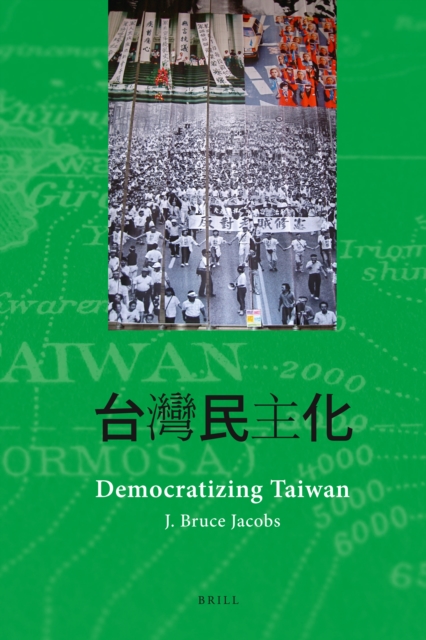
Democratizing Taiwan
Taiwan is only one of four consolidated Asian democracies. Democratizing Taiwan provides the most comprehensive analysis of Taiwan's peaceful democratization including the past authoritarian experience, leadership both within and outside government, popular protest and elections, and constitutional interpretation and amendments.
eBook


The Kaohsiung Incident in Taiwan and Memoirs of a Foreign Big Beard
The Kaohsiung Incident contributed importantly to Taiwan's ultimate democratization. The simultaneous murder of the mother and twin daughters of a key defendant shocked Taiwan and the world. Part 2 is the author's memoir of three months in police protection.
eBook

Cultural, ethnic, and political nationalism in contemporary Taiwan : bentuhua
This volume analyzes what is arguably the single most important aspect of cultural and political change in Taiwan over the past quarter-century: the trend toward 'indigenization' (bentuhua). Focusing on the indigenization of politics and culture and its close connection with the identity politics of ethnicity and nationalism, this volume is an attempt to map prominent contours of the indigenization paradigm as it has unfolded in Taiwan. The opening chapters concern the origin and nature of the trend toward indigenization with its roots in the unique historical trajectory of politics and culture in Taiwan. Subsequent chapters deal with responses and reactions to indigenization in a variety of social, cultural and intellectual domains.
eBook

THE LONG-TERM EFFECTS OF STATE REPRESSION ON POLITICAL BEHAVIOR AND ATTITUDES: EVIDENCE FROM TAIWAN
This article examines how violence against citizens affects their political attitudes and behavior in the long run, and how those effects vary over time. We construct and analyze a novel dataset on the victims of Taiwan's February 28 Incident, in 1947, with survey data spanning 1990 to 2017. Our empirical analysis shows that cohorts having directly or indirectly experienced the Incident are less likely to support the Kuomintang Party (KMT), the former authoritarian ruling party responsible for the Incident. They tend to disagree with the key conventional policy stand of the KMT (unification with mainland China), are more likely to self-identify as Taiwanese, and are less likely to vote for KMT presidential candidates. Taiwan's residents who were born in towns with larger number of casualties during the Incident are more likely to reject unification. Finally, the effects are found to vary over the period following democratization.
Journal Article

The Dilemmas of Becoming Chinese in Taiwan
After the Civil War of 1945-1949, Taiwan and mainland China were separated and developed two different systems: a British-American liberal-democratic capitalist system, and a socialist system with one-party dictatorship. Although differences between the two sides developed, there was still a consensus on "Chinese identity" during the rule of Chiang Kai-shek and Chiang Ching-kuo in Taiwan. This "Chinese identity" began to waver and the idea of "Taiwan identity" gradually emerged around the 1980s. As a result, the struggle between unification and independence in Taiwan sharpened. "The Taiwan nativists" (dupai) want to achieve the ideal of "independent nationhood." "The Chinese culturalists" (tongpai) hope to maintain exchanges and interactions with the Mainland to create a win-win situation, and finally lead to a unified China. The current ratio of independence to unification (eventual not immediate), in terms of votes in the 2020 presidential election, is 57 percent for the Taiwan nativists and 43 percent for the Chinese culturalists. The Chinese culturalists firmly believe that cross-straits competition is grounded in institutional (rather than existential) competition, and experiments in Taiwan will contribute to the future of "China." But they are facing three dilemmas. The first is pressure from mainland China with the possibility of military invasion. The second is pressure from the Democratic Progressive Party upholding Taiwan independence. And third, generational change: because of their lineage, educational, and cultural background, the Chinese culturalists are of an older age group, and as time goes on, the number of supporters will gradually decrease.
Journal Article

Together in the Same Boat: Exiled Nationalist State and Chinese Civil War Exiles in 1950s Taiwan
When the Chinese Communist Party (CCP) came to power, one million mainland Chinese were forcibly displaced to Taiwan with Chiang Kai-shek's regime. Today, this event is still largely considered as a relocation of government or a military withdrawal operation instead of a massive population movement. Contrary to popular belief, many of the displaced mainlanders were not Nationalist elites. Most were common soldiers, petty civil servants, and war refugees from different walks of life. Based on newspapers, magazines, surveys, declassified official documents produced in 1950s Taiwan and contemporary oral history, this article uncovers the complicated relationship between the regime in exile and the people in exile. It argues that the interdependency between the two, in particular between the migrant state and the socially atomized lower class migrants, was formed gradually over a decade due to two main factors: wartime displacement and the need to face an unfriendly local population together.
Journal Article
LIBERAL TAIWAN VERSUS ILLIBERAL SOUTH KOREA: THE DIVERGENT PATHS OF ELECTION CAMPAIGN REGULATION
South Korea and Taiwan have developed very different sets of election campaign regulations. While both countries had highly restrictive campaign rules during the authoritarian era, they have diverged since democratic transition. South Korea still imposes numerous restrictions on campaigning activities, but Taiwan has removed most of the restrictions. We explore the causes of these divergent trajectories through comparative historical process tracing, focusing on critical junctures and path dependence. We find that incumbency advantage and containment of new opposition parties were the primary objectives of introducing stringent regulations under the authoritarian regimes in both countries. The key difference was that, during the democratic transition, legislators affiliated with the opposition parties as well as the ruling party in South Korea enjoyed the incumbency advantage but that opposition forces in Taiwan did not. As a result, the opposition in Taiwan fought for liberalization of campaign regulations, but the South Korean opposition did not.
Journal Article
