
Catalogue Search | MBRL


Are you sure you want to remove the book from the shelf?

{{itemTitle}}
523
result(s) for
"Democratization Taiwan."
Sort by:


Party Politics in Taiwan
In 1991 Taiwan held its first fully democratic election. This first single volume of party politics in Taiwan analyzes the evolution of party competition in the country, looking at how Taiwan’s parties have adjusted to their new multi-party election environment. It features key chapters on:
the development of party politics in Taiwan
the impact of party change on social welfare, corruption and national identity
party politics in the DPP era.
Including interviews with high-ranking Taiwanese politicians and material on the 2004 Presidential election, this important work brings the literature up-to-date. It provides a valuable resource for scholars of Chinese and Taiwanese politics and a welcome addition to the field of regime transition and democratization.
Acknowledgements. List of Tables List of Figures. Abbreviations. 1. Party Change and the Democratic Evolution of Taiwan 2. The Development of Party Politics in Taiwan 3. Issues in Taiwanese Electoral Politics 4. Party Change on the Social Welfare Issue 5. Party Change on the Political Corruption Issue 6. Party Change on the National Identity Issue 7. Party Politics in the DPP Era 8. Conclusion. Bibliography. Appendix 1. Appendix 2
eBook

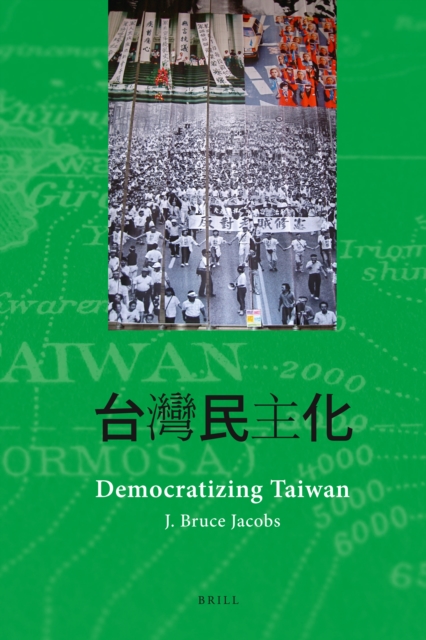
Democratizing Taiwan
Taiwan is only one of four consolidated Asian democracies. Democratizing Taiwan provides the most comprehensive analysis of Taiwan's peaceful democratization including the past authoritarian experience, leadership both within and outside government, popular protest and elections, and constitutional interpretation and amendments.
eBook


Cultural, ethnic, and political nationalism in contemporary Taiwan : bentuhua
This volume analyzes what is arguably the single most important aspect of cultural and political change in Taiwan over the past quarter-century: the trend toward 'indigenization' (bentuhua). Focusing on the indigenization of politics and culture and its close connection with the identity politics of ethnicity and nationalism, this volume is an attempt to map prominent contours of the indigenization paradigm as it has unfolded in Taiwan. The opening chapters concern the origin and nature of the trend toward indigenization with its roots in the unique historical trajectory of politics and culture in Taiwan. Subsequent chapters deal with responses and reactions to indigenization in a variety of social, cultural and intellectual domains.
eBook
Taiwan's democracy on trial
In Taiwan's Democracy on Trial, Professor Copper assesses the process of democratization in Taiwan during the Chen Shui-bian Era (2000 to 2008) and after. He shows that in several respects, most important being press freedom, human rights, ethnic relations, political reform, constitutionalism, and clean governance, democratization regressed. Economic management was not good and relations with the United States were severely strained, which also hurt the Chen administration and explains why the Nationalist Party returned to power in 2008. The democratization process has improved since 2008.
eBook

Taiwan at a tipping point
This study examines the Democratic Progressive Party's 2016 electoral victory in Taiwan. It places the election within the context of Taiwan's recent political history and investigates whether the party is likely to hold onto power.
eBook

Bowling Alone in Taiwan? Political Trust and Civic Participation of Taiwanese and Their Appraisal of Liberal Democracy and Personal Wellbeing
Based on a nationwide survey dataset collected by Taiwan’s Executive Yuan (2017) (N = 2737) and adopting structural equation modelling with bootstrapped method, we confirm that citizens’ positive appraisal of liberal democracy can foster subjective wellbeing via political trust but find civic participation irrelevant in this model. The proposed model remains significant after age, education, residency and personal income are controlled. The only exceptions are the gender effects in the relationship between appraisal of liberal democracy and political trust and that between political trust and civic participation. The former is positively stronger for female, whereas the latter is negatively stronger for male. While civic participation has long been widely accepted as a foundational component of any consolidated democracy, empirical evidence of this study calls for reflection on the application of this notion in an East Asian setting.
Journal Article

The State-Society Interaction in the Process of Taiwan’s Democratization from 1990 to 1992
This paper examining the process of Taiwan’s democratization introduces a special mode of democratization which involves cooperative interactions between reformists in the state and oppositionists in society. Focusing on the years 1990 to 1992, a key period of Taiwan’s democratization during which key authoritarianism-supporting institutions were destroyed, the paper demonstrates that a tacit coalition of the reformists in the state and the oppositionists in society began to loom in Taiwan in July 1988 and was solidified in June 1990, and, from June 1990 to December 1992, this coalition successfully forced the conservatives in the state to accept its demand that key authoritarianism-supporting institutions had to be destroyed.
Journal Article