
Catalogue Search | MBRL


Are you sure you want to remove the book from the shelf?

{{itemTitle}}
44
result(s) for
"Democratization United Arab Emirates."
Sort by:


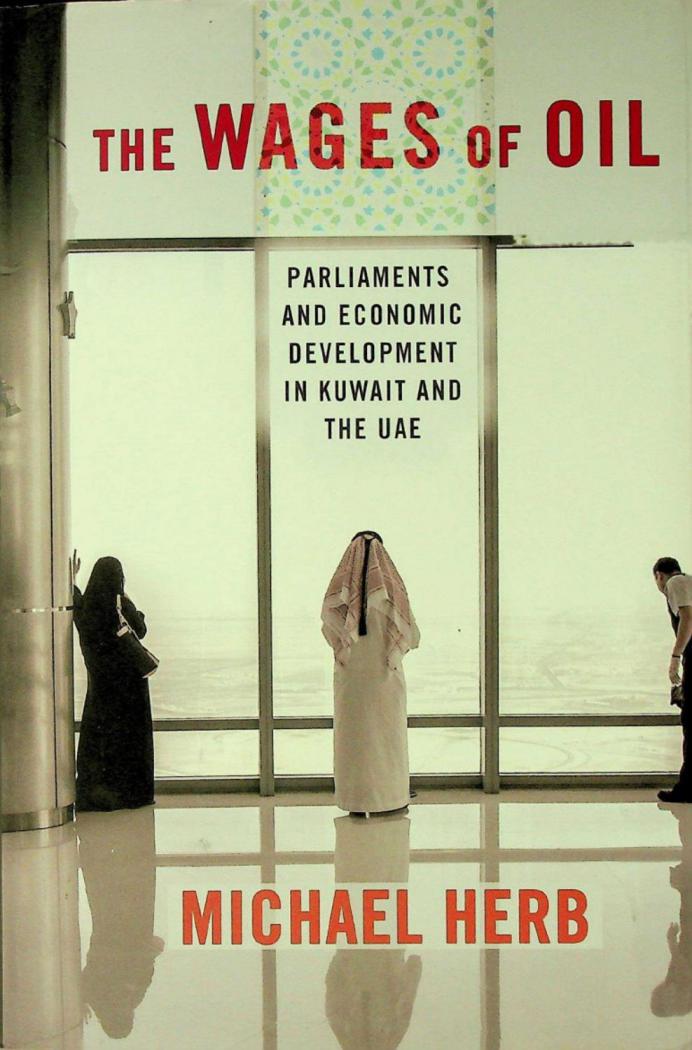
The Wages of Oil
The contrast between Kuwait and the UAE today illustrates the vastly different possible futures facing the smaller states of the Gulf. Dubai's rulers dream of creating a truly global business center, a megalopolis of many millions attracting immigrants in great waves from near and far. Kuwait, meanwhile, has the most spirited and influential parliament in any of the oil-rich Gulf monarchies.
InThe Wages of Oil, Michael Herb provides a robust framework for thinking about the future of the Gulf monarchies. The Gulf has seen enormous changes in recent years, and more are to come. Herb explains the nature of the changes we are likely to see in the future. He starts by asking why Kuwait is far ahead of all other Gulf monarchies in terms of political liberalization, but behind all of them in its efforts to diversify its economy away from oil. He compares Kuwait with the United Arab Emirates, which lacks Kuwait's parliament but has moved ambitiously to diversify.
This data-rich book reflects the importance of both politics and economic development issues for decision-makers in the Gulf. Herb develops a political economy of the Gulf that ties together a variety of issues usually treated separately: Kuwait's National Assembly, Dubai's real estate boom, the paucity of citizen labor in the private sector, class divisions among citizens, the caste divide between citizens and noncitizens, and the politics of land.
eBook

Militarization and Democratization: A Socio-Legal Analysis of the Third Scramble for Africa
The Third Scramble for Africa has emerged as a focal point of economic and geopolitical interest, within a neocolonial global context, in which the role of modernized militaries increasingly includes interference in political affairs and weakening the prospects for genuine democracy on the continent. To show how militarization and the loss of democracy have evolved into tools for accelerating a Third Scramble for Africa, this paper will analyze developments surrounding coups d'etat in Mali and Sudan. It will advance the case that militarization and the decline of democracy are now inextricably linked to the Third Scramble for Africa. KEYWORDS: militarization, democratization, Third Scramble for Africa, Mali, Sudan
Journal Article


Democracy, visa-waivers, and international mobility
In examining visa-waiver agreements, previous studies have primarily focused on economic motivations and effects. In this article, we explore the potential political motivations and consequences. Particularly, we propose that there is a positive relationship between visa-waivers and democracy. We test this using a global dataset that records bilateral travel visa requirements for all countries between 1973 and 2013. We find support for our main hypothesis. We also examine the relationship between democracy, visa waivers and economic development. Contrary to our expectations, we find that democracy continues to exert influence on visa waivers even at high levels of income. Non-democracies fail to attain visa waivers even when they are wealthy. Finally, we explore whether visa waivers could have an impact on individuals’ attitudes towards democracy. Using survey data from 18 Latin American countries, we find suggestive evidence that that visa-waivers can have a positive impact on individuals’ democratic attitudes. Taken together, the findings suggest that democracy and visa-waivers might have a mutually reinforcing relationship.
Journal Article

A NATION OF BUREAUCRATS: POLITICAL PARTICIPATION AND ECONOMIC DIVERSIFICATION IN KUWAIT AND THE UNITED ARAB EMIRATES
Not long ago, two safe generalizations could be made about the Gulf monarchies: ruling families dominated their politics, and oil dominated their economies. In recent years that has begun to change. In Kuwait the parliament challenges the political predominance of the ruling family. Meanwhile, Dubai and, increasingly, the other emirates of the United Arab Emirates (UAE) have made real progress in diversifying their economies away from oil—at least until the recent economic crisis. Yet political liberalization and economic diversification have not gone hand in hand: Kuwait's economy remains dependent on oil, and the United Arab Emirates remains resolutely authoritarian. This is no accident. Kuwait's high level of political participation encourages its dependence on oil while the UAE's economic diversification requires a lack of political participation by citizens. The reasons for this are specific to the peculiar political economy of these labor markets: in these richest of rentier-states, there is little need for the class compromise between capitalists and workers on which capitalist democracy usually rests.
Journal Article

The United Arab Emirates: Statehood and Nation-Building in a Traditional Society
Nationals represent barely 20% of the population in the United Arab Emirates, but form the economically and socially privileged group of UAE citizens. The Rulers of the seven emirates were able to retain the historical loyalty of the \"Emiratis\" by advancing the economic
development of the individual states, while Abu Dhabi-financed federal development helped to create a viable national state. Democratization is not of the same urgency as in some neighboring Gulf countries.
Journal Article