
Catalogue Search | MBRL


Are you sure you want to remove the book from the shelf?

{{itemTitle}}
6,419
result(s) for
"Demokratie"
Sort by:


Democracy : a world history
Overview: In our time, the term \"democracy\" is frequently evoked to express aspirations for peace and social change or particular governmental systems that claim to benefit more than a select minority of the population. In this book, Temma Kaplan examines attempts from ancient Mesopotamia to the early twenty first century to create democratic governments that allow people to secure food, shelter, land, water, and peace for their mutual benefit. Since early times, proponents of direct or participatory democracy have come into conflict with the leaders of representative institutions that claim singular power over democracy. Patriots of one form or another have tried to reclaim the initiative to determine what democracy should mean and who should manage it. Frequently, people in small communities, trade unions, or repressed racial, religious, and political groups have marched forward using the language of democracy to carve a space for themselves and their ideas at the center of political life. Sometimes they have reinterpreted the old laws, and sometimes they have formulated new laws and institutions in order to gain greater opportunities to debate the major issues of their time. This book examines the development of the democratic ideal from ancient Rome to the Cortes in Spain, the philosophies of Guru Nanak and the Castilian patriot Juan de Padilla, and such inspirational personalities as the Polish trade unionist Anna Walentnyowicz and Burmese politician Aung San Suu Kyi. Though few democracies have sustained themselves for significant lengths of time, their emergence nearly everywhere on earth over thousands of years indicates their resilience despite the fragility of the democratic ideal.
Book


What is populism?
This work argues that at populism's core is a rejection of pluralism. Populists will always claim that they and they alone represent the people and their true interests. Müller also shows that, contrary to conventional wisdom, populists can govern on the basis of their claim to exclusive moral representation of the people: if populists have enough power, they will end up creating an authoritarian state that excludes all those not considered part of the proper \"people.\" The book proposes a number of concrete strategies for how liberal democrats should best deal with populists and, in particular, how to counter their claims to speak exclusively for \"the silent majority\" or \"the real people.\" - Provided by the publisher.
Book

Economic Origins of Dictatorship and Democracy
This book develops a framework for analyzing the creation and consolidation of democracy. Different social groups prefer different political institutions because of the way they allocate political power and resources. Thus democracy is preferred by the majority of citizens, but opposed by elites. Dictatorship nevertheless is not stable when citizens can threaten social disorder and revolution. In response, when the costs of repression are sufficiently high and promises of concessions are not credible, elites may be forced to create democracy. By democratizing, elites credibly transfer political power to the citizens, ensuring social stability. Democracy consolidates when elites do not have strong incentive to overthrow it. These processes depend on (1) the strength of civil society, (2) the structure of political institutions, (3) the nature of political and economic crises, (4) the level of economic inequality, (5) the structure of the economy, and (6) the form and extent of globalization.
eBook


Democratic utopianism: still searching for the truest meaning of democracy
The objects of this research are: first, to explore the concept of democracy and its different meanings. Second, to highlight the shortcomings of living in a democratic country. Third, to explore the political leverage and potential dangers posed by members of elite democracy on the masses. Fourth, to warn political leaders of the setback of relying on a system of government that is nonexistent or practiced in its truest form. The researcher investigated the following: Divergent meanings and interpretations of democracy identified some shortcomings associated with democracy and the dangers of the powerful elite who are political leaders imposed on citizens. The main results of the research: first, there is no single country in the world that can rightfully hold claim to practicing democracy in its truest form. Second, democracy is an ideal system of government we all aspired to have, and third, the elite class has manipulated democratic processes to ensure their perpetual dominance over the masses. Fourth, democracy needs to be instituted properly and effectively for the benefit of citizens. The area of practical use of the research: all citizens living in a country where democracy is practiced, political leaders, political party members, students, workers, and public office holders, employees of regional and global organizations.
Journal Article

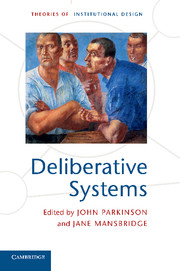
Deliberative Systems
'Deliberative democracy' is often dismissed as a set of small-scale, academic experiments. This volume seeks to demonstrate how the deliberative ideal can work as a theory of democracy on a larger scale. It provides a new way of thinking about democratic engagement across the spectrum of political action, from towns and villages to nation states, and from local networks to transnational, even global systems. Written by a team of the world's leading deliberative theorists, Deliberative Systems explains the principles of this new approach, which seeks ways of ensuring that a division of deliberative labour in a system nonetheless meets both deliberative and democratic norms. Rather than simply elaborating the theory, the contributors examine the problems of implementation in a real world of competing norms, competing institutions and competing powerful interests. This pioneering book will inspire an exciting new phase of deliberative research, both theoretical and empirical.
eBook