
Catalogue Search | MBRL


Are you sure you want to remove the book from the shelf?

{{itemTitle}}
85
result(s) for
"Denazification Germany."
Sort by:


Nazi Crimes against Jews and German Post-War Justice
Of all victims of Nazi persecution, German Jews had to suffer the Nazi yoke for the longest time. Throughout the Third Reich, they were exposed to anti-Jewish propaganda, discrimination, anti-Semitic laws and increasingly to outrages and offences by non-Jewish Germans. While the International Military Tribunal and the subsequent American Military Tribunals at Nuremberg dealt with a variety of Nazi crimes according to international law, these courts did not consider themselves cognizant in adjudicating wrongdoings against German citizens and those who lost German citizenship based on the so-called \"Nuremberg laws,\" such as Germany's Jews. Until recently, scholarship failed to explore this task of the German judiciary in more detail. Edith Raim fills this gap by showing the extent of the crimes committed against Jews beyond the traditionally known facts and by elucidating how the West German administration of justice was reconstructed under Allied supervision.
eBook


From crusade to hazard
From Crusade to Hazard: The Denazification of Bremen Germany relates how the American and British combat forces and military government officers occupied, administered, and denazified Bremen and its environs from 1945 to 1947. The three distinct phases in administering Bremen had a profound impact on the denazification of the city. Denazification legislation was first determined by the Americans, then by the British, and then again by the Americans. Throughout, denazification teams tried to find a middle way between the American dictum of a radical purge of the whole population and the less ambitious British goal of only cleansing the administration. This delicate balancing act led to an implementation of a purge that was unique to the Bremen enclave. While it succeeded in discovering and punishing many of the main functionaries of the Nazi regime, it also fell victim to its own ambition and collapsed underneath the weight of its administrative processes. As deadlines and waning governmental support forced a quick end to the program, the bloated denazification bureaucracy resorted to classifying most of the remaining cases as benign 'followers,' even when they hardly deserved that label. At a time when interest in de-politicizing old classes of administrators affiliated with dictatorial regimes is being increasingly fueled by contemporary world events, this book is a particularly valuable contribution.
eBook

Learning from the Germans : race and the memory of evil
\"As an increasingly polarized America fights over the legacy of racism, Susan Neiman, author of the contemporary philosophical classic Evil in Modern Thought, asks what we can learn from the Germans about confronting the evils of the past.\"--Provided by publisher.
Book
The antifascist classroom : denazification in Soviet-occupied Germany, 1945-1949
This study explores the history of the New School that developed in the postwar period and its role in communicating antifascism to young people in the Soviet zone. Blessing traces how the decisions about how to educate young people after the National Socialist dictatorship became part of a broader discussion about the future of the German nation.
eBook


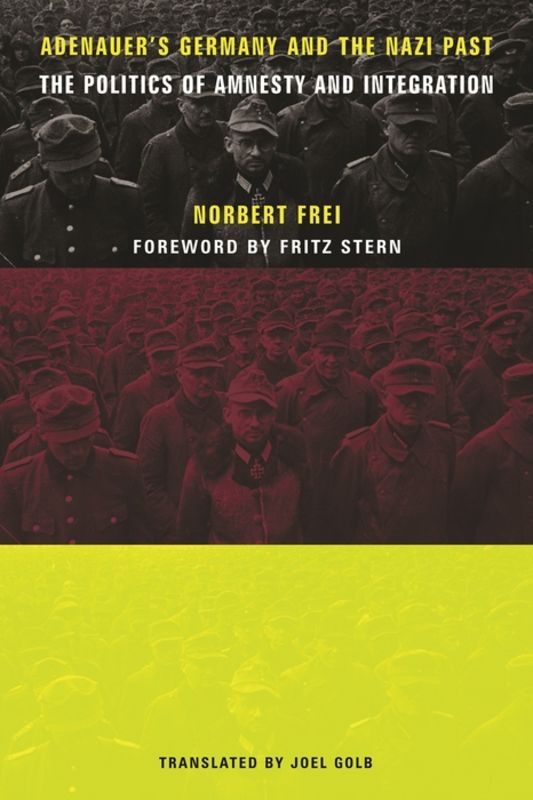
Adenauer's Germany and the Nazi past
Of all the aspects of recovery in postwar Germany perhaps none was as critical or as complicated as the matter of dealing with Nazi criminals, and, more broadly, with the Nazi past. While on the international stage German officials spoke with contrition of their nation's burden of guilt, at home questions of responsibility and retribution were not so clear. In this masterful examination of Germany under Adenauer, Norbert Frei shows that, beginning in 1949, the West German government dramatically reversed the denazification policies of the immediate postwar period and initiated a new \"Vergangenheitspolitik,\" or \"policy for the past,\" which has had enormous consequences reaching into the present. Adenauer's Germany and the Nazi Past chronicles how amnesty laws for Nazi officials were passed unanimously and civil servants who had been dismissed in 1945 were reinstated liberally—and how a massive popular outcry led to the release of war criminals who had been condemned by the Allies. These measures and movements represented more than just the rehabilitation of particular individuals. Frei argues that the amnesty process delegitimized the previous political expurgation administered by the Allies and, on a deeper level, served to satisfy the collective psychic needs of a society longing for a clean break with the unparalleled political and moral catastrophe it had undergone in the 1940s. Thus the era of Adenauer devolved into a scandal-ridden period of reintegration at any cost. Frei's work brilliantly and chillingly explores how the collective will of the German people, expressed through mass allegiance to new consensus-oriented democratic parties, cast off responsibility for the horrors of the war and Holocaust, effectively silencing engagement with the enormities of the Nazi past.
eBook

A lot of material on post-WWII Germany
\"[...] the Oppenhoff assassination, while it made a splash, did not represent any kind of yardstick by which to judge the Nazi guerrilla movement,\" Taylor writes.
Newspaper Article