
Catalogue Search | MBRL


Are you sure you want to remove the book from the shelf?

{{itemTitle}}
309
result(s) for
"Denisov"
Sort by:

Design of a compact quasi-optical mode converter for a 105-GHz gyrotron using optimized perturbation technique
This paper presents the design and optimization of a compact quasi-optical (QO) mode converter for a high-performance gyrotron operating at 105 GHz in the
mode. The converter integrates a dimpled-wall launcher with a novel dual-direction perturbation technique alternating positive and negative deviations based on coupled mode theory. This approach reduces the launcher length to 85 mm, with a cut length of 20 mm (23.53% of the total length), while maintaining high mode conversion efficiency. MATLAB-based parametric analysis was used to optimize the launcher’s field distribution, and FEKO simulations validated its radiation performance. The mirror system comprising quasi-elliptical, elliptical, and parabolic mirrors ensures precise phase correction and beam shaping, contributing to high mode purity and compactness. Simulations demonstrate outstanding performance, achieving 99.4% scalar and 98.6% vector Gaussian mode content at the output. This design offers a compact and efficient solution for next-generation millimeter-wave applications.
Journal Article

Optimized Quasi-Optical Mode Converter for TE33,12 in 210 GHz Gyrotron
This article discusses the design of a high-performance quasi-optical mode converter for the TE33,12 mode at 210 GHz. The conversion process is challenging due to a caustic-to-cavity radius ratio of approximately 0.41. The mode converter employs an optimized dimpled wall launcher, analyzed using coupling mode theory with twenty-five coupled modes, compared to the usual nine modes and optimized reflector systems, to effectively address the conversion challenge.Electromagnetic field analysis within the launcher wall was optimized using MATLAB R2021b. The radiation fields from the launcher were analyzed in free space using Gaussian optics and vector diffraction theory. The mirror system consists of a quasi-elliptical mirror, an elliptical mirror, and phase-corrected parabolic mirrors. Following phase correction, the output window achieved a scalar Gaussian mode content of 99.0% and a vector Gaussian mode content of 97.4%.
Journal Article

Wie sowjetische Musik „vaterländisch“ wurde, oder: Die Avantgarde im Spät- und Postsozialismus neu erfinden (1970–1998)
During the last decades of the Soviet Union, composers and musicians witnessed a dissolution of the contexts in which they were used to inventing and performing music. “Soviet Music”, a vague but inclusive umbrella term for serious music production, took one of two different directions: on the one hand, it increasingly became part of a global musical avant-garde, on the other hand it was forced to adapt to increasingly narrow, Russocentric and even nationalistic attitudes. This contribution investigates ambiguities surrounding these attributes as well as the concrete problems they created for three composers - Sofia Gubaidulina, Alfred Schnittke and Edison Denisov. In particular, it concentrates on fictions of authenticity created by a milestone of Soviet cinema: Farewell to Matëra by Ėlem Klimov and Larisa Shepitko. In doing so, the article questions “1991” as an important caesura and instead makes a case for conceptualizing late and post-Soviet socialism as one common period in Russian musical history.
Journal Article
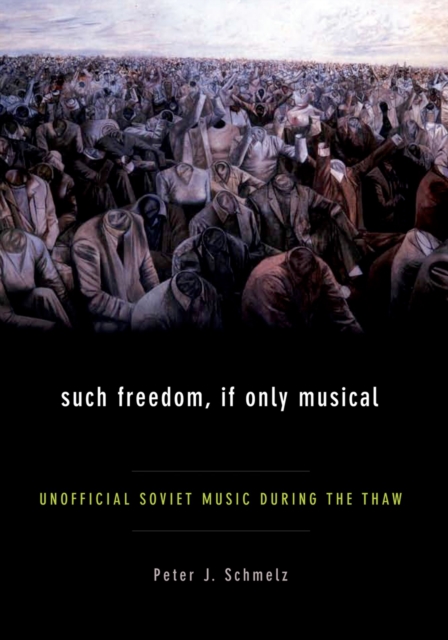
Such Freedom, If Only Musical
Drawing upon oral history, analysis, and a critical synthesis of secondary literature, this book examines the construction and reception of the “unofficial” music in the Soviet Union produced during the Thaw (roughly 1956–74) by composers including Alfred Schnittke, Arvo Pärt, Sofia Gubaidulina, Valentin Silvestrov, Andrey Volkonsky, and Edison Denisov. This book addresses “unofficial” music in all of its contradictions, and argues for a more refined understanding of its changing meanings during the Thaw (and the cold war). The book traces two interrelated phenomena. The first is the developing social function provided by “unofficial” concert life, which allowed Soviet listeners to congregate and question traditional socialist realist verities, and by extension many other facets of life in the USSR. The second is the shifting nature of the musical styles embraced by “unofficial” composers. Initially, while still conservatory students in the 1950s, they encountered music previously off‐limits, including scores by Schoenberg, Boulez, and other Western modernists. They avidly pursued the serial compositional techniques in these “new” scores. However, tiring of the limited expressive possibilities they perceived in these methods, they turned in other directions, first to aleatory devices, and then to quotations from familiar tonal works. The stylistic development of this generation thereby moved from “abstraction” to “mimesis” (borrowing musicologist Karol Berger's terminology). In their mimetic works from the end of the 1960s, the “unofficial” Soviet composers more directly engaged the contemporary situation in the USSR and in so doing received more favorable responses from listeners and Soviet critics alike. Andrey Volkonsky Edison Denisov Alfred Schnittke Sofia Gubaidulina Valentin Silvestrov Arvo Pärt serialism aleatory cold war oral history
eBook
Wie sowjetische Musik „vaterländisch\ wurde, oder: Die Avantgarde im Spät- und Postsozialismus neu erfinden (1970–1998) 1
During the last decades of the Soviet Union, composers and musicians witnessed a dissolution of the contexts in which they were used to inventing and performing music. \"Soviet Music\", a vague but inclusive umbrella term for serious music production, took one of two different directions: on the one hand, it increasingly became part of a global musical avant-garde, on the other hand it was forced to adapt to increasingly narrow, Russocentric and even nationalistic attitudes. This contribution investigates ambiguities surrounding these attributes as well as the concrete problems they created for three composers - Sofia Gubaidulina, Alfred Schnittke and Edison Denisov. In particular, it concentrates on fictions of authenticity created by a milestone of Soviet cinema: Farewell to Matera by Ėlem Klimov and Larisa Shepitko. In doing so, the article questions \"1991\" as an important caesura and instead makes a case for conceptualizing late and post-Soviet socialism as one common period in Russian musical history.
Journal Article

Uniqueness of reflectionless Jacobi matrices and the Denisov-Rakhmanov Theorem
If a Jacobi matrix JJ is reflectionless on (−2,2)(-2,2) and has a single an0a_{n_0} equal to 11, then JJ is the free Jacobi matrix an≡1a_n\\equiv 1, bn≡0b_n\\equiv 0. The paper discusses this result and its generalization to arbitrary sets and presents several applications, including the following: if a Jacobi matrix has some portion of its ana_n’s close to 11, then one assumption in the Denisov-Rakhmanov Theorem can be dropped.
Journal Article
SOC: Sweden trounce Wales in Euro16 warm-up
\"Victories are always fun. I'm happy we scored three goals, and that the three goalscorers aren't named Zlatan,\" Sweden coach Erik Hamren said. Russian media claimed Zenit St Petersburg midfielder Artur Yusupov was likely to be called up to replace [Igor Denisov] in Russia's 23-man squad after his injury in the draw with Serbia. \"Denisov has a serious injury and it's likely we will need a replacement,\" Slutskiy told reporters.
Newsletter

Soviet Cultural Offensive
The author has \"tried to understand the realities of Soviet society, drawing both upon a superb critical judgment and a warmly sympathetic human insight.\" He \"has given the American public material for thought and a prod in the right direction.\"
Originally published in 1960.
The Princeton Legacy Library uses the latest print-on-demand technology to again make available previously out-of-print books from the distinguished backlist of Princeton University Press. These editions preserve the original texts of these important books while presenting them in durable paperback and hardcover editions. The goal of the Princeton Legacy Library is to vastly increase access to the rich scholarly heritage found in the thousands of books published by Princeton University Press since its founding in 1905.
eBook

Edison Denisov's Second Conservatory: Analysis and Implementation
This article discusses the political climate of Stalin and post-Stalin Russia, and the effects on education and music composition - as well as access to music and music theory outside Russia - during those times. Edison Denisov, who studied at the Moscow Conservatory until 1959, undertook an independent study of many composers he felt had been unjustly omitted from the school's official curriculum. The article examines what Denisov learned during his time at the institution and then attempts to discover how he incorporated his knowledge into his own compositional style. Denisov's analysis of a particular work by Anton Webern (Piano Variations) is discussed in detail.
Journal Article
Russian air-defence weapon to have hypersonic missiles by 2017
The first test launches took place in April, Aleksandr Denisov, the general director of the Vysokotochnyye Kompleksy (High-Precision Systems) company told the agency. \"Work in this direction has significantly progressed from design to development and to actual trials,\" he said. \"Demonstration launches of the missile took place in April at the Ashuluk range during a...
Newsletter