
Catalogue Search | MBRL


Are you sure you want to remove the book from the shelf?

{{itemTitle}}
341
result(s) for
"Denmark Copenhagen."
Sort by:

Time Out Copenhagen
Time Out Guides is rated top guidebook brand by Which? Survey, for level of detail, photography, quality of maps, ease of finding information and value for money. Time Out Copenhagen gives the lowdown on where to go and what to see in this most civilised of cities. With the help of local experts, the guide takes you beyond the cliches - into the neighbourhoods of Vesterbro, Norrebro, Osterbro and Frederiksberg, where most Copenhageners live and go out, sampling the full extent of its museums, restaurants, cafes and shops. Praised and admired for its cycling culture, New Nordic cuisine and contemporary architecture, Copenhagen is enjoying a much-deserved heyday. Though still celebrated for its historic royal palaces and mid-century design, it's now taken on a new identity as the style, gastronomic and green capital of Europe. The city's new daily food market, Torvehallerne, is buzzing; its bike lanes are an inspiration for urban planners worldwide; and its citizens are impeccably dressed.
Book
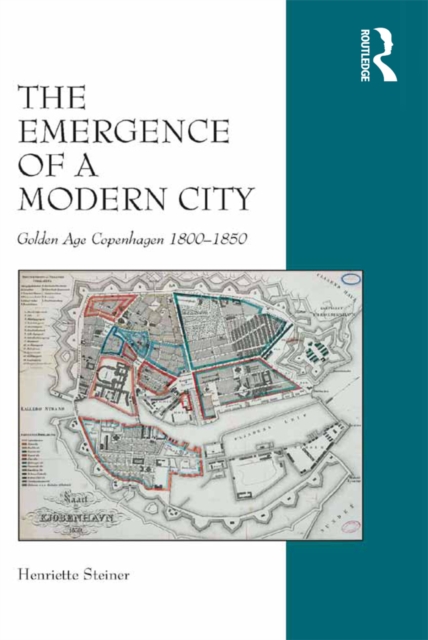
The Emergence of a Modern City
This book is an exploration of how urban life in Copenhagen, in the period known as the Golden Age (c. 1800 to 1850), was experienced and structured socially, institutionally, and architecturally. It draws on a broad historical source material - spanning urban anecdotes, biography, philosophy, literature, and visual culture - to do so. The book argues that Copenhagen emerged as a modern city at this time, despite the fact that the Golden Age never witnessed the appearance of the main characteristics of the modernisation of cities associated with industrialisation, such as street lighting, sewer systems, and railroads. The book outlines the historical and topographical context of Copenhagen in the Golden Age with a special focus on the works of the most prominent architect of the period, C.F. Hansen. The characterisation of the city is complemented by investigations into writings of three citizens: the philosopher Soren Kierkegaard, the novelist Thomasine Gyllembourg, and the criminal Ole Kollerod, who all take an interest in the city's institutional and urban structures as well as their own place in it. From these different sources, a picture is painted of urban life and thought at a time when the city began to take on characteristics of ambiguity and alienation in European thinking, while at the same time the city itself retained some pre-modern motifs of a symbolic order. This transformation is set in a larger process of cultural re-orientation, from traditional Baroque culture to what might be termed Romantic culture. The book reconsiders the significance of this transformation for the emergent order of the modern European city in the nineteenth century and thus of the very foundation on which our own urban culture rests.
eBook


Gentrification—Gentle or Traumatic? Urban Renewal Policies and Socioeconomic Transformations in Copenhagen
This article contrasts the intentions and outcomes of the publicly instigated and supported urban renewal of Copenhagen's Inner Vesterbro district. Apart from physically upgrading the decaying buildings, the municipality's aim was to include the inhabitants in the urban renewal process and, seemingly, to prevent the dislocation of people from the neighbourhood. However, due to ambiguous policies, the workings of the property market and the lack of sufficient deflecting mechanisms, middle-class inhabitants are now replacing the high concentration of socioeconomically vulnerable people that characterised Vesterbro before the urban renewal. This process may appear 'gentle', but it is nonetheless an example of how state and market interact to produce gentrification with 'traumatic' consequences for individuals and the city as a socially just space.
Journal Article

The Urban Lifeworld
Urban conditions are crucial to our experience of modernity, and, as reflected by art, literature and popular culture, have influenced contemporary ideas of what urban life is about.The Urban Lifeworld contributes to our understanding of the cultural role of cities by offering new insight into the analysis of urban experience. Two exceptional cities, New York and Copenhagen, are the focus of this exploration of cultural representations of urban life, which investigates the contrasts between perceptions and formation of the urban lifeworld.Integrating sociological, aesthetic and anthropological approaches to urban questions, this collection of essays presents a new vision of the cityscape which will enrich both academic debate and public life.
eBook

The subjectivity of participation : articulating social work practice with youth in Copenhagen
\"Using an innovative approach in critical psychology, this study examines collectivity, participation, and subjectivity, and the social theories that may help us understand these matters\"-- Provided by publisher.
BOOK
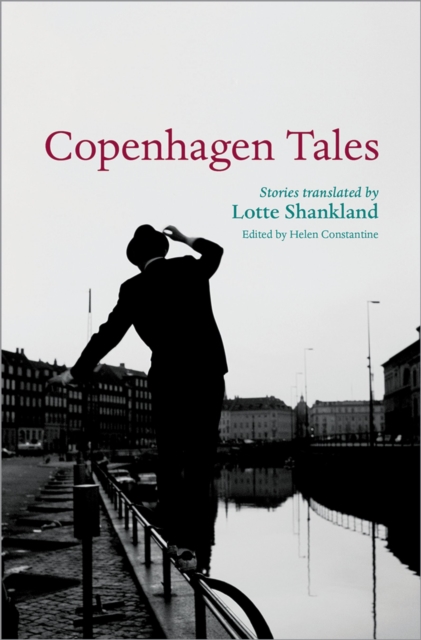
Copenhagen Tales
The Danish love of story-telling is richly demonstrated in this unique anthology of seventeen tales drawn from the canon of Danish literature over the past two hundred years. Together these stories present a unique view of the city of Copenhagen.
eBook

The killing. III
Detective Inspector for homicide, Sarah Lund, is contacted by old flame Mathias Borch from National Intelligence. Borch fears that what first appeared to be a random killing at the docks is the beginning of an assassination attempt on Prime Minister Troels Hartmann. The murder draws attention towards the shipping and oil giant, Zeeland, run by billionaire Robert Zeuthen. When Zeuthen's daughter is kidnapped, the investigation takes on a different dimension as it soon becomes clear that her disappearance is linked to the murder of a young girl in Jutland some years earlier.
Book

Indexical meanings of s+ among Copenhagen youth: Social perception of a phonetic variant in different prosodic contexts
It is well documented that the same sociolinguistic feature can be used as a sociolinguistic resource with different indexical potentials in different linguistic as well as social contexts. Often, however, indexical meanings of a specific feature are related to or derived from one another. In this article we present the results of a perceptual study of indexical meanings of alveolar versus fronted (s)—[s] versus [s+]—in different registers. The data consist of responses to male speakers' use of [s] and [s+] respectively, in two different registers that may be labelled “modern Copenhagen speech” and “street language.” Results show that the [s+] indexes femininity and gayness when it occurs in “modern Copenhagen,” whereas the (s)-variation has a different and less significant effect when occurring in “street language.” We discuss the implications for theories of indexical fields and the relation between features and clusters of features in speakers' perceptions. (Indexical meaning, phonetic variation, fronted /s/, perception of sexual orientation and ethnicity, matched guise technique).
Journal Article