
Catalogue Search | MBRL


Are you sure you want to remove the book from the shelf?

{{itemTitle}}
1,916
result(s) for
"Denmark History."
Sort by:


Urbanization in Viking Age and Medieval Denmark
This study traces the history of urbanization in Denmark from c. 500-1350 and explores how interconnected political, religious, economic factors were instrumental in bringing about the growth of towns. Prior to urban development, certain specialized sites such as elite residences and coastal landing places performed many of the functions that would later be taken over by medieval towns. Fundamental changes in political power, the coming of Christianity, and economic development over the course of the Viking and Middle Ages led to the abandonment of these sites in favour of new urban settlements that would come to form the political, religious, and economic centres of the medieval kingdom. Bringing together both archaeological and historical sources, this study illustrates not only how certain cultural and economic shifts were crucial to the development of towns, but also the important role urbanization had in the transition from Viking to medieval Denmark.
eBook

Women in business in early modern Copenhagen : 1740-1835
This volume tells the stories of women who worked legally, under their own names, in early modern Copenhagen. They could be found selling goods on the streets, managing shops and schools, working in metal trades or the construction industry, even running factories and merchant fleets. Carol Gold shows that these self-sufficient women, regardless of marital status, were a integral part of the production and distribution of goods in the flourishing Danish capital's golden years.
Book

The Cartoons That Shook the World
On September 30, 2005, the Danish newspaperJyllands-Postenpublished twelve cartoons of the Prophet Muhammad. Five months later, thousands of Muslims inundated the newspaper with outpourings of anger and grief by phone, email, and fax; from Asia to Europe Muslims took to the streets in protest. This book is the first comprehensive investigation of the conflict that aroused impassioned debates around the world on freedom of expression, blasphemy, and the nature of modern Islam.
Jytte Klausen interviewed politicians in the Middle East, Muslim leaders in Europe, the Danish editors and cartoonists, and the Danish imam who started the controversy. Following the winding trail of protests across the world, she deconstructs the arguments and motives that drove the escalation of the increasingly globalized conflict. She concludes that the Muslim reaction to the cartoons was not-as was commonly assumed-a spontaneous emotional reaction arising out of the clash of Western and Islamic civilizations. Rather it was orchestrated, first by those with vested interests in elections in Denmark and Egypt, and later by Islamic extremists seeking to destabilize governments in Pakistan, Lebanon, Libya, and Nigeria. Klausen shows how the cartoon crisis was, therefore, ultimately a political conflict rather than a colossal cultural misunderstanding.
eBook

A history of Denmark
\"The history of modern Denmark is the story of how a once extensive and diverse empire slowly fragmented under the changing circumstances of the times. In this introductory guide, Knud J. V. Jespersen traces the process of disintegration and reduction that helped to form the modern Danish State and its international position. Employing a thematic approach, Jespersen explains how the Denmark of today was shaped by wars, territorial losses, domestic upheavals, new methods of production, and changes in thought. In this thoroughly revised third edition, there is an increased focus on the wider Nordic and European contexts of Danish history. There is a wealth of new material on imperialism, immigration, class and gender, and a nuanced exploration of Denmark's scientific and cultural accomplishments. Incorporating discussion of the 2015 terror attack in Copenhagen and the impact of Brexit as seen by Denmark, this overview of Danish history is at the cutting-edge of current affairs\"-- Provided by publisher.
Book

Saxo Grammaticus
Using the Gesta Danorumof Saxo Grammaticus as its main primary source, this works analyzes the transitions of the twelfth to thirteenth centuries in Denmark, particularly in the context of the Northern Crusades.
eBook

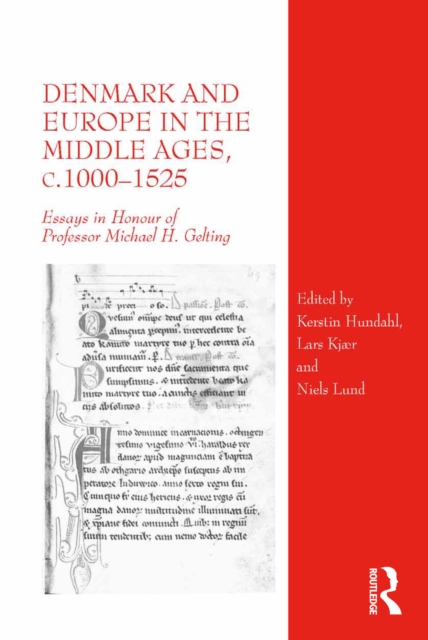
Denmark and Europe in the Middle Ages, c.1000-1525
Where medieval Denmark and Scandinavia as a whole has often been seen as a cultural backwater that passively and belatedly received cultural and political impulses from Western Europe, Professor Michael H. Gelting and scholars inspired by him have shown that the intellectual, religious and political elite of Denmark actively participated in the renaissance and reformation of the central and later medieval period. This work has wide ramifications for understanding developments in medieval Europe, but so far the discussion has taken place only in Danish-language publications. This anthology brings the latest research in Danish medieval history to a wider audience and integrates it with contemporary international discussions of the making of the European middle ages.
eBook

Traditional Danish sweaters : 200 stars and other classic motifs from historic sweaters
\"From a little-known chapter of knitting history comes the Danish 'night sweater'--part of women's traditional dress in the 1800s, these sweaters have long been overlooked in surveys of Scandinavian handcrafting and design. But now celebrated Danish knitting expert Vivian H²xbro has brought together diligent research, comprehensive charts, and her own painstaking efforts to reconstruct these carefully-preserved garments to create a unique collection of single-color relief patterns. Within, knitted, purled, and crossed stitches form hundreds of classic star motifs, edgings, horizontal and vertical pattern panels, and striking 'traveling stitch' designs. Learn the history of night sweaters in Denmark, with a rundown of special techniques and regional knitting practices, and then dive into a neatly-organized library of 200 charts for motifs of all kinds. Follow step-by-step instructions as you reconstruct traditional Danish sweaters in contemporary sizes, work traditionally-inspired patterns for a stole, top, tunic, and more--or use these motifs, edgings, and decorative panels in projects of your own design\"-- Back cover.
Book

The Danish revolution, 1500-1800 : an ecohistorical interpretation
This book tells the story of a fertile European country that, as a result of over population and military armament, over exploited its fields and forests in a non-sustainable fashion. By the eighteenth century Denmark, along with other European countries, found itself in an ecological crisis involving clear felling of forests, sand drift, floods, inadequate soil fertilization and cattle disease. This crisis was overcome by a green biotechnological revolution that changed the whole pattern of agriculture, and by the abandonment of wood as a raw material and source of energy in favour of coal and iron. This book outlines the background of the present-day ecological crisis, both in the industrial world and in developing countries, and attempts to understand early modern Europe from a consistently ecological viewpoint.
eBook