
Catalogue Search | MBRL


Are you sure you want to remove the book from the shelf?

{{itemTitle}}
10,263
result(s) for
"Derrida"
Sort by:


The End of the World and Other Teachable Moments: Jacques Derrida's Final Seminar
The End of the World and Other Teachable Moments follows the remarkable itinerary of Jacques Derrida's final seminar, The Beast and the Sovereign (2001-2003), as the explicit themes of the seminar, namely, sovereignty and the question of the animal, come to be supplemented and interrupted by questions of death, mourning, survival, the archive, and, especially, the end of the world.
eBook


Derrida’s of grammatology
Everything you need to know about Derrida's Of Grammatology in one volume.
eBook


Scatter 1: The Politics of Politics in Foucault, Heidegger, and Derrida
What if political rhetoric is unavoidable, an irreducible part of politics itself? In contrast to the familiar denunciations of political horse-trading, grandstanding, and corporate manipulation from those lamenting the crisis in liberal democracy, this book argues that the \"politics of politics,\" usually associated with rhetoric and sophistry, is, like it or not, part of politics from the start. Denunciations of the sorry state of current politics draw on a dogmatism and moralism that share an essentially metaphysical and Platonic ground. Failure to deconstruct that ground generates a philosophically and politically debilitating selfrighteousness that this book attempts to understand and undermine. After a detailed analysis of Foucault's influential late concept of parrhesia, which is shown to be both philosophically and politically insufficient, close readings of Heidegger, Kierkegaard, and Derrida trace complex relations between sophistry, rhetoric, and philosophy; truth and untruth; decision; madness and stupidity in an exploration of the possibility of developing an affirmative thinking of politics that is not mortgaged to the metaphysics of presence. It is suggested that Heidegger's complex accounts of truth and decision must indeed be read in close conjunction with his notorious Nazi commitments but nevertheless contain essential insights that many strident responses to those commitments ignore or repress. Those insights are here developed--via an ambitious account of Derrida's often misunderstood interruption of teleology--into a deconstructive retrieval of the concept of dignity. This lucid and often witty account of a crucial set of developments in twentieth-century thought prepares the way for a more general re-reading of the possibilities of political philosophy that will be undertaken in Volume 2 of this work, under the sign of an essential scatter that defines the political as such.
eBook


SENTIDO O SIGNIFICACIÓN EN EL ARTE COREOGRÁFICO CONTEMPORÁNEO: UNA APROXIMACIÓN AL TRABAJO COMPOSITIVO DE WILLIAM FORSYTHE A PARTIR DEL PENSAMIENTO DE JACQUES DERRRIDA
Abstract The interest of this report resides in the communicative power of dance and in its capacity of been understood as a scenic and theatrical language, focusing both dance and choreograpy as possible independent languages able to generate sense, meaning and, or significance, questioning the possibility of being understood as a rhetoric display where the formal configuration takes the leading role in the scenic composition without giving up its communicative capacity; affair that wants to analyze the choreographic creation processes and dancistics from it interaction with the aesthetic theory and literature. To develop the present analysis we have chosen the aesthetic thought of Jacques Derrida, about whom we shall create the pertinent line of argument linking it to the compositive way of action of the american choreographer William Forsythe. La infinita discusión entre forma-sentido, significado y, o, significación es una condición inscrita en el ADN de la danza, planteando múltiples cuestiones englobadas en una serie de interrogantes ocupados de reflexionar sobre procesos de creación en los que escribir es sinónimo de manifestar. Por otro, nos acercamos a William Forsythe (1949), reconocido como una de las figuras más relevantes, complejas y originales de la danza y la composición coreográfica actual.
Journal Article
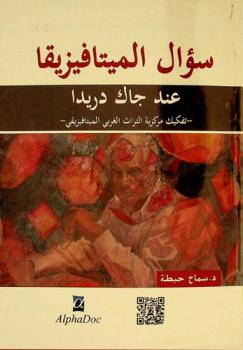
سؤال الميتافيزيقا عند جاك دريدا : تفكيك مركزية التراث الغربي الميتافيزيقي
في سياق الحديث عما تبدى في المنعطفات الفكرية الكبرى ضمن تاريخ الفكر الفلسفي الغربي تحديدا هو ما سعى فيه العقل صوب ما أمكنه الخوض فيه مساءلة وتقص، وباعتبار أن هذه الرؤى تندرج ضمن منهج الفلسفة القائم على التأمل العقلي الاستنباطي لغرض تتبع مسار المسائل الميتافيزيقية، هذه الأخيرة التي تعد واحدة من القضايا الفلسفية التي استقطبت الاهتمام والانتباه منذ بواكير وإرهاصات التفكير الإنساني في نمطه الفلسفي ونالت حظها الأوفر في متون المنظرين لها... وموضوعات أخرى.
BOOK

L'animal chez Michel de Montaigne ou pour une politique de l'appreciation de la bete
Si la Renaissance n'explore pas a fond ni souvent la theorie de l'intelligence animale, l'essai L'apologie de Raymond Sebond de Michel de Montaigne est une exception qui surprend le lecteur de jadis et d'aujourd'hui par l'analyse originale de ce sujet capital. En demantelant la croyance--deja bien etablie au XVIe siecle--que l'etre humain detient la raison et la verite absolue, l'auteur demontre que l'humain n'est pas aussi sage que sa presomption le mene a croire et que l'animal n'est pas aussi sot et insense que nous aimons croire. Ainsi reussit-il a relativiser la hierarchie etablie entre les deux categories de creatures qui se trouveraient plutot dans une continuite que dans une division ou une separation intransigeante. Although Renaissance thought did not explore the question of animal intelligence either thoroughly or often, Michel de Montaigne's essay, The Apology of Raymond Sebond, with its original analysis of this topic, represents an exception as surprising today as it was for readers of the time. In dismantling the belief--already well established in the sixteenth century--that human beings possess reason and absolute truth, Montaigne demonstrates that they are not as wise as they presume to be and that animals are not as dumb and senseless as we like to think. He thus succeeds in relativizing the established hierarchy between the two categories of creatures, which appear situated on a continuum rather than divided by a strict separation.
Journal Article