
Catalogue Search | MBRL


Are you sure you want to remove the book from the shelf?

{{itemTitle}}
85
result(s) for
"Derrida, Jacques, 1930-2004."
Sort by:
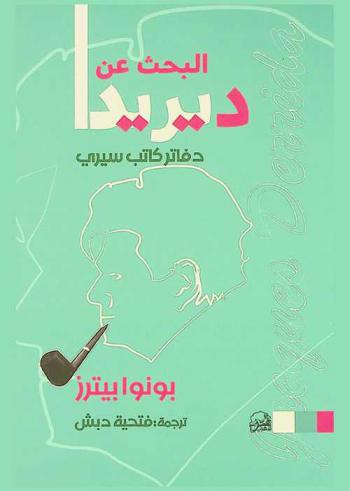
البحث عن ديريدا : ثلاث سنوات مع ديريدا : دفاتر كاتب سيري
يقول الكاتب كان هذا الكتاب صدى تجربة، وكأنه كتب نفسه بنفسه من دون أن أدرك إلى أين سيأخذني. رافقني منذ الفكرة الأولى وحتى تحرير الفصول الأخيرة، ويمكنه أن يستمر أبعد من ذلك. إنه ليس يوميات حميمة: لا شيء من جوانب حياتي الأخرى يظهر فيه تقريبا ولا حتى من أعمالي الأخرى. وعلى الرغم من أنه يمكن لدفاتر كاتب سيري أن تقرأ بشكل مستقل، إلا أنها تصاحب ديريدا الذي ظهر في التوقيت نفسه وعن الناشر نفسه. أردت ألا يحصل تقاطع بين الأثرين. عندما أتعرض إلى اللقاءات بالشهود، فإن موضوع المقابلات نفسه لا يرد إلا تلميحا طفيفا. إنها انطباعاتي التي أبوح بها.
Book

Derrida, le poème : de la poésie comme indéconstructible
L’œuvre de Jacques Derrida n’aura cessé d’interroger la poésie et le poème, au travers d’une confrontation insistante à un corpus signé par certains des plus grands noms de la modernité : Mallarmé, Artaud, Ponge, Celan, Genet, pour n’en citer que quelques-uns. Le poème y est d’abord (1960-1970) saisi comme l’incarnation du rêve logocentrique d’une parole présente à elle-même, contractée et configurée dans l’unité d’un seul souffle. Déconstruit pour en reconduire l’occurrence à l’immanence générale d’une littérature faite Texte, il deviendra (avec Mallarmé notamment) l’un des instruments les plus puissants de l’opération de déconstruction.
Mais le poème résiste et insiste en son lieu singulier, à partir notamment des années 1980 : à l’effort déconstructeur, il objecte décidément sa « chose » (Signéponge), l’effet vertigineux de son secret (Schibboleth), l’itération sans fin de sa redite (Feu la cendre). Ce livre se propose dès lors de montrer comment le poème apparaît, au terme de l’itinéraire derridien, comme l’un des noms de l’indéconstructible.
eBook

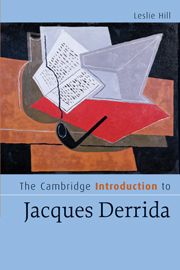
The Cambridge Introduction to Jacques Derrida
Few thinkers of the latter half of the twentieth century have so profoundly and radically transformed our understanding of writing and literature as Jacques Derrida (1930–2004). Derridian deconstruction remains one of the most powerful intellectual movements of the present century, and Derrida's own innovative writings on literature and philosophy are crucially relevant for any understanding of the future of literature and literary criticism today. Derrida's own manner of writing is complex and challenging and has often been misrepresented or misunderstood. In this book, Leslie Hill provides an accessible introduction to Derrida's writings on literature which presupposes no prior knowledge of Derrida's work. He explores in detail Derrida's relationship to literary theory and criticism, and offers close readings of some of Derrida's best known essays. This introduction will help those coming to Derrida's work for the first time, and suggests further directions to take in studying this hugely influential thinker.
eBook


Augustine and postmodernism : confessions and circumfession
At the heart of the current surge of interest in religion among
contemporary Continental philosophers stands Augustine's Confessions. With Derrida's
Circumfession constantly in the background, this volume takes up the provocative
readings of Augustine by Heidegger, Lyotard, Arendt, and Ricoeur. Derrida himself
presides over and comments on essays by major Continental philosophers and
internationally recognized Augustine scholars. While studies on and about Augustine
as a philosopher abound, none approach his work from such a uniquely postmodern
point of view, showing both the continuing relevance of Augustine and the religious
resonances within postmodernism. Posed at the intersection of philosophy, theology,
and religious studies, this book will be of interest to scholars and students of
Augustine as well as those interested in the invigorating discussion between
philosophy, religion, and postmodernism. Contributors include
Geoffrey Bennington, Philippe Capelle, John D. Caputo, Elizabeth A. Clark, Hent de
Vries, Jacques Derrida, Jean Bethke Elshtain, Richard Kearney, Catherine Malabou,
James O'Donnell, Michael J. Scanlon, and Mark Vessey. Indiana
Series in the Philosophy of Religion -- Merold Westphal, general editor
eBook


Politics of Deconstruction
The book offers a new introduction to Jacques Derrida and to Deconstruction as an important strand of Continental Philosophy. From his early writings on phenomenology and linguistics to his later meditations on war, terrorism, and justice, Jacques Derrida (1930–2004) achieved prominence on an international scale by addressing as many different audiences as he did topics. Yet despite widespread acclamation, his work has never been considered easy. Rendering accessible debates that marked more than four decades of engagement and inquiry, Susanne Lüdemann traces connections between the philosopher's own texts and those of his many interlocutors, past and present.
Unlike conventional introductions, Politics of Deconstruction offers a number of personal approaches to reading Derrida and invites readers to find their own. Emphasizing the relationship between philosophy and politics, it shows that, with Deconstruction, there is much more at stake than an \"academic\" discussion, for Derrida's work deals with all the burning political and intellectual challenges of our time. The author's own professional experience in both the United States and in Europe, which particularly inform her chapter on Derrida's reception in the United States, opens a unique perspective on a unique thinker, one that rewards specialists and newcomers alike.
eBook
Transcendence and Inscription
The philosophy of Jacques Derrida is one of the milestones of twentieth century thought and is still of great influence in many disciplines today. This book offers a survey of many aspects of Derrida's work, mainly focusing on the significance of his thoughts for the domains of ethics, politics and religion. The main thesis of this study is that the key to a fruitful evaluation of the strong and weak points of his work can be found in its ambiguous relation to the metaphysical tradition. Usually Derrida's ideas, and deconstruction as it is practiced and manifested by many others, are seen as a critique of metaphysics. This is true, but it is also just one side of the matter. In many cases, especially in by far the most of Derrida's texts, deconstructions are as well a continuation and even an affirmation of the metaphysical tradition. Despite his continuous critique of metaphysical ways of thought, and despite the deconstructions of metaphysical constructions, Derrida's own style of thinking and writing is still driven by a metaphysical desire that includes a \"hubris of metaphysics\". Through this perspective, this study provides a profound evaluation of the significance of Derrida's philosophy for ethics, politics and religion.
eBook

The Derrida Wordbook
Jacques Derrida (1930-2004) was undoubtedly one of the most influential thinkers of the twentieth century. He informed debate across many varied subjects and questions, from literature and philosophy to politics, ethics, religion, aesthetics, and culture. The Derrida Wordbook offers scholars, students, and researchers an extensive glossary, providing the reader with definitions of a wide range of terms employed by, or associated with, Derrida.
eBook