
Catalogue Search | MBRL


Are you sure you want to remove the book from the shelf?

{{itemTitle}}
9,540
result(s) for
"Derrida, Jacques."
Sort by:


The End of the World and Other Teachable Moments: Jacques Derrida's Final Seminar
The End of the World and Other Teachable Moments follows the remarkable itinerary of Jacques Derrida's final seminar, The Beast and the Sovereign (2001-2003), as the explicit themes of the seminar, namely, sovereignty and the question of the animal, come to be supplemented and interrupted by questions of death, mourning, survival, the archive, and, especially, the end of the world.
eBook


Derrida’s of grammatology
Everything you need to know about Derrida's Of Grammatology in one volume.
eBook


Scatter 1: The Politics of Politics in Foucault, Heidegger, and Derrida
What if political rhetoric is unavoidable, an irreducible part of politics itself? In contrast to the familiar denunciations of political horse-trading, grandstanding, and corporate manipulation from those lamenting the crisis in liberal democracy, this book argues that the \"politics of politics,\" usually associated with rhetoric and sophistry, is, like it or not, part of politics from the start. Denunciations of the sorry state of current politics draw on a dogmatism and moralism that share an essentially metaphysical and Platonic ground. Failure to deconstruct that ground generates a philosophically and politically debilitating selfrighteousness that this book attempts to understand and undermine. After a detailed analysis of Foucault's influential late concept of parrhesia, which is shown to be both philosophically and politically insufficient, close readings of Heidegger, Kierkegaard, and Derrida trace complex relations between sophistry, rhetoric, and philosophy; truth and untruth; decision; madness and stupidity in an exploration of the possibility of developing an affirmative thinking of politics that is not mortgaged to the metaphysics of presence. It is suggested that Heidegger's complex accounts of truth and decision must indeed be read in close conjunction with his notorious Nazi commitments but nevertheless contain essential insights that many strident responses to those commitments ignore or repress. Those insights are here developed--via an ambitious account of Derrida's often misunderstood interruption of teleology--into a deconstructive retrieval of the concept of dignity. This lucid and often witty account of a crucial set of developments in twentieth-century thought prepares the way for a more general re-reading of the possibilities of political philosophy that will be undertaken in Volume 2 of this work, under the sign of an essential scatter that defines the political as such.
eBook

Transcendence and Inscription
The philosophy of Jacques Derrida is one of the milestones of twentieth century thought and is still of great influence in many disciplines today. This book offers a survey of many aspects of Derrida's work, mainly focusing on the significance of his thoughts for the domains of ethics, politics and religion. The main thesis of this study is that the key to a fruitful evaluation of the strong and weak points of his work can be found in its ambiguous relation to the metaphysical tradition. Usually Derrida's ideas, and deconstruction as it is practiced and manifested by many others, are seen as a critique of metaphysics. This is true, but it is also just one side of the matter. In many cases, especially in by far the most of Derrida's texts, deconstructions are as well a continuation and even an affirmation of the metaphysical tradition. Despite his continuous critique of metaphysical ways of thought, and despite the deconstructions of metaphysical constructions, Derrida's own style of thinking and writing is still driven by a metaphysical desire that includes a \"hubris of metaphysics\". Through this perspective, this study provides a profound evaluation of the significance of Derrida's philosophy for ethics, politics and religion.
eBook
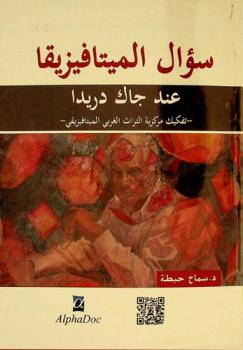
سؤال الميتافيزيقا عند جاك دريدا : تفكيك مركزية التراث الغربي الميتافيزيقي
في سياق الحديث عما تبدى في المنعطفات الفكرية الكبرى ضمن تاريخ الفكر الفلسفي الغربي تحديدا هو ما سعى فيه العقل صوب ما أمكنه الخوض فيه مساءلة وتقص، وباعتبار أن هذه الرؤى تندرج ضمن منهج الفلسفة القائم على التأمل العقلي الاستنباطي لغرض تتبع مسار المسائل الميتافيزيقية، هذه الأخيرة التي تعد واحدة من القضايا الفلسفية التي استقطبت الاهتمام والانتباه منذ بواكير وإرهاصات التفكير الإنساني في نمطه الفلسفي ونالت حظها الأوفر في متون المنظرين لها... وموضوعات أخرى.
BOOK

The Derrida Wordbook
Jacques Derrida (1930-2004) was undoubtedly one of the most influential thinkers of the twentieth century. He informed debate across many varied subjects and questions, from literature and philosophy to politics, ethics, religion, aesthetics, and culture. The Derrida Wordbook offers scholars, students, and researchers an extensive glossary, providing the reader with definitions of a wide range of terms employed by, or associated with, Derrida.
eBook