
Catalogue Search | MBRL


Are you sure you want to remove the book from the shelf?

{{itemTitle}}
1,395
result(s) for
"Description logics."
Sort by:

The description logic handbook : theory, implementation, and applications
\"Description logics are embodied in several knowledge-based systems and are used to develop various real-life applications. Now in paperback, The Description Logic Handbook provides a thorough account of the subject, covering all aspects of research in this field, namely: theory, implementation, and applications. Its appeal will be broad, ranging from more theoretically oriented readers, to those with more practically oriented interests who need a sound and modern understanding of knowledge representation systems based on description logics. As well as general revision throughout the book, this new edition presents a new chapter on ontology languages for the semantic web, an area of great importance for the future development of the web. In sum, the book will serve as a unique resource for the subject, and can also be used for self-study or as a reference for knowledge representation and artificial intelligence courses.\"--Back cover.
Book

Queries With Exact Truth Values on Concept and Role Atoms in Paraconsistent Description Logics
We present a novel approach to querying classically inconsistent description logic (DL) knowledge bases by adopting a paraconsistent semantics with the four 'Belnapian' values: exactly true (T), exactly false (F), both (B), and neither (N). In contrast to prior studies on paraconsistent DLs, we allow truth value operators in the query language over concept and role atoms, which can be used to differentiate between answers obtained from contradictory evidence and those based upon only positive evidence. We present a reduction to classical DL query answering that allows us to pinpoint the precise combined and data complexity of answering queries with values in paraconsistent ALCHI with two- and four-valued roles and their sublogics. Notably, we show that tractable data complexity is retained for Horn DLs. We also present a comparison with repair-based inconsistency-tolerant semantics, showing that the two approaches are incomparable: if we consider queries with the T (exactly true) operator, then we neither over-approximate the most cautious repair-based semantics, nor under-approximate the least cautious ones.
Journal Article

An introduction to description logic
Description logics (DLs) have a long tradition in computer science and knowledge representation, being designed so that domain knowledge can be described and so that computers can reason about this knowledge. DLs have recently gained increased importance since they form the logical basis of widely used ontology languages, in particular the web ontology language OWL. Written by four renowned experts, this is the first textbook on description logics. It is suitable for self-study by graduates and as the basis for a university course. Starting from a basic DL, the book introduces the reader to their syntax, semantics, reasoning problems and model theory and discusses the computational complexity of these reasoning problems and algorithms to solve them. It then explores a variety of reasoning techniques, knowledge-based applications and tools and it describes the relationship between DLs and OWL.-- Source other than Library of Congress.
Book

A Family of Dynamic Description Logics for Representing and Reasoning About Actions
Description logics provide powerful languages for representing and reasoning about knowledge of static application domains. The main strength of description logics is that they offer considerable expressive power going far beyond propositional logic, while reasoning is still decidable. There is a demand to bring the power and character of description logics into the description and reasoning of dynamic application domains which are characterized by actions. In this paper, based on a combination of the propositional dynamic logic PDL, a family of description logics and an action formalism constructed over description logics, we propose a family of dynamic description logics
DDL
(
X
@
) for representing and reasoning about actions, where
X
represents well-studied description logics ranging from the
to the
, and
X
@
denotes the extension of
X
with the @ constructor. The representation power of
DDL
(
X
@
) is reflected in four aspects. Firstly, the static knowledge of application domains is represented as RBoxes and acyclic TBoxes of the description logic
X
. Secondly, the states of the world and the pre-conditions of atomic actions are described by ABox assertions of the description logic
X
@
, and the post-conditions of atomic actions are described by primitive literals of
X
@
. Thirdly, starting with atomic actions and ABox assertions of
X
@
, complex actions are constructed with regular program constructors of PDL, so that various control structures on actions such as the “Sequence”, “Choice”, “Any-Order”, “Iterate”, “If-Then-Else”, “Repeat-While” and “Repeat-Until” can be represented. Finally, both atomic actions and complex actions are used as modal operators for the construction of formulas, so that many properties on actions can be explicitly stated by formulas. A tableau-algorithm is provided for deciding the satisfiability of
DDL
(
X
@
)-formulas; based on this algorithm, reasoning tasks such as the realizability, executability and projection of actions can be effectively carried out. As a result,
DDL
(
X
@
) not only offers considerable expressive power going beyond many action formalisms which are propositional, but also provides decidable reasoning services for actions described by it.
Journal Article
Tractable Reasoning and Efficient Query Answering in Description Logics: The DL-Lite Family
Issue Title: Special Issue on Reasoning in Description Logics We propose a new family of description logics (DLs), called DL-Lite, specifically tailored to capture basic ontology languages, while keeping low complexity of reasoning. Reasoning here means not only computing subsumption between concepts and checking satisfiability of the whole knowledge base, but also answering complex queries (in particular, unions of conjunctive queries) over the instance level (ABox) of the DL knowledge base. We show that, for the DLs of the DL-Lite family, the usual DL reasoning tasks are polynomial in the size of the TBox, and query answering is LogSpace in the size of the ABox (i.e., in data complexity). To the best of our knowledge, this is the first result of polynomial-time data complexity for query answering over DL knowledge bases. Notably our logics allow for a separation between TBox and ABox reasoning during query evaluation: the part of the process requiring TBox reasoning is independent of the ABox, and the part of the process requiring access to the ABox can be carried out by an SQL engine, thus taking advantage of the query optimization strategies provided by current database management systems. Since even slight extensions to the logics of the DL-Lite family make query answering at least NLogSpace in data complexity, thus ruling out the possibility of using on-the-shelf relational technology for query processing, we can conclude that the logics of the DL-Lite family are the maximal DLs supporting efficient query answering over large amounts of instances.[PUBLICATION ABSTRACT]
Journal Article

An ASP approach for reasoning in a concept-aware multipreferential lightweight DL
In this paper we develop a concept aware multi-preferential semantics for dealing with typicality in description logics, where preferences are associated with concepts, starting from a collection of ranked TBoxes containing defeasible concept inclusions. Preferences are combined to define a preferential interpretation in which defeasible inclusions can be evaluated. The construction of the concept-aware multipreference semantics is related to Brewka’s framework for qualitative preferences. We exploit Answer Set Programming (in particular, asprin) to achieve defeasible reasoning under the multipreference approach for the lightweight description logic ξ$\\mathcal L_ \\bot ^ + $.
Journal Article

Concept learning in description logics using refinement operators
With the advent of the Semantic Web, description logics have become one of the most prominent paradigms for knowledge representation and reasoning. Progress in research and applications, however, is constrained by the lack of well-structured knowledge bases consisting of a sophisticated schema and instance data adhering to this schema. It is paramount that suitable automated methods for their acquisition, maintenance, and evolution will be developed. In this paper, we provide a learning algorithm based on refinement operators for the description logic ALCQ including support for concrete roles. We develop the algorithm from thorough theoretical foundations by identifying possible abstract property combinations which refinement operators for description logics can have. Using these investigations as a basis, we derive a practically useful complete and proper refinement operator. The operator is then cast into a learning algorithm and evaluated using our implementation
DL-Learner
. The results of the evaluation show that our approach is superior to other learning approaches on description logics, and is competitive with established ILP systems.
Journal Article
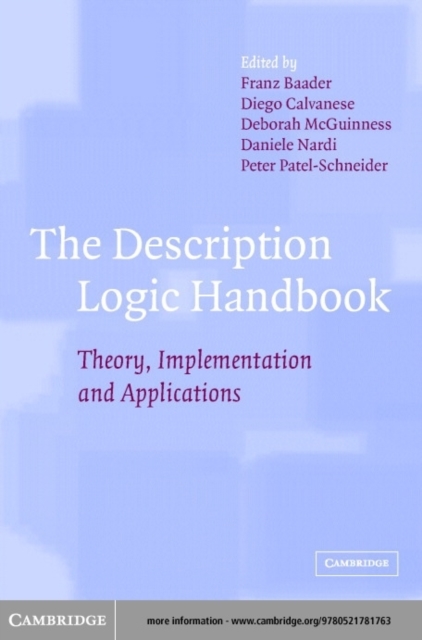
The Description Logic Handbook
The Description Logic Handbook covers all aspects of the research in the field of knowledge representation. Written by some of the most prominent researchers in the field, and covering the basic technical material and implementational aspects, it is both a unique reference and a self-study guide.
eBook
Efficient TBox Reasoning with Value Restrictions using the wer Reasoner
The inexpressive Description Logic (DL)${\\cal F}{{\\cal L}_0}$, which has conjunction and value restriction as its only concept constructors, had fallen into disrepute when it turned out that reasoning in${\\cal F}{{\\cal L}_0}$w.r.t. general TBoxes is E xp T ime -complete, that is, as hard as in the considerably more expressive logic${\\cal A}{\\cal L}{\\cal C}$. In this paper, we rehabilitate${\\cal F}{{\\cal L}_0}$by presenting a dedicated subsumption algorithm for${\\cal F}{{\\cal L}_0}$, which is much simpler than the tableau-based algorithms employed by highly optimized DL reasoners. Our experiments show that the performance of our novel algorithm, as prototypically implemented in our${\\cal F}{{\\cal L}_0}$wer reasoner, compares very well with that of the highly optimized reasoners.${\\cal F}{{\\cal L}_0}$wer can also deal with ontologies written in the extension${\\cal F}{{\\cal L}_ \\bot }$of${\\cal F}{{\\cal L}_0}$with the top and the bottom concept by employing a polynomial-time reduction, shown in this paper, which eliminates top and bottom. We also investigate the complexity of reasoning in DLs related to the Horn-fragments of${\\cal F}{{\\cal L}_0}$and${\\cal F}{{\\cal L}_ \\bot }$.
Journal Article

Developing a Novel Ontology for Cybersecurity in Internet of Medical Things-Enabled Remote Patient Monitoring
IoT has seen remarkable growth, particularly in healthcare, leading to the rise of IoMT. IoMT integrates medical devices for real-time data analysis and transmission but faces challenges in data security and interoperability. This research identifies a significant gap in the existing literature regarding a comprehensive ontology for vulnerabilities in medical IoT devices. This paper proposes a fundamental domain ontology named MIoT (Medical Internet of Things) ontology, focusing on cybersecurity in IoMT (Internet of Medical Things), particularly in remote patient monitoring settings. This research will refer to similar-looking acronyms, IoMT and MIoT ontology. It is important to distinguish between the two. IoMT is a collection of various medical devices and their applications within the research domain. On the other hand, MIoT ontology refers to the proposed ontology that defines various concepts, roles, and individuals. MIoT ontology utilizes the knowledge engineering methodology outlined in Ontology Development 101, along with the structured life cycle, and establishes semantic interoperability among medical devices to secure IoMT assets from vulnerabilities and cyberattacks. By defining key concepts and relationships, it becomes easier to understand and analyze the complex network of information within the IoMT. The MIoT ontology captures essential key terms and security-related entities for future extensions. A conceptual model is derived from the MIoT ontology and validated through a case study. Furthermore, this paper outlines a roadmap for future research, highlighting potential impacts on security automation in healthcare applications.
Journal Article