
Catalogue Search | MBRL


Are you sure you want to remove the book from the shelf?

{{itemTitle}}
1,112
result(s) for
"Desert resources development"
Sort by:

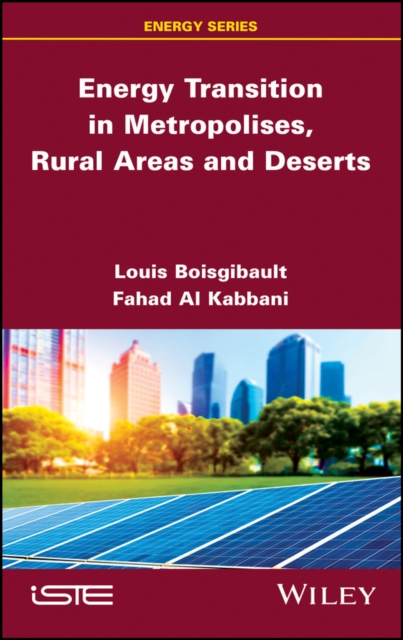
Energy Transition in Metropolises, Rural Areas, and Deserts
Energy Transition in Metropolises, Rural Areas and Deserts presents detailed field studies of energy transition in Lille, Riyadh, Fayence, Bokhol, Ouarzazate and the Arabian Desert.It analyzes local actions and good practices - according to the resources and constraints involved - in the process of removing the obstacles to the transition.
eBook


The Arid Lands
Deserts are commonly imagined as barren, defiled, worthless places, wastelands in need of development. This understanding has fueled extensive anti-desertification efforts -- a multimillion-dollar global campaign driven by perceptions of a looming crisis. In this book, Diana Davis argues that estimates of desertification have been significantly exaggerated and that deserts and drylands -- which constitute about 41% of the earth's landmass -- are actually resilient and biodiverse environments in which a great many indigenous people have long lived sustainably. Meanwhile, contemporary arid lands development programs and anti-desertification efforts have met with little success. As Davis explains, these environments are not governed by the equilibrium ecological dynamics that apply in most other regions. Davis shows that our notion of the arid lands as wastelands derives largely from politically motivated Anglo-European colonial assumptions that these regions had been laid waste by \"traditional\" uses of the land. Unfortunately, such assumptions still frequently inform policy. Drawing on political ecology and environmental history, Davis traces changes in our understanding of deserts, from the benign views of the classical era to Christian associations of the desert with sinful activities to later (neo)colonial assumptions of destruction. She further explains how our thinking about deserts is problematically related to our conceptions of forests and desiccation. Davis concludes that a new understanding of the arid lands as healthy, natural, but variable ecosystems that do not necessarily need improvement or development will facilitate a more sustainable future for the world's magnificent drylands.
eBook

Energy from the Desert
The fourth volume in the established Energy from the Desert series examines and evaluates the potential and feasibility of Very Large Scale Photovoltaic Power Generation (VLS-PV) systems, which have capacities ranging from several megawatts to gigawatts, and to develop practical project proposals toward implementing the VLS-PV systems in the future. It comprehensively analyses all major issues involved in such large scale applications, based on the latest scientific and technological developments by means of close international co-operation with experts from different countries. From the perspective of the global energy situation, global warming, and other environmental issues, it is apparent that VLS-PV systems can: contribute substantially to global energy needsbecome economically and technologically feasible soon contribute significantly to global environmental protection contribute significantly to socio-economic development This book recognises that very large scale solar electricity generation provides economic, social and environmental benefits, security of electricity supply and fair access to affordable and sustainable energy solutions and that VLS-PV systems must be one of the promising options for large-scale deployment of PV systems and renewable energy technologies.
eBook
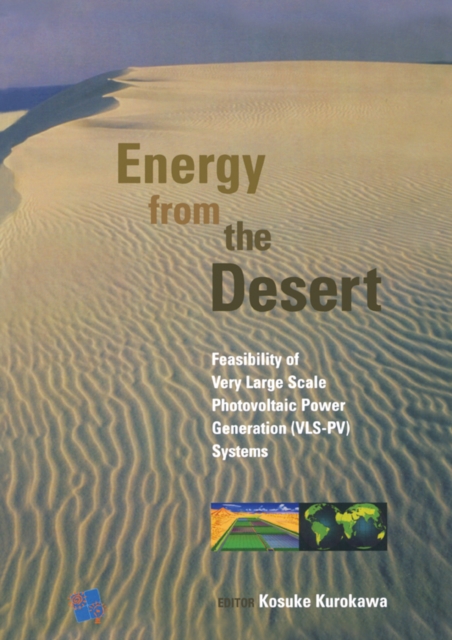
Energy from the Desert
The world's deserts are sufficiently large that, in theory, covering a fraction of their landmass with PV systems could generate many times the current primary global energy supply.
This Energy from the Desert volume examines and evaluates the potential of very large scale photovoltaic power generation (VLS-PV) systems. Following from the success of the first book on the subject, the authors present practical case studies of both virtual and real projects based on selected regions (including the Mediterranean, the Middle East, the Gobi Desert and Western Australia) and their specific socio-economic dynamics, and argue that VLS-PV systems in desert areas will be readily available in the near future.
As the essential companion to the previous International Energy Agency (IEA) volume it reiterates and develops key concepts introduced by the original study and provides firm practical recommendations to achieve long-term targets for policy-makers and investors.
eBook

Study of Changes in the Ulan Buh Desert under the Dual Impacts of Desert Farmland Development and Climate Change
Desert farmland provides food for desert areas, but water is the main limiting factor of this region, thus desert farmland has an extremely fragile ecological environment. This study investigated the temporal and spatial variations of vegetation NDVI (Normalized Difference Vegetation Index) in the Ulan Buh Desert, China, from 1990 to 2022, using long-term Landsat satellite data obtained from the Google Earth Engine platform and local statistical data. The results showed that from 1990 to 2022, the NDVI exhibited relatively small fluctuations and a steady increase. Furthermore, the study analyzed the impact of climate factors, namely precipitation and temperature, on NDVI, and collected the groundwater lever changes under irrigation and farmland development. The results demonstrated a positive correlation between NDVI and both precipitation and temperature from 1990 to 2006. The study area experienced an overall trend of increasing humidity. Specifically, from 1990 to 2006, significant positive correlations with precipitation and temperature were observed in 4.4% and 5.5% of the region, respectively. From 2007 to 2022, significant positive correlations were observed in 5.4% and 72.8% of the region for precipitation and temperature, respectively. These findings suggest that temperature has become increasingly influential on vegetation NDVI, while the impact of precipitation remains relatively stable. Moreover, the study assessed the impact of human activities on vegetation NDVI. The results revealed that from 1990 to 2006, human activities contributed to 43.1% of the promotion of local vegetation NDVI, which increased to 90.9% from 2007 to 2022. This study provides valuable insights into the dynamics of vegetation in the Ulan Buh Desert and its response to climatic changes and human activities. The findings highlight the significance of climate conditions and human interventions in shaping the vegetation dynamics in the region, offering essential information for ecological restoration and conservation efforts.
Journal Article

Rebranding Desolation
This article explores the trope of desert desolation in the Zionist state-building project. It traces the strategic uses of desolate imagery in the pioneer narrative (1880s–1920s), by the New Hebrew culture (1923–1948), during the ‘golden age’ of urban and regional planning (1948–1956), and through marketing the Negev desert town of Mitzpe Ramon to tourists (1993–present). These eras highlight the tension between desolation as reflecting the alienated ‘outsiders’ gaze’ versus desolation as energizing and inspiring place making. I argue that since unproductive, desolate landscapes pose an economic threat, both Israel’s collectivist and capitalist settlement projects have confronted the challenge of strategically rebranding desolation to promote its allure.
Journal Article
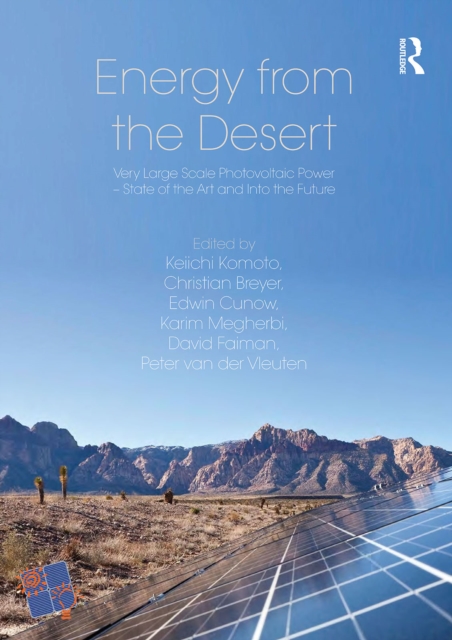
Very Large Scale Photovoltaic Power: State of the Art and Into the Future
The fourth volume in the established Energy from the Desert series examines and evaluates the potential and feasibility of Very Large Scale Photovoltaic Power Generation (VLS-PV) systems, which have capacities ranging from several megawatts to gigawatts, and to develop practical project proposals toward implementing the VLS-PV systems in the future. It comprehensively analyses all major issues involved in such large scale applications, based on the latest scientific and technological developments by means of close international co-operation with experts from different countries. From the perspective of the global energy situation, global warming, and other environmental issues, it is apparent that VLS-PV systems can: contribute substantially to global energy needsbecome economically and technologically feasible soon contribute significantly to global environmental protection contribute significantly to socio-economic development This book recognises that very large scale solar electricity generation provides economic, social and environmental benefits, security of electricity supply and fair access to affordable and sustainable energy solutions and that VLS-PV systems must be one of the promising options for large-scale deployment of PV systems and renewable energy technologies.
eBook