
Catalogue Search | MBRL


Are you sure you want to remove the book from the shelf?

{{itemTitle}}
46,878
result(s) for
"Design Methodology"
Sort by:


Frame Innovation
When organizations apply old methods of problem-solving to new kinds of problems, they may accomplish only temporary fixes or some ineffectual tinkering around the edges. Today's problems are a new breed -- open, complex, dynamic, and networked -- and require a radically different response. In this book, Kees Dorst describes a new, innovation-centered approach to problem-solving in organizations: frame creation. It applies \"design thinking,\" but it goes beyond the borrowed tricks and techniques that usually characterize that term. Frame creation focuses not on the generation of solutions but on the ability to create new approaches to the problem situation itself.The strategies Dorst presents are drawn from the unique, sophisticated, multilayered practices of top designers, and from insights that have emerged from fifty years of design research. Dorst describes the nine steps of the frame creation process and illustrates their application to real-world problems with a series of varied case studies. He maps innovative solutions that include rethinking a store layout so retail spaces encourage purchasing rather than stealing, applying the frame of a music festival to understand late-night problems of crime and congestion in a club district, and creative ways to attract young employees to a temporary staffing agency. Dorst provides tools and methods for implementing frame creation, offering not so much a how-to manual as a do-it-yourself handbook -- a guide that will help practitioners develop their own approaches to problem-solving and creating innovation.
eBook

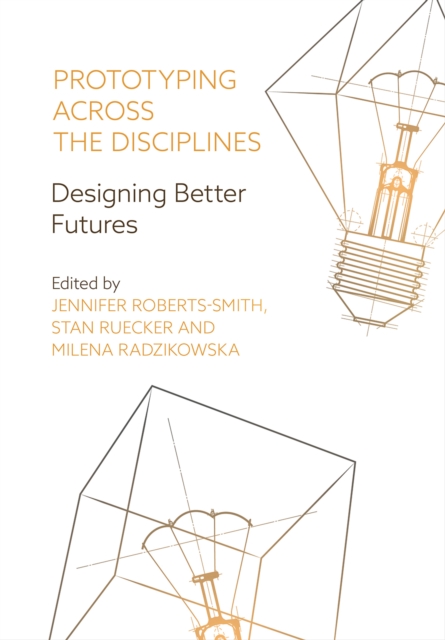
Prototyping across the Disciplines
If people from different fields are going to work together on projects, then they need to begin to understand each other. They can be separated by the words they use, the ways they work and how they think. However, in many fields there is common ground, in the attempts to create what is sometimes called inventive knowledge. These fields progress not only by understanding increasingly more about what already exists, but by making guesses about possible better futures. The guesses consist of small forays into that future, using strategies that are variously called learning through making, research through design or, more simply, prototyping.
While traditionally associated primarily with industrial design, and more recently with software development, prototyping is now used as an important tool in areas ranging from materials engineering to landscape architecture to the digital humanities. This book collects current theories and methods of prototyping in a dozen disciplines, illustrating them through case studies of actual projects, whether in industry or the classroom.
This edited collection aims to provide a context, a theoretical framework and a set of methodologies for interdisciplinary collaboration in design. Each chapter offers a different disciplinary perspective on prototyping, providing a case study as a point of comparison for identifying commonalities and divergences in current practices. Contributions are from a group of scholars with worldwide experience of working and presenting in design, and who are currently based in Canada, the United States, Chile and Brazil.
This book isn't just about design across the disciplines, it is about how prototyping works in different disciplines. Prototyping is a crucial part of the design process, and a practice used by creators from all design disciplines, from architects and engineers, to industrial and service designers, to test a concept or process and evaluate an idea.
Much research has been published on prototyping in design; what makes this new book unique is the cross disciplinary nature, showing designers how they can learn from various approaches to improve their skills. Disciplines discussed include post-human design, theatre, tabletop game design, landscape architecture and arts entrepreneurship.
Primarily of interest to design scholars and practitioners with an interest in integrative design. Undergraduates and graduate students in design, HCI (human-computer interaction) and the digital humanities. Textbook potential.
eBook

Graphic design discourse : evolving theories, ideologies, and processes of visual communication
\"Since its inception, the field of graphic design--whose primary aim is visual communication--has struggled between two contradictory poles: design resulting from a rigorous, fixed set of rules, and design that expresses the hand of the artist. But what if designers focused on process and critical analysis over visual outcome? Through a carefully selected collection of more than seventy-five seminal texts spanning centuries and bridging the disciplines of art, architecture, design history, philosophy, and cultural theory, this illuminating anthology establishes a new paradigm for graphic design methodologies for the twenty-first century\"-- Provided by publisher.
Book

Development of a bulk cargo fruit sampler
The design of an agricultural machine or equipment can be considered of great complexity, due to the interactions between the operator, the machine, the product and the environment. There is a lack of available technologies for collecting fruit in bulk cargo at any time from transport to industries. A limiting factor is the loading of fruits that are at the base of the cargo. This study was carried out to develop a detailed design of a bulk cargo fruit sampler that can collect fruits in any position of the x, y and z axes. A methodology was applied and adapted to execute the design. This methodology was divided into the following stages: design planning, informational design, conceptual design, preliminary design and detailed design. The variant considered the most appropriate was selected for the preliminary design and detailed design. The concepts were divided into chassis or support, sample collector and support for sample removal. The removal of fruits was carried out to maintain as much of their interaction with the environment outside the collector as possible. With the conclusion of the detailed design, it was possible to file, at the National Institute of Industrial Property, the patent for the collector of fruit samples in bulk cargo. Results obtained from fruits in the collector were used in doctoral theses.
Journal Article

Becoming human by design
\"The last in Tony Fry's celebrated trilogy of books continues his radical rethinking of design. 'Becoming Human by Design's provocative argument presents a revised reading of human 'evolution' centred on ontological design. Examining the relation of design to the nature of the human species - where the species came from, how it was created, what it became and its likely future - Fry asserts that current biological and social models of evolution are an insufficient explanation of how 'we humans' became what we are. Making a case for ontological design as an evolutionary agency, the book posits the relation between the formation of the world of human fabrication and the making of mankind itself as indivisible. It also functions as a provocation to rethink the fate of Homo sapiens, recognising that all species are finite and that the fate of humankind turns on a fundamental Darwinian principle - adapt or die. Fry considers the nature of adaptation, arguing that it will depend on an ability to think and design in new ways\"--P. [4] of cover.
Book

Multi-Criteria Optimal Design for FUEL Cell Hybrid Power Sources
This paper presents the development of a global and integrated sizing approach under different performance indexes applied to fuel cell/battery hybrid power systems. The strong coupling between the hardware sizing process and the system supervision (energy management strategy EMS) makes it hard for the design to consider all the possibilities, and today’s methodologies are mostly experience-based approaches that are impervious to technological disruption. With a smart design approach, new technologies are easier to consider, and this approach facilitates the use of new technologies for transport applications with a decision help tool. An automotive application with a hybrid fuel cell (PEMFC)/battery (Li-Ion) is considered to develop this approach. The proposed approach is based on imbricated optimization loops and considers multiple criteria such as the fuel consumption, reliability, and volume of the architecture, in keeping with industry expectations to allow a good trade-off between different performance indexes and explore their design options. This constitutes a low computational time and a very effective support tool that allows limited overconsumption and lifetime reduction for designed architecture in extreme and non-optimal use. We obtain, thanks to this work, a pre-design tool that helps to realize the first conception choice.
Journal Article

The art of insight : how great visualization designers think
\"The Art of Insight: How Great Visualization Designers Think is a book about making design decisions in difficult situations. Decision-making is an essential skill for designers because anyone can create a data visualization with just a few clicks. Data is easily available online, and multiple free and easy-to-use software tools have appeared in the past few years. These developments have led to an explosion in the amount and variety of graphs, charts, and maps. We see them everywhere, from news publications to social media. Cairo explains this is a positive phenomenon, but only if the creators of those visualizations are able to think clearly and ethically about what they are doing. As the famous line from the 2002 Spider-Man movie says, with great power comes great responsibility. Visualization books often focus on rules for creating charts and maps, but rarely explain the origin of those rules. Readers are told to start all graphs at a zero baseline, never use pie charts, maximize the data-ink ratio, and so on. Cairo argues that this approach is misguided: it shoehorns designers into a single rigid mode of thinking, based only on the perspective of the book's author or authors\"-- Provided by publisher.
Book

Digital Research Methods in Fashion and Textile Studies
Are you a researcher struggling to mine and make sense of a mountain of fashion data?Are you interested in learning about how digital methods and tools could enhance your research?Have you thought about ways to spark and engage in academic conversations on social media?.
eBook