
Catalogue Search | MBRL


Are you sure you want to remove the book from the shelf?

{{itemTitle}}
20
result(s) for
"Detective and mystery films -- United States -- History and criticism"
Sort by:


Unless the threat of death is behind them : hard-boiled fiction and film noir
Early in the twentieth century a new character type emerged in the crime novels of American writers such as Dashiell Hammett and Raymond Chandler: the \"hard-boiled\" detective, most famously exemplified by Sam Spade in The Maltese Falcon. Unlike the analytical detectives of nineteenth-century fiction, such as Edgar Allan Poe's Inspector Dupin, the new detectives encountered cases not as intricate logical puzzles but as stark challenges of manhood. In the stories of these characters and their criminal opposites, John T. Irwin explores the tension within ideas of American masculinity between subordination and independence and, for the man who becomes \"his own boss, \" the conflict between professional codes and personal desires. He shows how, within different works of hard-boiled fiction, the professional either overcomes the personal or is overcome by it, ending in ruinous relationships or in solitary integrity, and how within the genre all notions of manly independence are ultimately revealed to be illusions subordinate to fate itself.
Tracing the stylistic development of the genre, Irwin demonstrates the particular influence of the novel of manners, especially the writing of F. Scott Fitzgerald. He goes on to argue that, from the time of World War II, when hard-boiled fiction began to appear on the screen in film noir just as women entered the workforce in large numbers, many of its themes came to extend to female empowerment. Finally, he discusses how these themes persist in contemporary dramatic series on television, representing the conflicted lives of Americans into the twenty-first century.
eBook

Hollywood's detectives : crime series in the 1930s and 1940s from the whodunnit to hard-boiled noir
The study of Hollywood detectives has often overlooked the B-Movie mystery series in favour of hard-boiled film. Hollywood's Detectives redresses this oversight by examining key detective series of the 1930s and 1940s to explore their contributions to the detective genre.
eBook

Detecting Men
Detecting Men examines the history of the Hollywood detective genre and the ways that detective films have negotiated changing social attitudes toward masculinity, heroism, law enforcement, and justice. Genre film can be a site for the expression and resolution of problematic social issues, but while there have been many studies of such other male genres as war films, gangster films, and Westerns, relatively little attention has been paid to detective films beyond film noir. In this volume, Philippa Gates examines classical films of the thirties and forties as well as recent examples of the genre, including Die Hard, the Lethal Weapon films, The Usual Suspects, Seven, Devil in a Blue Dress, and Murder by Numbers, in order to explore social anxieties about masculinity and crime and Hollywood's conceptions of gender. Up until the early 1990s, Gates argues, the primary focus of the detective genre was the masculinity of the hero. However, from the mid-1990s onward, the genre has shifted to more technical portrayals of crime scene investigation, forensic science, and criminal profiling, offering a reassuring image of law enforcement in the face of violent crime. By investigating the evolution of the detective film, Gates suggests, perhaps we can detect the male.
eBook
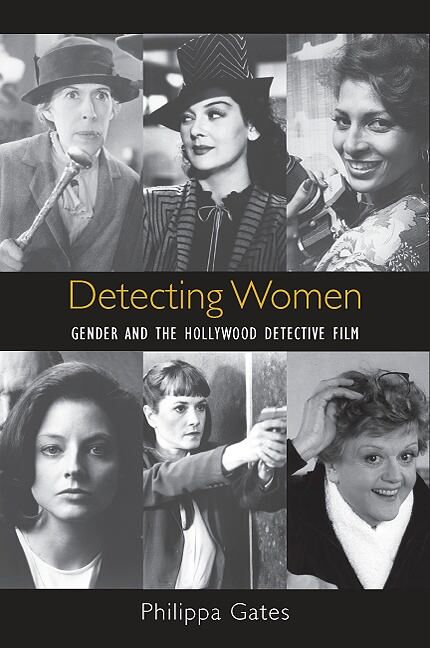
Detecting Women
Finalist for the 2012 Edgar Award in the Best
Critical/Biographical Category presented by the Mystery Writers of
America In this extensive and authoritative study of over
300 films, Philippa Gates explores the \"woman detective\" figure
from her pre-cinematic origins in nineteenth century detective
fiction through her many incarnations throughout the history of
Hollywood cinema. Through the lens of theories of gender, genre,
and stardom and engaging with the critical concepts of
performativity, masquerade, and feminism, Detecting Women analyzes
constructions of the female investigator in the detective genre and
focuses on the evolution of her representation from 1929 to today.
While a popular assumption is that images of women have become
increasingly positive over this period, Gates argues that the most
progressive and feminist models of the female detective exist in
mainstream film's more peripheral products such as 1930's B-picture
and 1970's Blaxploitation films. Offering revisions and new
insights into peripheral forms of mainstream film, Gates explores
this space that allows a fantasy of resolution of social anxieties
about crime and, more interestingly, gender, in the 20th and early
21st centuries. The author's innovative, engaging, and capacious
approach to this important figure within feminist film history
breaks new ground in the field of gender and film studies.
eBook

Crime Films
This book surveys the entire range of crime films, including important subgenres such as the gangster film, the private eye film, film noir, as well as the victim film, the erotic thriller, and the crime comedy. Focusing on ten films that span the range of the twentieth century, Thomas Leitch traces the transformation of the three leading figures that are common to all crime films: the criminal, the victim and the avenger. Analyzing how each of the subgenres establishes oppositions among its ritual antagonists, he shows how the distinctions among them become blurred throughout the course of the century. This blurring, Leitch maintains, reflects and fosters a deep social ambivalence towards crime and criminals, while the criminal, victim and avenger characters effectively map the shifting relations between subgenres, such as the erotic thriller and the police film, within the larger genre of crime film that informs them all.
eBook

Maximum Movies—Pulp Fictions
In the words of Richard Maltby . . . \"Maximum Movies--Pulp Fictions describes two improbably imbricated worlds and the piece of cultural history their intersections provoked.\" One of these worlds comprises a clutch of noisy, garish pulp movies--Kiss Me Deadly, Shock Corridor, Fixed Bayonets!, I Walked with a Zombie, The Lineup, Terror in a Texas Town, Ride Lonesome--pumped out for the grind houses at the end of the urban exhibition chain by the studios' B-divisions and fly-by-night independents. The other is occupied by critics, intellectuals, cinephiles, and filmmakers such as Jean-Luc Godard, Manny Farber, and Lawrence Alloway, who championed the cause of these movies and incited the cultural guardians of the day by attacking a rigorously policed canon of tasteful, rarified, and ossified art objects. Against the legitimate, and in defense of the illegitimate, in an insolent and unruly manner, they agitated for the recognition of lurid sensational crime stories, war pictures, fast-paced Westerns, thrillers, and gangster melodramas were claimed as examples of the true, the real, and the authentic in contemporary culture--the foundation upon which modern film studies sits.
eBook

TV Cops
The police drama has been one of the longest running and most popular genres in American television. In TV Cops, Jonathan Nichols-Pethick argues that, perhaps more than any other genre, the police series in all its manifestations-from Hill Street Blues to Miami Vice to The Wire-embodies the full range of the cultural dynamics of television.
Exploring the textual, industrial, and social contexts of police shows on American television, this book demonstrates how polices drama play a vital role in the way we understand and engage issues of social order that most of us otherwise experience only in such abstractions as laws and crime statistics. And given the current diffusion and popularity of the form, we might ask a number of questions that deserve serious critical attention: Under what circumstances have stories about the police proliferated in popular culture? What function do these stories serve for both the television industry and its audiences? Why have these stories become so commercially viable for the television industry in particular? How do stories about the police help us understand current social and political debates about crime, about the communities we live in, and about our identities as citizens?
eBook

Hardboiled and High Heeled
Can a gumshoe wear high heels? In a genre long dominated by men, women are now taking their place-as authors and as characters-alongside hard-boiled legends like Sam Spade and Mike Hammer. Hardboiled and High Heeled examines the meteoric rise of the female detective in contemporary film, television, and literature.
Richly illustrated and written with a fan's love of the genre, Hardboiled and High Heeled is an essential introduction to women in detective fiction, from past to present, from pulp fiction to blockbuster films.
Linda Mizejewski is Professor of English and Chair of the Women's Studies Department at Ohio State University. She is author of Ziegfeld Girl: Image and Icon in Culture and Cinema and Divine Decadence: Fascism, Female Spectacle, and the Makings of Sally Bowles . She lives in Columbus, Ohio.
eBook

Language, Ideology and Identity in Serial Killer Narratives
In this book, Gregoriou explores the portrayal of the serial killer identity and its related ideology across a range of contemporary crime narratives, including detective fiction, the true crime genre and media journalism. How exactly is the serial killer consciousness portrayed, how is the killing linguistically justified, and how distinguishing is the language revolving around criminal ideology and identity across these narrative genres? By employing linguistic and content-related methods of analysis, her study aims to work toward the development of a stylistic framework on the representation of serial killer ideology across factual (i.e. media texts), factional (i.e. true crime books) and fictional (i.e. novels) murder narratives. ‘Schema’ is a term commonly used to refer to organised bundles of knowledge in our brains, which are activated once we come across situations we have previously experienced, a ‘group schema’ being one such inventory shared by many. By analysing serial murder narratives across various genres, Gregoriou uncovers a widely shared ‘group schema’ for these murderers, and questions the extent to which real criminal minds are in fact linguistically fictionalised. Gregoriou’s study of the mental functioning and representation of criminal personas can help illuminate our schematic understanding of actual criminal minds.
Christiana Gregoriou is a lecturer in English Stylistics at the University of Leeds. She has an interest in the linguistic make-up of literary texts, and crime narratives in particular. She's published on the criminal mind style, a book on English Literary Stylistics and a monograph on Deviance in Contemporary Crime Fiction .
1. Crime Scenes 2. Killer Headlines 3. True Crime! 4. Buying Crime 5. The Verdict
eBook