
Catalogue Search | MBRL


Are you sure you want to remove the book from the shelf?

{{itemTitle}}
1,952
result(s) for
"Detroit(Mich.)"
Sort by:


Driving Detroit
For most of the twentieth century, Detroit was a symbol of American industrial might, a place of entrepreneurial and technical ingenuity where the latest consumer inventions were made available to everyone through the genius of mass production. Today, Detroit is better known for its dwindling population, moribund automobile industry, and alarmingly high murder rate. InDriving Detroit, author George Galster, a fifth-generation Detroiter and internationally known urbanist, sets out to understand how the city has come to represent both the best and worst of what cities can be, all within the span of a half century. Galster invites the reader to travel with him along the streets and into the soul of this place to grasp fully what drives the Motor City. With a scholar's rigor and a local's perspective, Galster uncovers why metropolitan Detroit's cultural, commercial, and built landscape has been so radically transformed. He shows how geography, local government structure, and social forces created a housing development system that produced sprawl at the fringe and abandonment at the core. Galster argues that this system, in tandem with the region's automotive economic base, has chronically frustrated the population's quest for basic physical, social, and psychological resources. These frustrations, in turn, generated numerous adaptations-distrust, scapegoating, identity politics, segregation, unionization, and jurisdictional fragmentation-that collectively leave Detroit in an uncompetitive and unsustainable position. Partly a self-portrait, in which Detroiters paint their own stories through songs, poems, and oral histories,Driving Detroitoffers an intimate, insightful, and perhaps controversial explanation for the stunning contrasts-poverty and plenty, decay and splendor, despair and resilience-that characterize the once mighty city.
eBook


Listening to Workers
Historians and readers alike often overlook the everyday experiences of workers. Drawing on years of interviews and archival research, Daniel J. Clark presents the rich, interesting, and sometimes confounding lives of men and women who worked in Detroit-area automotive plants in the 1950s.
In their own words, the interviewees frankly discuss personal matters like divorce and poverty alongside recollections of childhood and first jobs, marriage and working women, church and hobbies, and support systems and workplace dangers. Their frequent struggles with unstable jobs and economic insecurity upend notions of the 1950s as a golden age of prosperity while stories of domestic violence and infidelity open a door to intimate aspects of their lives. Taken together, the narratives offer seldom-seen accounts of autoworkers as complex and multidimensional human beings.
Compelling and surprising, Listening to Workers foregoes the union-focused strain of labor history to provide ground-level snapshots of a blue-collar world.
eBook

City primeval : high noon in Detroit
Clement Mansell knows how easy it is to get away with murder. The seriously crazed killer is already back on the Detroit streets -- thanks to some nifty courtroom moves by his crafty looker of a lawyer -- and he's feeling invincible enough to execute a crooked Motown judge on a whim. Homicide Detective Raymond Cruz thinks the \"Oklahoma Wildman\" crossed the line long before this latest outrage, and he's determined to see that the hayseed psycho does not slip through the legal system's loopholes a second time. But that means a good cop is going to have to play somewhat fast and loose with the rules -- in order to maneuver Mansell into a wild Midwest showdown that he won't be walking away from.
Book
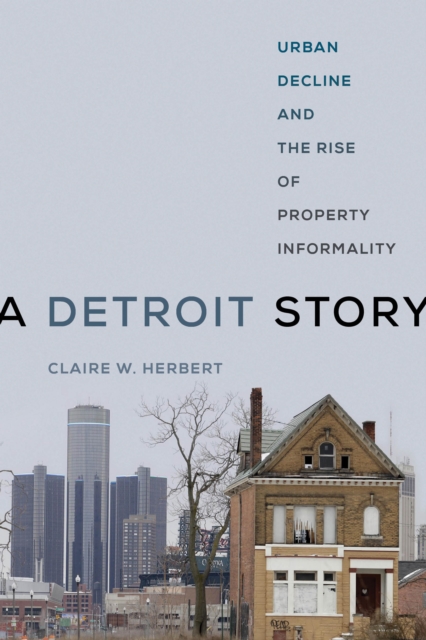
A Detroit Story
Bringing to the fore a wealth of original research, A Detroit Story examines how the informal reclamation of abandoned property has been shaping Detroit for decades. Claire Herbert lived in the city for almost five years to get a ground-view sense of how this process molds urban areas. She participated in community meetings and tax foreclosure protests, interviewed various groups, followed scrappers through abandoned buildings, and visited squatted houses and gardens. Herbert found that new residents with more privilege often have their back-to-the-earth practices formalized by local policies, whereas longtime, more disempowered residents, usually representing communities of color, have their practices labeled as illegal and illegitimate. She teases out how these divergent treatments reproduce long-standing inequalities in race, class, and property ownership.
eBook

Detroit & Ann Arbor : a great destination
A comprehensive explorer's guide to Detroit and Ann Arbor, Michigan, with maps and information on hotels and restaurants, shopping and entertainment, and other interesting sights.
Book

Fitzgerald
This on-the-ground study of one square mile in Detroit was written in collaboration with neighborhood residents, many of whom were involved with the famous Detroit Geographical Expedition and Institute. Fitzgerald, at its core, is dedicated to understanding global phenomena through the intensive study of a small, local place. Beginning with an 1816 encounter between the Ojibwa population and the neighborhood's first surveyor, William Bunge examines the racialized imposition of local landscapes over the course of European American settlement. Historical events are firmly situated in space-a task Bunge accomplishes through liberal use of maps and frequent references to recognizable twentieth-century landmarks. More than a work of historical geography, Fitzgerald is a political intervention. By 1967 the neighborhood was mostly African American; Black Power was ascendant; and Detroit would experience a major riot. Immersed in the daily life of the area, Bunge encouraged residents to tell their stories and to think about local politics in spatial terms. His desire to undertake a different sort of geography led him to create a work that was nothing like a typical work of social science. The jumble of text, maps, and images makes it a particularly urgent book-a major theoretical contribution to urban geography that is also a startling evocation of street-level Detroit during a turbulent era. A Sarah Mills Hodge Fund Publication
eBook

The fifty-year rebellion : how the U.S. political crisis began in Detroit
\"On July 23, 1967, the eyes of the nation fixed on Detroit as thousands took to the streets to vent their frustrations with white racism, police brutality, and vanishing job prospects in the place that gave rise to the American Dream. For mainstream observers, the \"riot\" brought about the ruin of a once-great city, and then in 2013, the city's municipal bankruptcy served as a bailout that paved the way for Detroit to finally be rebuilt. Challenging this prevailing view, Scott Kurashige portrays the past half-century as a long \"rebellion\" the underlying tensions of which continue to haunt the city and the U.S. nation-state. Michigan's scandal-ridden emergency-management regime represents the most concerted effort to quell this rebellion by disenfranchising the majority black citizenry and neutralizing the power of unions. The corporate architects of Detroit's restructuring have championed the creation of a \"business-friendly\" city where billionaire developers are subsidized to privatize and gentrify downtown while working-class residents are squeezed out by rampant housing evictions, school closures, water shutoffs, toxic pollution, and militarized policing. From the grassroots, however, Detroit has emerged as an international model for survival, resistance, and solidarity through the creation of urban farms, freedom schools, and self-governing communities. A quintessential American story of tragedy and hope, The Fifty-Year Rebellion forces us to look in the mirror and ask, Are we succumbing to authoritarian plutocracy, or can we create a new society rooted in social justice and participatory democracy?\"--Provided by publisher.
Book

Detroit
Episodes of racial conflict in Detroit form just one facet of the city's storied and legendary history, and they have sometimes overshadowed the less widely known but equally important occurrence of interracial cooperation in seeking solutions to the city's problems. The conflicts also present many opportunities to analyze, learn from, and interrogate the past in order to help lay the groundwork for a stronger, more equitable future. This astute and prudent history poses a number of critical questions: Why and where have race riots occurred in Detroit? How has the racial climate changed or remained the same since the riots? What efforts have occurred since the riots to reduce racial inequality and conflicts, and to build bridges across racial divides? Unique among books on the subject,Detroitpays special attention to post-1967 social and political developments in the city, and expands upon the much-explored black-white dynamic to address the influx of more recent populations to Detroit: Middle Eastern Americans, Hispanic Americans, and Asian Americans. Crucially, the book explores the role of place of residence, spatial mobility, and spatial inequality as key factors in determining access to opportunities such as housing, education, employment, and other amenities, both in the suburbs and in the city.
eBook